

236
N. A. HOLME
experienced when using a coarser sieve must bc balanced against the
very much greater time taken to sort the sample. An aperture of
1.6 mm may be best for general work, and when a mesh much less
than 1 m m is considered it will be appreciated that the sample may
have to be sorted under a lens or t)inocular microscope.
Some workers use wire mesh sieves with square meshes, others
perforated sheet metal with round holes. Sieving is a rather inexact
process in which the main object is to wash away the mud and fine
Sieve apertures (rnrn)
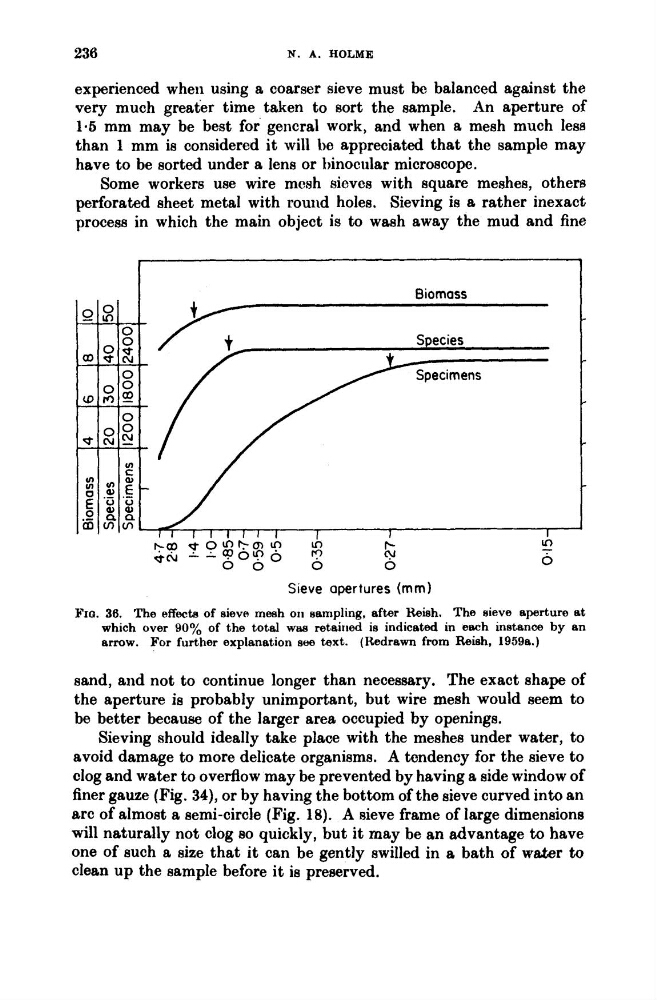
FIQ. 36. The effects of sieve mesh on sampling. after Heish. The sieve aperture at
which over 90% of the total was retained is indicated in each instance by an
arrow. For further explanation me text. (Redrawn from Reish, 19598.)
sand, and not to continue longer than necessary. The exact shape of
the aperture is probably unimportant, but wire mesh would seem to
be better because of the larger area occupied by openings.
Sieving should ideally take place with the meshes under water, to
avoid damage to more delicate organisms. A tendency for the sieve to
clog and water to overflow may be prevented by having a side window of
finer gauze (Fig. 34), or by having the bottom of the sieve curved into an
arc of almost a semi-circle (Fig. 18). A Rieve frame of large dimensions
will naturally not clog so quickly, but it may be an advantage to have
one of such a size that it can be gently swilled in a bath of water to
clean up the sample before it is preserved.
N. A. HOLME
experienced when using a coarser sieve must bc balanced against the
very much greater time taken to sort the sample. An aperture of
1.6 mm may be best for general work, and when a mesh much less
than 1 m m is considered it will be appreciated that the sample may
have to be sorted under a lens or t)inocular microscope.
Some workers use wire mesh sieves with square meshes, others
perforated sheet metal with round holes. Sieving is a rather inexact
process in which the main object is to wash away the mud and fine
Sieve apertures (rnrn)
FIQ. 36. The effects of sieve mesh on sampling. after Heish. The sieve aperture at
which over 90% of the total was retained is indicated in each instance by an
arrow. For further explanation me text. (Redrawn from Reish, 19598.)
sand, and not to continue longer than necessary. The exact shape of
the aperture is probably unimportant, but wire mesh would seem to
be better because of the larger area occupied by openings.
Sieving should ideally take place with the meshes under water, to
avoid damage to more delicate organisms. A tendency for the sieve to
clog and water to overflow may be prevented by having a side window of
finer gauze (Fig. 34), or by having the bottom of the sieve curved into an
arc of almost a semi-circle (Fig. 18). A Rieve frame of large dimensions
will naturally not clog so quickly, but it may be an advantage to have
one of such a size that it can be gently swilled in a bath of water to
clean up the sample before it is preserved.