

METHODS OF SAMPLING THE BENTHOS
233
which the sample is emptied, and on the outside of which play a series
of jets of water. This method would retain some of the very smallest
animals, but could only be usrd whcre the sample was of fine mud.
Another separation method for muds is described by Durham (in
Hartman, 1955). This consish of n set of graded screens agitated by
mechanical shaker and with six overhead Rprinkler heads spraying
water mean while (Fig. 33). Such elaborate methods are only necessary
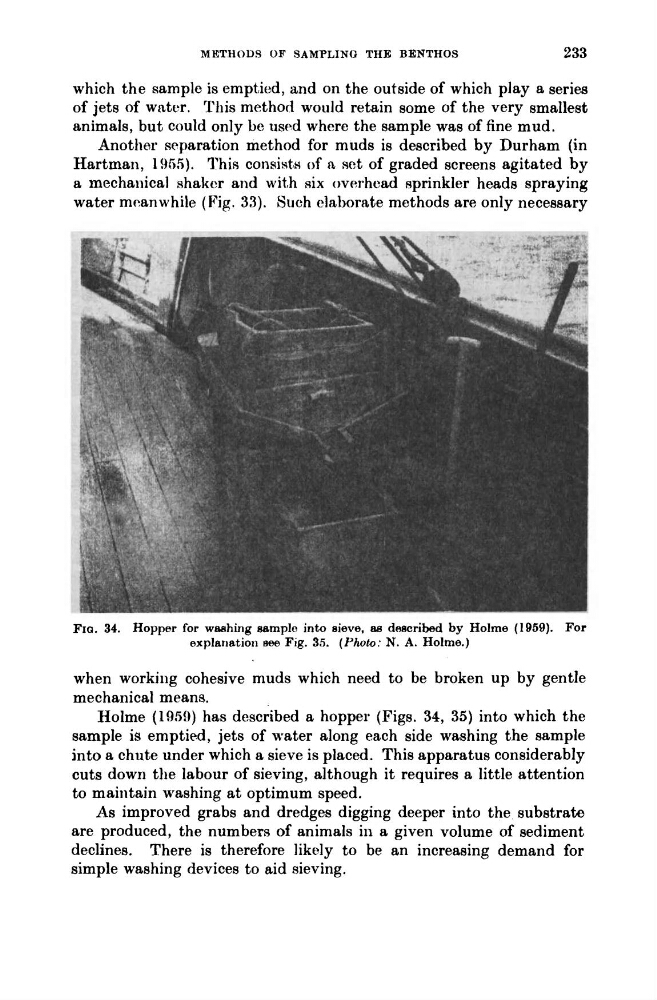
FIQ. 34. Hopper for washing sample into sieve, as described by Holme (1959). For
explanation see Fig. 35. (Photo: N. A. Holme.)
when working cohesive muds which need to be broken up by gentle
mechanical means.
Holme (1959) has described a hopper (Figs. 34, 35) into which the
sample is emptied, jets of water along each side washing the sample
into a chute under which a sieve is placed. This apparatus considerably
cuts down the labour of sieving, although it requires a little attention
to maintain washing a t optimum speed.
As improved grabs and dredges digging deeper into the substrate
are produced, the numbers of animals in a given volume of sediment
declines. There is therefore likely to be an increasing demand for
simple washing devices to aid sieving.
233
which the sample is emptied, and on the outside of which play a series
of jets of water. This method would retain some of the very smallest
animals, but could only be usrd whcre the sample was of fine mud.
Another separation method for muds is described by Durham (in
Hartman, 1955). This consish of n set of graded screens agitated by
mechanical shaker and with six overhead Rprinkler heads spraying
water mean while (Fig. 33). Such elaborate methods are only necessary
FIQ. 34. Hopper for washing sample into sieve, as described by Holme (1959). For
explanation see Fig. 35. (Photo: N. A. Holme.)
when working cohesive muds which need to be broken up by gentle
mechanical means.
Holme (1959) has described a hopper (Figs. 34, 35) into which the
sample is emptied, jets of water along each side washing the sample
into a chute under which a sieve is placed. This apparatus considerably
cuts down the labour of sieving, although it requires a little attention
to maintain washing a t optimum speed.
As improved grabs and dredges digging deeper into the substrate
are produced, the numbers of animals in a given volume of sediment
declines. There is therefore likely to be an increasing demand for
simple washing devices to aid sieving.