

X1ETIIOL)S OF SAhIPLIN(; THE BENTHOS
203
in larger sizes. Oiic fea,turiL of tlw design is that the air in the pressure
chamber re-exlmds as the inst rumelit is hoisted, and must be vented
in some way that does iiot blow out‘ thr sample.
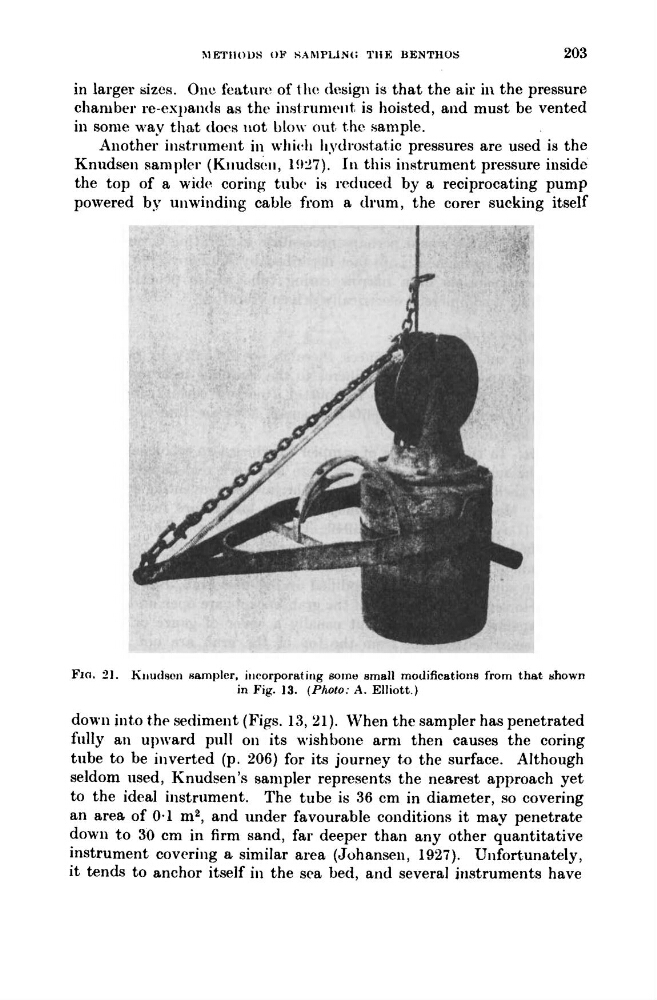
A4iiother instrument in w1iic.h Iiydrostatic pressures are used is the
Knudsen sampler (Kiiudsrii, 1!!27). In this instrument pressure inside
the top of a wide coring tube is reduced by a reciprocating pump
powered by unwinding cable from a drum, the corer sucking itself
FIG. 21. Kiludson sampler, illcorporatirig mine small modifications from that ehown
in Fig. 13. (Photo; A. Elliott.)
down into the sediment (Figs. 13, 21). When the sampler has penetrated
fully an upward pull on its wishbone arm then causes the coring
tube to be inverted (p. 206) for its journey to the surface. Although
seldom used, Knudsen’s sampler represents the nearest approach yet
to the ideal instrument. The tube is 36 cm in diameter, so covering
an area of 0.1 m2, and under favourable conditions it may penetrate
down to 30 cm in firm sand, far deeper than any other quantitative
instrument covering a similar area (Johansen, 1927). Unfortunately,
it tends to anchor itself in the sea bed, and several instruments have
203
in larger sizes. Oiic fea,turiL of tlw design is that the air in the pressure
chamber re-exlmds as the inst rumelit is hoisted, and must be vented
in some way that does iiot blow out‘ thr sample.
A4iiother instrument in w1iic.h Iiydrostatic pressures are used is the
Knudsen sampler (Kiiudsrii, 1!!27). In this instrument pressure inside
the top of a wide coring tube is reduced by a reciprocating pump
powered by unwinding cable from a drum, the corer sucking itself
FIG. 21. Kiludson sampler, illcorporatirig mine small modifications from that ehown
in Fig. 13. (Photo; A. Elliott.)
down into the sediment (Figs. 13, 21). When the sampler has penetrated
fully an upward pull on its wishbone arm then causes the coring
tube to be inverted (p. 206) for its journey to the surface. Although
seldom used, Knudsen’s sampler represents the nearest approach yet
to the ideal instrument. The tube is 36 cm in diameter, so covering
an area of 0.1 m2, and under favourable conditions it may penetrate
down to 30 cm in firm sand, far deeper than any other quantitative
instrument covering a similar area (Johansen, 1927). Unfortunately,
it tends to anchor itself in the sea bed, and several instruments have