

PO2
N. A . HOLME
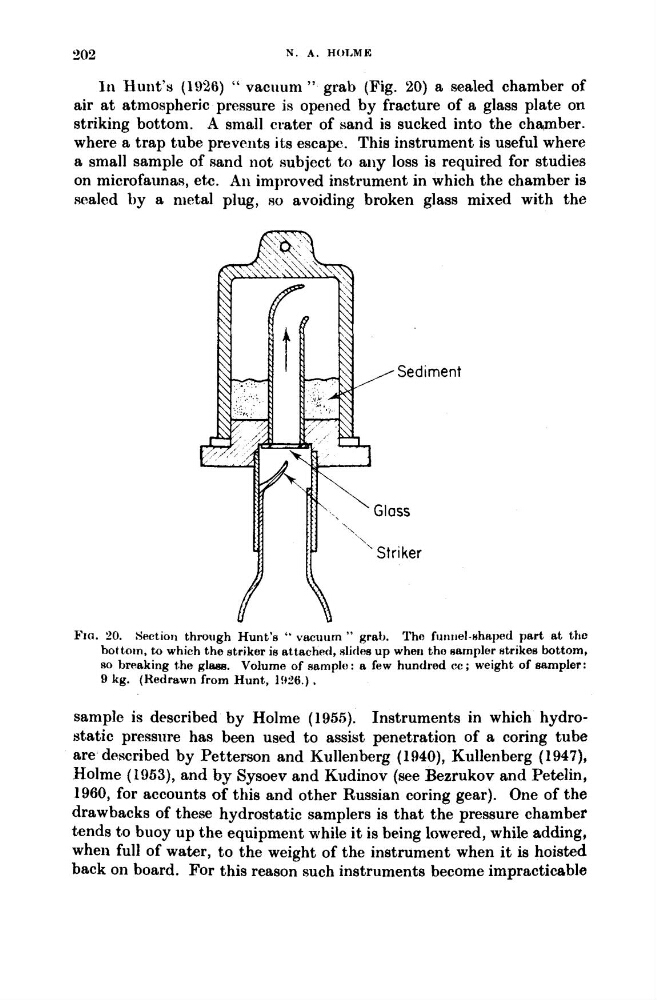
In Hunt’s (1926) “ vaciium ” grab (Fig. 20) a sealed chamber of
air at atmospheric pressure is opened by fracture of a glass plate on
striking bottom. A small crater of sand is sucked into the chamber.
where a trap tube prevents its escape. This instrument is useful where
a small sample of sand not subject to any loss is required for studies
on microfaunas, etc. An improved instrument in which the chamber is
sealed by a nietal plug, so avoiding broken glass mixed with the
FIG. 20. Section through Hunt’s ‘‘ vmmurn ” grab. The fiitiiiel-whrtpetl part at the
bottom, to which the striker is attached, slides up when tho #ampler ntriken bottom,
so breaking the glase. Volume of samplo: a few hundred c c ; weight of sampler:
9 kg. (Redrawn from Hunt, l!t%.) .
sample is described by Holme (1955). Instruments in which hydrostatic pressure has been used to assist penetration of a coring tube
are described by Petterson and Kullenberg (1940), Kullenberg (1947),
Holme (1953), and by Sysoev and Kudinov (see Bezrukov and Petelin,
1960, for accounts of this and other Russian coring gear). One of the
drawbacks of these hydrostatic samplers is that the pressure chamber
tends to buoy up the equipment while it is being lowered, while adding,
when full of water, to the weight of the instrument when it is hoisted
back on board. For this reason such instruments become impracticable
N. A . HOLME
In Hunt’s (1926) “ vaciium ” grab (Fig. 20) a sealed chamber of
air at atmospheric pressure is opened by fracture of a glass plate on
striking bottom. A small crater of sand is sucked into the chamber.
where a trap tube prevents its escape. This instrument is useful where
a small sample of sand not subject to any loss is required for studies
on microfaunas, etc. An improved instrument in which the chamber is
sealed by a nietal plug, so avoiding broken glass mixed with the
FIG. 20. Section through Hunt’s ‘‘ vmmurn ” grab. The fiitiiiel-whrtpetl part at the
bottom, to which the striker is attached, slides up when tho #ampler ntriken bottom,
so breaking the glase. Volume of samplo: a few hundred c c ; weight of sampler:
9 kg. (Redrawn from Hunt, l!t%.) .
sample is described by Holme (1955). Instruments in which hydrostatic pressure has been used to assist penetration of a coring tube
are described by Petterson and Kullenberg (1940), Kullenberg (1947),
Holme (1953), and by Sysoev and Kudinov (see Bezrukov and Petelin,
1960, for accounts of this and other Russian coring gear). One of the
drawbacks of these hydrostatic samplers is that the pressure chamber
tends to buoy up the equipment while it is being lowered, while adding,
when full of water, to the weight of the instrument when it is hoisted
back on board. For this reason such instruments become impracticable