

186
N . A . HOLME
appears that satisfactory sampling is deyendciit on a vcry slow,
horizontal pull, otherwise the conical dredge bounces on the bottom.
This may be because it is towed by three chains rather than by rigid
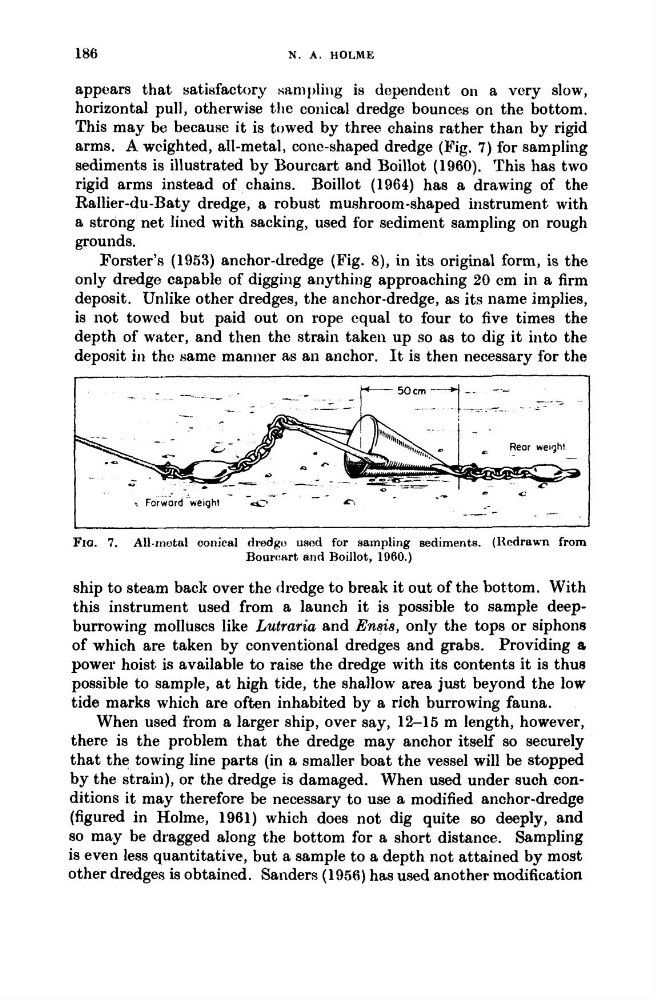
arms. A weighted, all-metal, cone-shaped dredge (Fig. 7) for sampling
sediments is illustrated by Bourcart and Boillot (1960). This has two
rigid arms instead of chains. Boillot (1964) has a drawing of the
Rallier-du-Baty dredge, a robust mushroom-shaped instrument with
a strong net lined with sacking, used for sediment sampling on rough
grounds.
Forster’s (1953) anchor-dredge (Fig. 8), in its original form, is the
only dredge capable of digging anything approaching 20 cm in a firm
deposit. Unlike other dredges, the anchor-dredge, as its name implies,
is not towed but paid out on rope equal to four to five times the
depth of wnter, and then the strain taken up so as to dig it into the
deposit in the xame manner as an anchor. It is then necessary for the
FIQ. 7. All-inotal conical dredgo usod for sampling sediments. (Hcdrawn from
Bourcart and Hoillot, 1960.)
ship to steam back over the dredge to break it out of the bottom. With
this instrument used from a launch it is possible to sample deepburrowing molluscs like Lutruria and Ensis, only the tops or siphons
of which are taken by conventional dredges and grabs. Providing a
power hoist is available to raise the dredge with its contents it is thus
possible to sample, at high tide, the shallow area just beyond the low
tide marks which are often inhabited by a rich burrowing fauna.
When used from a larger ship, over say, 12-15 m length, however,
there is the problem that the dredge may anchor itself so securely
that the towing line parts (in a smaller boat the vessel will be stopped
by the strain), or the dredge is damaged. When used under such conditions it may therefore be necessary to use a modified anchor-dredge
(figured in Holme, 1961) which does not dig quite so deeply, and
SO may be dragged along the bottom for a short distance. Sampling
is even less quantitative, but a sample to a depth not attained by most
other dredges is obtained. Sanders (1956) has used another modification
N . A . HOLME
appears that satisfactory sampling is deyendciit on a vcry slow,
horizontal pull, otherwise the conical dredge bounces on the bottom.
This may be because it is towed by three chains rather than by rigid
arms. A weighted, all-metal, cone-shaped dredge (Fig. 7) for sampling
sediments is illustrated by Bourcart and Boillot (1960). This has two
rigid arms instead of chains. Boillot (1964) has a drawing of the
Rallier-du-Baty dredge, a robust mushroom-shaped instrument with
a strong net lined with sacking, used for sediment sampling on rough
grounds.
Forster’s (1953) anchor-dredge (Fig. 8), in its original form, is the
only dredge capable of digging anything approaching 20 cm in a firm
deposit. Unlike other dredges, the anchor-dredge, as its name implies,
is not towed but paid out on rope equal to four to five times the
depth of wnter, and then the strain taken up so as to dig it into the
deposit in the xame manner as an anchor. It is then necessary for the
FIQ. 7. All-inotal conical dredgo usod for sampling sediments. (Hcdrawn from
Bourcart and Hoillot, 1960.)
ship to steam back over the dredge to break it out of the bottom. With
this instrument used from a launch it is possible to sample deepburrowing molluscs like Lutruria and Ensis, only the tops or siphons
of which are taken by conventional dredges and grabs. Providing a
power hoist is available to raise the dredge with its contents it is thus
possible to sample, at high tide, the shallow area just beyond the low
tide marks which are often inhabited by a rich burrowing fauna.
When used from a larger ship, over say, 12-15 m length, however,
there is the problem that the dredge may anchor itself so securely
that the towing line parts (in a smaller boat the vessel will be stopped
by the strain), or the dredge is damaged. When used under such conditions it may therefore be necessary to use a modified anchor-dredge
(figured in Holme, 1961) which does not dig quite so deeply, and
SO may be dragged along the bottom for a short distance. Sampling
is even less quantitative, but a sample to a depth not attained by most
other dredges is obtained. Sanders (1956) has used another modification