

THE PRESENT STATUS OF SOME ASPECTS OF MARINE YIOROBIOLOGY
139
amplea
analyeed
64
111
196
96
123
earlier, some workers might have reservations regarding the validity
of some of the sampling techniques used. These investigations were
made during the years 1964 to 1961, from stations distributed throughout the Pacific, Indian, Atlantic, Arctic and Antarctic Oceans, the
Greenland, Norwegian and North Seas, and included sampling sea
water at depth intervals from the surface to the bottom, as well as the
sea muds themselves. In all, many thousands of samples were examined
during the course of this work, allowing several generalizations to be
mad0 concerning the distribution of microorganisms in the World's
oceans.
-
0-9
- -
9.3
3.6
4.1
22.9
34.2
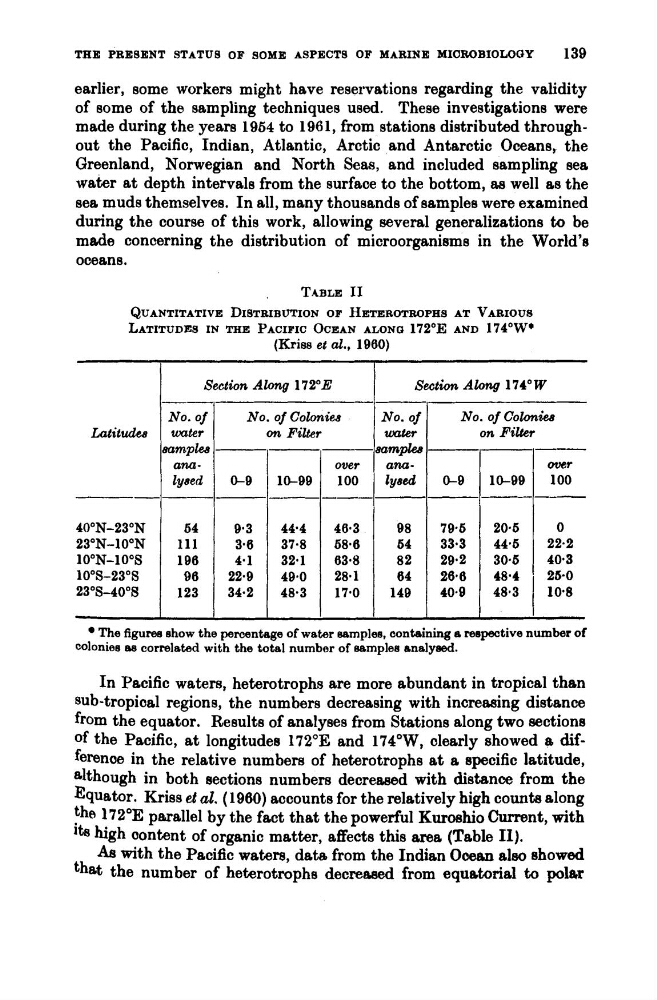
TABLE 11
QUANTITATIVE DISTRIBUTION OF HETEROTROPHS AT VARIOUS
LATITUDES IN THE PACIFIC OCEAN ALONG 172'E AND 174'W*
(Kriss et al., 1960)
44.4
37.8
32.1
49.0
48.3
~
Latitwlee
--40°N-23'N
23"N-1 O' N
10°N-10's
lO'S-23'S
23'5-40'8
46.3
68.6
63.8
28.1
17.0
Section Along 172'E
No.qfj
No. of Colonies
water
on Filter
10-99 I 100
~
Section Along 174'W
No. of
waler
anaa m *
lysed
98
64
82
64
149
-
No. of Colon&
on Filter
over
100
_0
22.2
40.3
26.0
10.8
-
The figures show the pementage of W8br semples, containing 8 respective number of
Colonies 88 correlated with the total number of mmplee snelyeed.
In Pacific waters, heterotrophs are more abundant in tropical than
sub-tropical regions, the numbers decreasing with increesing distance
from the equator. Results of analyses from Stations along two eections
of the Pacific, at longitudes 172"E and 174"W, dearly showed a differenoe in the relative numbers of heterotrophs at a specific latitude,
although in both sections numbers decreased with distance from the
Equator. Kriss et al. (1960) accounts for the relatively high counts along
the 172'E parallel by the fact that the powerful Kuroehio Current, with
high content of organic matter, affects this area (Table 11).
AS with the Pacific watem, data from the Indian 0 - also showed
that the number of heterotrophs decreased from equatorial to polar
139
amplea
analyeed
64
111
196
96
123
earlier, some workers might have reservations regarding the validity
of some of the sampling techniques used. These investigations were
made during the years 1964 to 1961, from stations distributed throughout the Pacific, Indian, Atlantic, Arctic and Antarctic Oceans, the
Greenland, Norwegian and North Seas, and included sampling sea
water at depth intervals from the surface to the bottom, as well as the
sea muds themselves. In all, many thousands of samples were examined
during the course of this work, allowing several generalizations to be
mad0 concerning the distribution of microorganisms in the World's
oceans.
-
0-9
- -
9.3
3.6
4.1
22.9
34.2
TABLE 11
QUANTITATIVE DISTRIBUTION OF HETEROTROPHS AT VARIOUS
LATITUDES IN THE PACIFIC OCEAN ALONG 172'E AND 174'W*
(Kriss et al., 1960)
44.4
37.8
32.1
49.0
48.3
~
Latitwlee
--40°N-23'N
23"N-1 O' N
10°N-10's
lO'S-23'S
23'5-40'8
46.3
68.6
63.8
28.1
17.0
Section Along 172'E
No.qfj
No. of Colonies
water
on Filter
10-99 I 100
~
Section Along 174'W
No. of
waler
anaa m *
lysed
98
64
82
64
149
-
No. of Colon&
on Filter
over
100
_0
22.2
40.3
26.0
10.8
-
The figures show the pementage of W8br semples, containing 8 respective number of
Colonies 88 correlated with the total number of mmplee snelyeed.
In Pacific waters, heterotrophs are more abundant in tropical than
sub-tropical regions, the numbers decreasing with increesing distance
from the equator. Results of analyses from Stations along two eections
of the Pacific, at longitudes 172"E and 174"W, dearly showed a differenoe in the relative numbers of heterotrophs at a specific latitude,
although in both sections numbers decreased with distance from the
Equator. Kriss et al. (1960) accounts for the relatively high counts along
the 172'E parallel by the fact that the powerful Kuroehio Current, with
high content of organic matter, affects this area (Table 11).
AS with the Pacific watem, data from the Indian 0 - also showed
that the number of heterotrophs decreased from equatorial to polar