

TEE B E R A ~ O U R AND PHYSXOLOOY OF HERRING AND OTHER CLUPEIDS 301
2. Fat dep8&
Fat is laid down in the connective tissue beneath the skin, in and between the myotomes, in the gut mesenteries and in the liver. Channon
and Saby (1932) showed in the herring, that liver and mesenteric fat
waa more labile than muscle fat, being laid down and drawn on sooner.
They estimated that 16% of the body fat waa transferred to the gonads
and 85% was metabolized during the spawning cycle.
15
-
vl
u
s 10
Y
0,
2
a
&J
$ 5
s
0
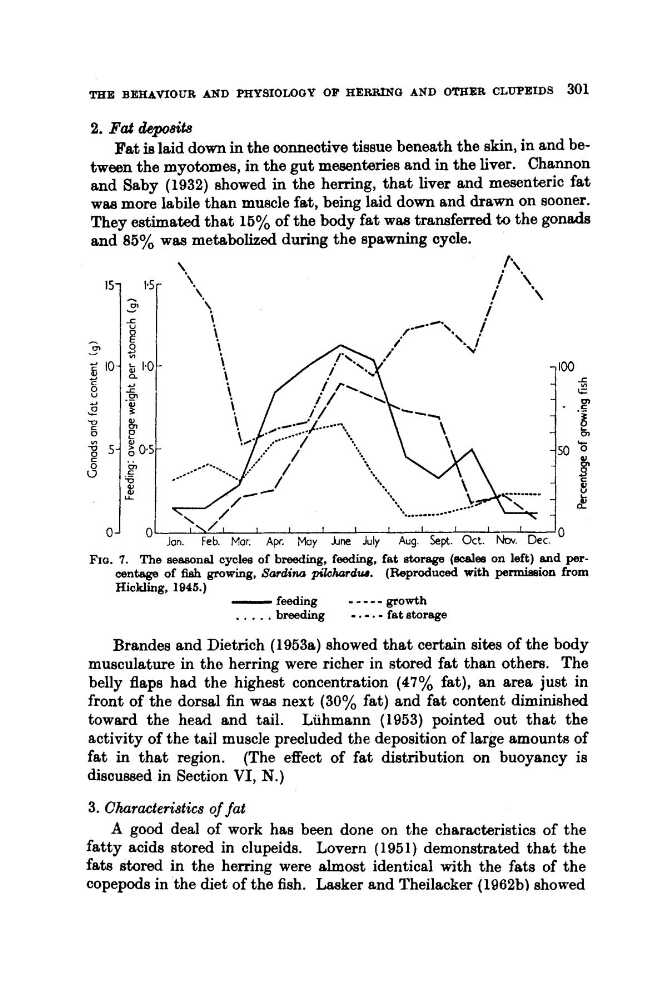
FIQ. 7. The seasonal cycles of breeding, feeding, fat storage ( d 0 a on left) and per(Reproduced with permiasion from
centage of fish growing, Sardinu pilehardus.
Hickling, 1946.)
- feeding - - - - - growth
- . - . - fat storage
. . . . . breeding
Brandes and Dietrich (1 953a) showed that certain sites of the body
musculature in the herring were richer in stored fat than others. The
belly flaps had the highest concentration (47% fat), an area just in
front of the dorsal fin waa next (30% fat) and fat content diminished
toward the head and tail. Luhmann (1953) pointed out that the
activity of the tail muscle precluded the deposition of large amounts of
fat in that region. (The effect of fat distribution on buoyancy is
discussed in Section VI, N.)
3. Characteristics of fat
A good deal of work has been done on the characteristics of the
fatty acids stored in clupeids. Lovern (1951) demonstrated that the
fats stored in the herring were almost identical with the fats of the
copepods in the diet of the fish. Lasker and Theilacker (1962bl showed
2. Fat dep8&
Fat is laid down in the connective tissue beneath the skin, in and between the myotomes, in the gut mesenteries and in the liver. Channon
and Saby (1932) showed in the herring, that liver and mesenteric fat
waa more labile than muscle fat, being laid down and drawn on sooner.
They estimated that 16% of the body fat waa transferred to the gonads
and 85% was metabolized during the spawning cycle.
15
-
vl
u
s 10
Y
0,
2
a
&J
$ 5
s
0
FIQ. 7. The seasonal cycles of breeding, feeding, fat storage ( d 0 a on left) and per(Reproduced with permiasion from
centage of fish growing, Sardinu pilehardus.
Hickling, 1946.)
- feeding - - - - - growth
- . - . - fat storage
. . . . . breeding
Brandes and Dietrich (1 953a) showed that certain sites of the body
musculature in the herring were richer in stored fat than others. The
belly flaps had the highest concentration (47% fat), an area just in
front of the dorsal fin waa next (30% fat) and fat content diminished
toward the head and tail. Luhmann (1953) pointed out that the
activity of the tail muscle precluded the deposition of large amounts of
fat in that region. (The effect of fat distribution on buoyancy is
discussed in Section VI, N.)
3. Characteristics of fat
A good deal of work has been done on the characteristics of the
fatty acids stored in clupeids. Lovern (1951) demonstrated that the
fats stored in the herring were almost identical with the fats of the
copepods in the diet of the fish. Lasker and Theilacker (1962bl showed