

300
J. H. 9. BLAXTER AND F. 0. T. HOLLIDAY
May and June and they stop feeding and lose fat in July and August.
After spawning they feed and lay down fat once more and then, during
the winter months, the fat reserves fall to their lowest point.
I n winter-spring spawning herring the good feeding conditions in
late spring and early summer (after spawning) build up the fat reserves.
With the development of the gonads in late autumn feeding stops, and
spawning in December-March means that the fish overwinter and
spawn with fat reserves considerably lower than the autumn spawners.
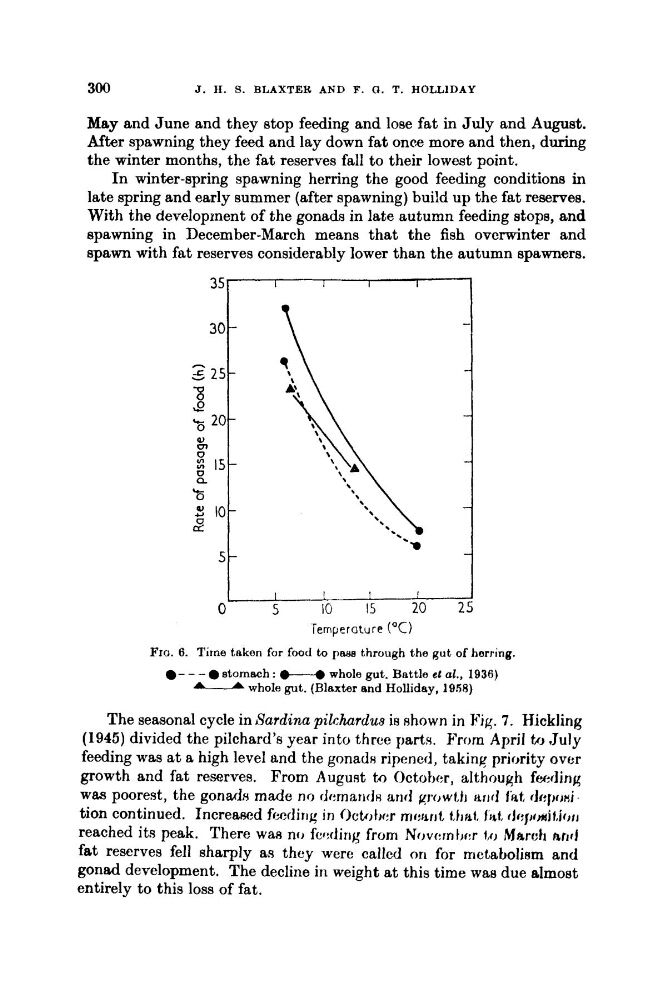
Temperature ("C)
FIQ. 6. Time taken for food to pwa through the gut of horring.
- - - stomach:
whole gut. Battle ct al., 1936)
whole gut. (Blaxter 4nd Holliday, 1958)
The seasonal cycle in 8ardina pilchardus is shown in Fig. 7. Hickling
(1945) divided the pilchard's year into three parts. From April tr, J ~ d y
feeding was at a high level and the gonads ripened, taking priority over
growth and fat reserves. From August t o October, although fwding
waa poorest, the gonwh made no rlernsridH and growth arid fitt, c f q m i
tiOn continued. Increamd ffzdirrg in 0chhr:r morirrt that fit, hjmifhjf1
reached its peak. There W;MI no fecding from N r i v a m t m to March a i d
fat reserves fell sharply as they were called on for metaboliem and
gonad development. The decline in weight at this time was due almost
entirely to this loss of fat.
J. H. 9. BLAXTER AND F. 0. T. HOLLIDAY
May and June and they stop feeding and lose fat in July and August.
After spawning they feed and lay down fat once more and then, during
the winter months, the fat reserves fall to their lowest point.
I n winter-spring spawning herring the good feeding conditions in
late spring and early summer (after spawning) build up the fat reserves.
With the development of the gonads in late autumn feeding stops, and
spawning in December-March means that the fish overwinter and
spawn with fat reserves considerably lower than the autumn spawners.
Temperature ("C)
FIQ. 6. Time taken for food to pwa through the gut of horring.
- - - stomach:
whole gut. Battle ct al., 1936)
whole gut. (Blaxter 4nd Holliday, 1958)
The seasonal cycle in 8ardina pilchardus is shown in Fig. 7. Hickling
(1945) divided the pilchard's year into three parts. From April tr, J ~ d y
feeding was at a high level and the gonads ripened, taking priority over
growth and fat reserves. From August t o October, although fwding
waa poorest, the gonwh made no rlernsridH and growth arid fitt, c f q m i
tiOn continued. Increamd ffzdirrg in 0chhr:r morirrt that fit, hjmifhjf1
reached its peak. There W;MI no fecding from N r i v a m t m to March a i d
fat reserves fell sharply as they were called on for metaboliem and
gonad development. The decline in weight at this time was due almost
entirely to this loss of fat.