

288
J. H. 9. BLAXTER AND F. a . T. HOLLIDAY
(Bishai, 1960a), whose activity was " restricted " between 26-9-32*2%
oxygen at 14°C ; this occurred at 55-64y0 oxygen in larvae 3-4 days old.
Larvae died in 6 hr at 11.6% satura,tion. The larvae would live at
oxygen values up to 41 1.4%.
Bishai (1961b) showed that herring larvae could withstand pressures
up to 4 atmospheres. No gas bubbles were found in the intestine when
the pressure was released from 2 atm to 1 atm in 10 min.
+--+
3ge jaw
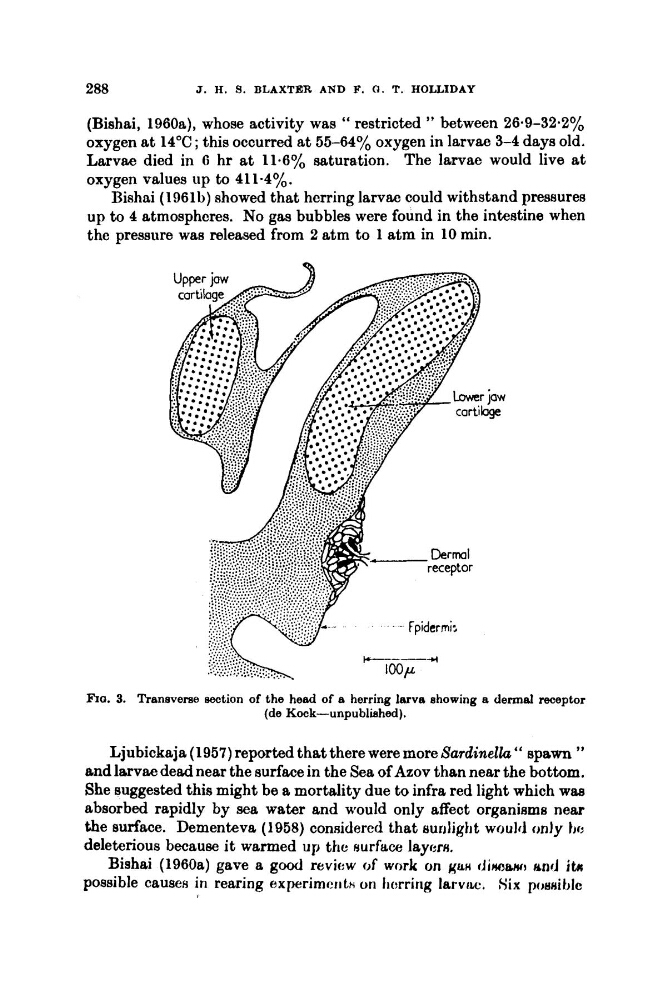
FIQ. 3. "raneveme section of the head of a herring larva ehowing a dermal receptor
(de Kock-unpubliahed).
Ljubickaja (1957) reported that there were more Sardinella '' spawn "
and larvae dead near the surface in the Sea of Azov than near the bottom.
She suggested this might be a mortality due to infra red light which waa
absorbed rapidly by sea water and would only affect organisms near
the surface. Dementeva (1958) condercd that sunlight wr~uld only hc
deleterious because it warmed up thc nurfrtce layfm.
Bishai (1960a) gave a good review of work on K~AH rliwrurr, and ih
possible causeR in rearing experimcrrtti on Iiorring larvac. Six poesi ble
J. H. 9. BLAXTER AND F. a . T. HOLLIDAY
(Bishai, 1960a), whose activity was " restricted " between 26-9-32*2%
oxygen at 14°C ; this occurred at 55-64y0 oxygen in larvae 3-4 days old.
Larvae died in 6 hr at 11.6% satura,tion. The larvae would live at
oxygen values up to 41 1.4%.
Bishai (1961b) showed that herring larvae could withstand pressures
up to 4 atmospheres. No gas bubbles were found in the intestine when
the pressure was released from 2 atm to 1 atm in 10 min.
+--+
3ge jaw
FIQ. 3. "raneveme section of the head of a herring larva ehowing a dermal receptor
(de Kock-unpubliahed).
Ljubickaja (1957) reported that there were more Sardinella '' spawn "
and larvae dead near the surface in the Sea of Azov than near the bottom.
She suggested this might be a mortality due to infra red light which waa
absorbed rapidly by sea water and would only affect organisms near
the surface. Dementeva (1958) condercd that sunlight wr~uld only hc
deleterious because it warmed up thc nurfrtce layfm.
Bishai (1960a) gave a good review of work on K~AH rliwrurr, and ih
possible causeR in rearing experimcrrtti on Iiorring larvac. Six poesi ble