

THE BEHAVIOUR AND PHYSIOLOGY OF HERRING AND OTHER CLUPEIDS 287
Speoiee
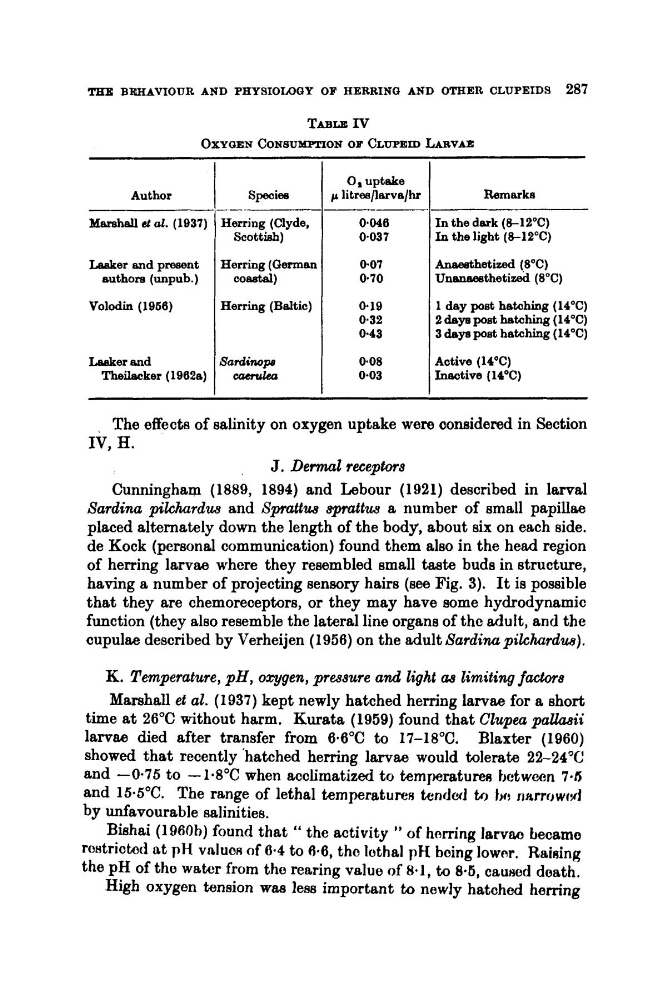
TABLE IV
OXYGEN CONSUDWCION OF CLUPEID LARVAE
0, uptske
p litree/larva/hr
Author
Mershall sl al. (1937)
Laaker and present
authora (unpub.)
Volodin (1966)
Laaker and
"heilecker (19628)
Herring (Clyde,
Scottish)
c o d )
Herring (German
Herring (Beltic)
Sardinop
cacrulur
0-048
0.03 7
0.07
0.70
0.19
0.32
0.43
0.08
0.03
Remarks
In the dark (a12"C)
In the light (8-12°C)
Aneeethetized (8°C)
Unenesethetimd (S'C)
1 day poet hatching (14OC)
2 days post hatching (14%)
3 days poet hatching (14'C)
Active (14OC)
Ineotive (14°C)
The effects of salinity on oxygen uptake were considered in Section
IV, H.
J. D e m l receptors
Cunningham (1889, 1894) and Lebour (1921) described in larval
Sardina pilchardus and Sprattw aprattw a number of small papillae
placed alternately down the length of the body, about six on each side.
de Kock (personal communication) found them also in the head region
of herring larvae where they resembled small taste buds in structure,
having a number of projecting sensory hairs (see Fig. 3). It is possible
that they are chemoreceptors, or they may have some hydrodynamic
function (they also resemble the lateral line organs of the adult, and the
cupulae described by Verheijen (1956) on the adult Sardinu pilchardue).
K. Temperature, p H , oxygen, pressure and light a8 limiting factore
Marshall et al. (1937) kept newly hatched herring larvae for a short
time at 26°C without harm. Kurata (1959) found that Clupea p a k i i
larvae died after transfer from fM"C to 17-18°C. Blaxter (1960)
showed that recently 'hatched herring larvae would tolerate 22-24°C
and -0.75 to -1.8"C when acclimatized to temperatures htweon 7.6
and 154°C. The range of lethal temperatures tcndwl h tm n m o w w l
by unfavourable salinities.
Bishai (1960b) found that l1 the activity " of homing Iarvm becarno
rustriatad a t pH v ~ ~ I u ~ R
of 0.4 to 6.6, tho luthal pH boing lower. Raising
the pH of the water from tho rearing value of 8.1 , to 8.6, cautmd death.
High oxygen tension wm less important to newly hatohod herring
Speoiee
TABLE IV
OXYGEN CONSUDWCION OF CLUPEID LARVAE
0, uptske
p litree/larva/hr
Author
Mershall sl al. (1937)
Laaker and present
authora (unpub.)
Volodin (1966)
Laaker and
"heilecker (19628)
Herring (Clyde,
Scottish)
c o d )
Herring (German
Herring (Beltic)
Sardinop
cacrulur
0-048
0.03 7
0.07
0.70
0.19
0.32
0.43
0.08
0.03
Remarks
In the dark (a12"C)
In the light (8-12°C)
Aneeethetized (8°C)
Unenesethetimd (S'C)
1 day poet hatching (14OC)
2 days post hatching (14%)
3 days poet hatching (14'C)
Active (14OC)
Ineotive (14°C)
The effects of salinity on oxygen uptake were considered in Section
IV, H.
J. D e m l receptors
Cunningham (1889, 1894) and Lebour (1921) described in larval
Sardina pilchardus and Sprattw aprattw a number of small papillae
placed alternately down the length of the body, about six on each side.
de Kock (personal communication) found them also in the head region
of herring larvae where they resembled small taste buds in structure,
having a number of projecting sensory hairs (see Fig. 3). It is possible
that they are chemoreceptors, or they may have some hydrodynamic
function (they also resemble the lateral line organs of the adult, and the
cupulae described by Verheijen (1956) on the adult Sardinu pilchardue).
K. Temperature, p H , oxygen, pressure and light a8 limiting factore
Marshall et al. (1937) kept newly hatched herring larvae for a short
time at 26°C without harm. Kurata (1959) found that Clupea p a k i i
larvae died after transfer from fM"C to 17-18°C. Blaxter (1960)
showed that recently 'hatched herring larvae would tolerate 22-24°C
and -0.75 to -1.8"C when acclimatized to temperatures htweon 7.6
and 154°C. The range of lethal temperatures tcndwl h tm n m o w w l
by unfavourable salinities.
Bishai (1960b) found that l1 the activity " of homing Iarvm becarno
rustriatad a t pH v ~ ~ I u ~ R
of 0.4 to 6.6, tho luthal pH boing lower. Raising
the pH of the water from tho rearing value of 8.1 , to 8.6, cautmd death.
High oxygen tension wm less important to newly hatohod herring