

THE BIOLOGY OF CORAL REEFS
243
As shown diagrammatically in Fig. 12, caloium appears to be taken
in directly from the water and not to be concentrated in the tissues prior
to deposition in the skeleton. Indeed the living tissues effectively
isolate the skeleton, preventing interchange or rer~ction with the sea
water (Goreau and Goreau, 1960~). The skeleton, which consists
exclusively of aragonite-the inability to secrete calcite has been
suggested as a possible reason for the paucity of corals in cold watersis, in the opinion of Goreau, formed outside the ectoderm cells. He
postulates a passage, by as yet unknown means, of calcium through the
tissues to be '' adsorbed on a mucopolysaccharide-like material that
forms part of the organic matrix and acts as the template upon which
the initial stages of skeletal mineralization occur " (Goreau, 1961a).
He postulates that the calcium combines with bicarbonate, largely
produced in metabolism, to form first calcium bicarbonate and then
calcium carbonate but the efficiency of this depends on the effective
removal of H,CO, which depends on reactions catalysed by carbonic
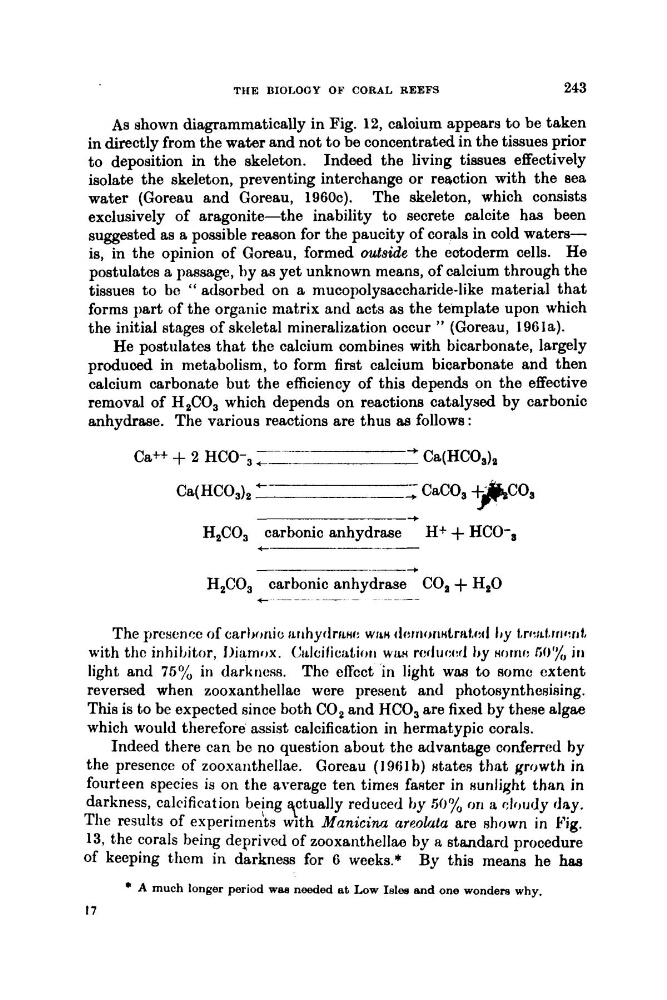
anhydraae. The various reactions are thus aa follows :
Ca++ + 2 HCO-, 5--* Ca(HCO,),
Ca( HCO,),
+
-
~
CaCO, +Fa
H,CO, carbonic anhydrase H+ + HCO-,
--*
-
_ -
H,CO, carbonic anhydrase CO, + H,O
+
. - - - . . - -
. . -.
The prescncc of carl)onio arihytlrnrcc: WILH tlarrrorircCrrt!,r:tl try t,rwd,rwri!,
with thc inhibitor, Ihrnox. (hIcjfication WUN rtx~uot!t! by Horrit: GO'%, in
light and 76% in darkness. The effect in light was to some cxtent
reversed when zooxanthellae were present and photosynthcsising.
This is to be expected since both CO, and HCO, are fixed by these algae
which would therefore assist calcification in hermatypic corals.
Indeed there can be no question about the advantage conferred by
the presence of zooxanthellae. Goreau (1961 b) HtateB that growth in
fourteen species is on the average ten times faRter in nunliyht than in
darkness, calcification being ctually reduced by 50'g Or1 a clr~udy day.
The results of experiments with Manicinn areohla are 8hown in Fig.
13, the corals being deprived of zooxanthellae by a standard procedure
of keeping them in darkness for 6 weeks.* By this meens he has
?
* A much longer period wm needed at Low Isles and one wondem why.
17
243
As shown diagrammatically in Fig. 12, caloium appears to be taken
in directly from the water and not to be concentrated in the tissues prior
to deposition in the skeleton. Indeed the living tissues effectively
isolate the skeleton, preventing interchange or rer~ction with the sea
water (Goreau and Goreau, 1960~). The skeleton, which consists
exclusively of aragonite-the inability to secrete calcite has been
suggested as a possible reason for the paucity of corals in cold watersis, in the opinion of Goreau, formed outside the ectoderm cells. He
postulates a passage, by as yet unknown means, of calcium through the
tissues to be '' adsorbed on a mucopolysaccharide-like material that
forms part of the organic matrix and acts as the template upon which
the initial stages of skeletal mineralization occur " (Goreau, 1961a).
He postulates that the calcium combines with bicarbonate, largely
produced in metabolism, to form first calcium bicarbonate and then
calcium carbonate but the efficiency of this depends on the effective
removal of H,CO, which depends on reactions catalysed by carbonic
anhydraae. The various reactions are thus aa follows :
Ca++ + 2 HCO-, 5--* Ca(HCO,),
Ca( HCO,),
+
-
~
CaCO, +Fa
H,CO, carbonic anhydrase H+ + HCO-,
--*
-
_ -
H,CO, carbonic anhydrase CO, + H,O
+
. - - - . . - -
. . -.
The prescncc of carl)onio arihytlrnrcc: WILH tlarrrorircCrrt!,r:tl try t,rwd,rwri!,
with thc inhibitor, Ihrnox. (hIcjfication WUN rtx~uot!t! by Horrit: GO'%, in
light and 76% in darkness. The effect in light was to some cxtent
reversed when zooxanthellae were present and photosynthcsising.
This is to be expected since both CO, and HCO, are fixed by these algae
which would therefore assist calcification in hermatypic corals.
Indeed there can be no question about the advantage conferred by
the presence of zooxanthellae. Goreau (1961 b) HtateB that growth in
fourteen species is on the average ten times faRter in nunliyht than in
darkness, calcification being ctually reduced by 50'g Or1 a clr~udy day.
The results of experiments with Manicinn areohla are 8hown in Fig.
13, the corals being deprived of zooxanthellae by a standard procedure
of keeping them in darkness for 6 weeks.* By this meens he has
?
* A much longer period wm needed at Low Isles and one wondem why.
17