

234
C. M . YONCE
vegetative cells. They also confirmed previous impressions about the
toughness of the outer membrane in the vegetative phase and gave
much information about the maintenance and the nutritional requirements of these organisms. The most significant of these is the
demonstrated ability “ to utilize some normal animal metabolites,
particularly waste products ”. This, of course, lies a t the base of their
success as symbionts, enabling them to act as automatic agents of
excretion for corals (Yonge, 1957).
The symbionts in Cassiopeia and Condylactis were identified as
AP
B
A
G r
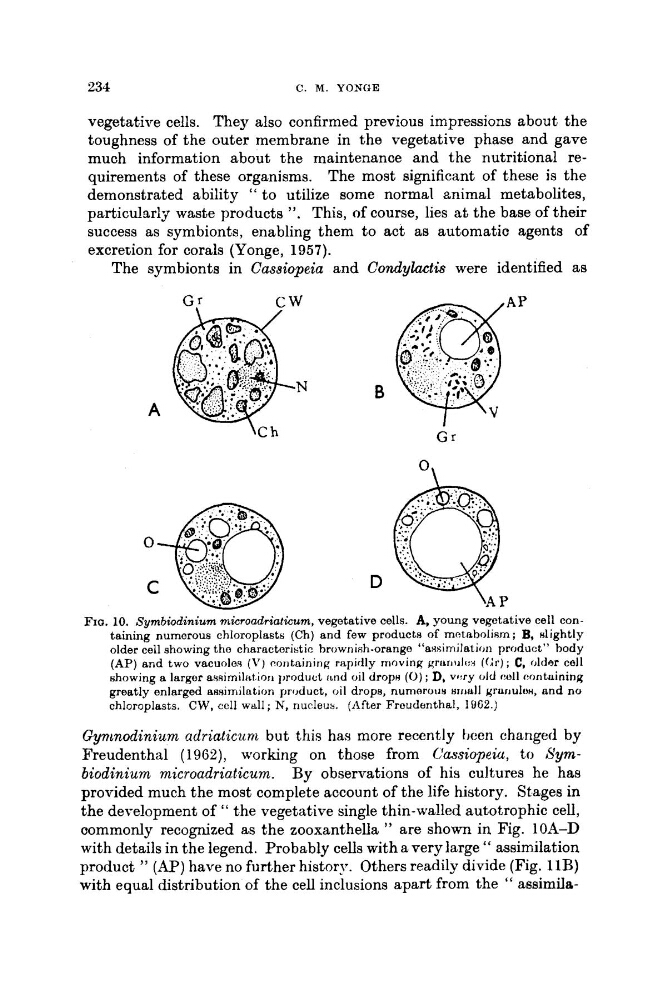
FIG. 10. Symbiodinium microadriaticum, vegetative cells. A, young vegetative cell containing numerous chloroplasts (Ch) and few products of mntabolifim; B, slightly
older cell showing the charactoritjtic brownifih-orange “axsirr~ilatir~n product” body
(AP) and two vacuoles (1’) containing nipidly mnving griiriulcw ((jr) ; c, older cell
showing a larger assimilrrt.iori product rind oil drops ( 0 ) ; D, vwy old r : d l fmntuining
greatly enlarged amimilntion rJrrJdUCt, oil drops, nunloroils K I I I U ~ ~
gruriulw, and no
chloroplasts. CW, cell wail ; N, nucleus. (After Freudenthal, 1962.)
Gynmodinium adriatieurn but this has more recently h e n changed by
Freudenthal (1962), working on those from C’assiopeiu, to Symbiodinium microudriuticum. By observations of his cultures he has
provided much the most complete account of the life history. St,ages in
the development of ‘‘ the vegetative single thin-walled autotrophic cell,
commonly recognized as the zooxanthella ” are shown in Fig. IOA-D
with details in the legend. Probably cells with a very large “ assimilation
product ’’ (AP) have no further history. Others readily &vide (Fig. 11B)
with equal distribution of the cell inclusions apart from the “ assimila-
C. M . YONCE
vegetative cells. They also confirmed previous impressions about the
toughness of the outer membrane in the vegetative phase and gave
much information about the maintenance and the nutritional requirements of these organisms. The most significant of these is the
demonstrated ability “ to utilize some normal animal metabolites,
particularly waste products ”. This, of course, lies a t the base of their
success as symbionts, enabling them to act as automatic agents of
excretion for corals (Yonge, 1957).
The symbionts in Cassiopeia and Condylactis were identified as
AP
B
A
G r
FIG. 10. Symbiodinium microadriaticum, vegetative cells. A, young vegetative cell containing numerous chloroplasts (Ch) and few products of mntabolifim; B, slightly
older cell showing the charactoritjtic brownifih-orange “axsirr~ilatir~n product” body
(AP) and two vacuoles (1’) containing nipidly mnving griiriulcw ((jr) ; c, older cell
showing a larger assimilrrt.iori product rind oil drops ( 0 ) ; D, vwy old r : d l fmntuining
greatly enlarged amimilntion rJrrJdUCt, oil drops, nunloroils K I I I U ~ ~
gruriulw, and no
chloroplasts. CW, cell wail ; N, nucleus. (After Freudenthal, 1962.)
Gynmodinium adriatieurn but this has more recently h e n changed by
Freudenthal (1962), working on those from C’assiopeiu, to Symbiodinium microudriuticum. By observations of his cultures he has
provided much the most complete account of the life history. St,ages in
the development of ‘‘ the vegetative single thin-walled autotrophic cell,
commonly recognized as the zooxanthella ” are shown in Fig. IOA-D
with details in the legend. Probably cells with a very large “ assimilation
product ’’ (AP) have no further history. Others readily &vide (Fig. 11B)
with equal distribution of the cell inclusions apart from the “ assimila-