

THE BIOLOGY OF CORAL REEFS
233
bvilggemanni. They are present in many other reef coelenterateshydrozoans and scyphozoans as well as anthozoans-but not in
ahermatypic corals. Knowledge about them has greatly increased
within very recent years. They are now known to represent the
vegetative stage of dinoflagellates. Hovasse (1937) had already, on
morphological groundfl, claimed their relationship with this group but
direct proof came initially from Kawaguti (1944a) who cultivated
zooxanthellae from Acropora coryrnbosa in Miquel-Allen’s solution and
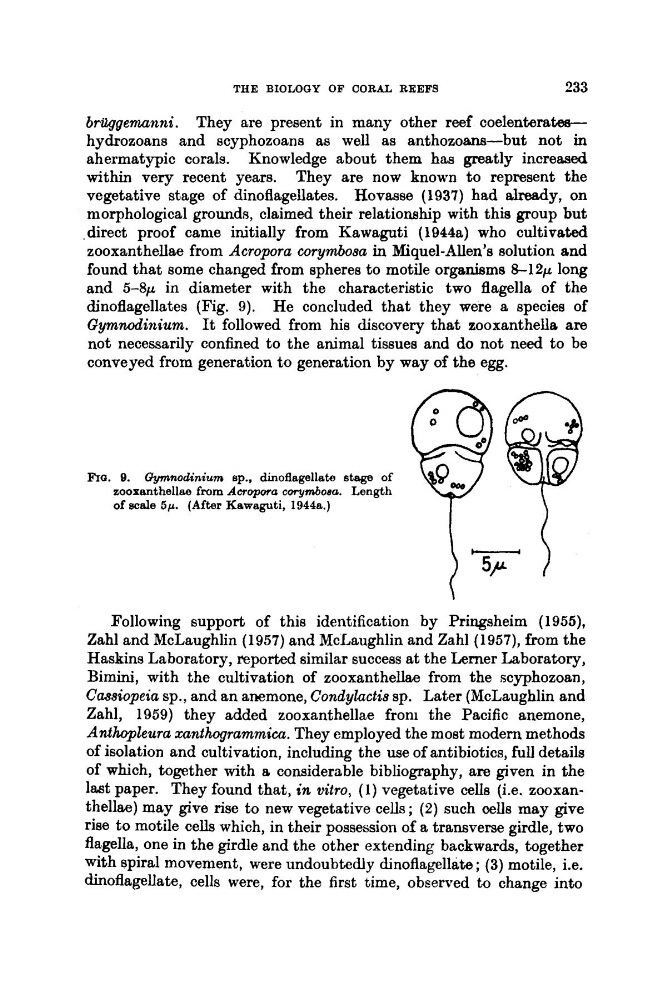
found that some changed from spheres to motile organisms 8-12p long
and 5-8p in diameter with the characteristic two flagella of the
dinoflagellates (Fig. 9). He concluded that they were a species of
G y m d i n i u m . It followed from his discovery that zooxanthella are
not necessarily confined to the animal tissues and do not need to be
conveyed from generation to generation by way of the egg.
FIQ. 9. Qymnodinium sp., dinoflagellate stage of
zooxanthellae from Acrqpwa corymboaa. Length
of scale 5p. (After Kawaguti, 1944a.)
Following support of this identification by Pringsheim (1 955),
Zahl and McLaughlin (1957) and McLaughlin and Zahl(1957), from the
Haskins Laboratory, reported similar success at the Lerner Laboratory,
Bimini, with the cultivation of zooxanthellae from the scyphozoan,
Cassiopeia sp., and an anemone, Condylactis sp. Later (McLaughlin and
Zahl, 1959) they added zooxanthellae from the Pacific anemone,
Anthopleura xanthogrammica. They employed the most modern methods
of isolation and cultivation, including the use of antibiotics, full details
of which, together with a considerable bibliography, are given in the
last paper. They found that, in vitro, (1) vegetative cells (i.e. zooxanthellae) may give rise to new vegetative cells ; (2) such cells may give
rise to motile cells which, in their possession of a transverse girdle, two
flagella, one in the girdle and the other extending backwards, together
with spiral movement, were undoubtedly dinoflagellate ; (3) motile, i.e.
dinoflagellate, cells were, for the first time, observed to change into
233
bvilggemanni. They are present in many other reef coelenterateshydrozoans and scyphozoans as well as anthozoans-but not in
ahermatypic corals. Knowledge about them has greatly increased
within very recent years. They are now known to represent the
vegetative stage of dinoflagellates. Hovasse (1937) had already, on
morphological groundfl, claimed their relationship with this group but
direct proof came initially from Kawaguti (1944a) who cultivated
zooxanthellae from Acropora coryrnbosa in Miquel-Allen’s solution and
found that some changed from spheres to motile organisms 8-12p long
and 5-8p in diameter with the characteristic two flagella of the
dinoflagellates (Fig. 9). He concluded that they were a species of
G y m d i n i u m . It followed from his discovery that zooxanthella are
not necessarily confined to the animal tissues and do not need to be
conveyed from generation to generation by way of the egg.
FIQ. 9. Qymnodinium sp., dinoflagellate stage of
zooxanthellae from Acrqpwa corymboaa. Length
of scale 5p. (After Kawaguti, 1944a.)
Following support of this identification by Pringsheim (1 955),
Zahl and McLaughlin (1957) and McLaughlin and Zahl(1957), from the
Haskins Laboratory, reported similar success at the Lerner Laboratory,
Bimini, with the cultivation of zooxanthellae from the scyphozoan,
Cassiopeia sp., and an anemone, Condylactis sp. Later (McLaughlin and
Zahl, 1959) they added zooxanthellae from the Pacific anemone,
Anthopleura xanthogrammica. They employed the most modern methods
of isolation and cultivation, including the use of antibiotics, full details
of which, together with a considerable bibliography, are given in the
last paper. They found that, in vitro, (1) vegetative cells (i.e. zooxanthellae) may give rise to new vegetative cells ; (2) such cells may give
rise to motile cells which, in their possession of a transverse girdle, two
flagella, one in the girdle and the other extending backwards, together
with spiral movement, were undoubtedly dinoflagellate ; (3) motile, i.e.
dinoflagellate, cells were, for the first time, observed to change into