

106
VICTOR L. LOOSANOFF AND HARRY C. DAVIS
sizes of larvae of C. virginica and C. gigas. No free-swimming larvae
measuring more than 312p in length were observed. Growth after
metamorphosis was, for a short period, somewhat faster in 0. lutida
than in G. virginica.
J. Crassostrea gigas (Thunberg)
C. gigas, the common commercial species of Japan, was introduced
to the waters of the State of Washington in 1902. During the last
few decades it has become one of the most important mollusks of our
Pacific northwest. Although the industry still depends largely upon
seed oysters imported from Japan, a natural set of C . gigae occurs
occasionally in such areas as Quilcene, Willapa and Dabob Bays and
Hood Canal.
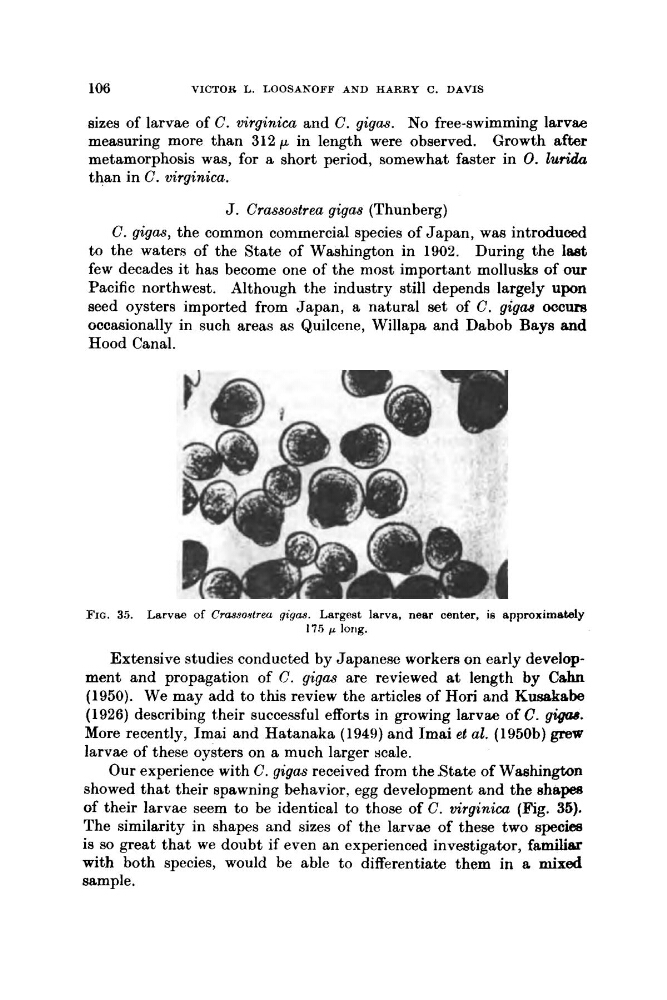
FIG. 35. Larvae of Crassoslreu q i p a . Largest larva, near center, is approximately
175 /L long.
Extensive studies conducted by Japanese workers on early development and propagation of C . gigas are reviewed at length by Cahn
(1950). We may add to this review the articles of Hori and Kumkabe
(1926) describing their successful efforts in growing larvae of C . gisQs.
More recently, Imai and Hatanaka (1949) and Imai et al. (1 950b) grew
larvae of these oysters on a much larger scale.
Our experience with C. gigas received from the State of Washington
showed that their spawning behavior, egg development and the s h a p
of their larvae seem to be identical to those of C . wirginica (Fig. 35).
The similarity in shapes and sizes of the larvae of these two species
is so great that we doubt if even an experienced investigator, familiax
with both species, would be able to differentiate them in a mixed
sample,
VICTOR L. LOOSANOFF AND HARRY C. DAVIS
sizes of larvae of C. virginica and C. gigas. No free-swimming larvae
measuring more than 312p in length were observed. Growth after
metamorphosis was, for a short period, somewhat faster in 0. lutida
than in G. virginica.
J. Crassostrea gigas (Thunberg)
C. gigas, the common commercial species of Japan, was introduced
to the waters of the State of Washington in 1902. During the last
few decades it has become one of the most important mollusks of our
Pacific northwest. Although the industry still depends largely upon
seed oysters imported from Japan, a natural set of C . gigae occurs
occasionally in such areas as Quilcene, Willapa and Dabob Bays and
Hood Canal.
FIG. 35. Larvae of Crassoslreu q i p a . Largest larva, near center, is approximately
175 /L long.
Extensive studies conducted by Japanese workers on early development and propagation of C . gigas are reviewed at length by Cahn
(1950). We may add to this review the articles of Hori and Kumkabe
(1926) describing their successful efforts in growing larvae of C . gisQs.
More recently, Imai and Hatanaka (1949) and Imai et al. (1 950b) grew
larvae of these oysters on a much larger scale.
Our experience with C. gigas received from the State of Washington
showed that their spawning behavior, egg development and the s h a p
of their larvae seem to be identical to those of C . wirginica (Fig. 35).
The similarity in shapes and sizes of the larvae of these two species
is so great that we doubt if even an experienced investigator, familiax
with both species, would be able to differentiate them in a mixed
sample,