

NEARING OF BIVALVR MOLLUSKS
106
The size of normal larvae, at the time oS swarming, waa about 185 p,
but on several occasions groups of smaller larvae, measuring from
165 to 170 p were released. Hori (1993) reported that larvae at the
time of release are between 175 and 185 p. Hopkins (1937) gave 180 p
as the average. Imai et al. (1954), in culturing 0. Zurida in Japanese
waters, fonnd that the length of larvae immediately after swarming
ranged from 174.6 to 189 p. In general, all these figures closely agree
with ours.
The larvae are quite dark, even when first releaaed, and appear
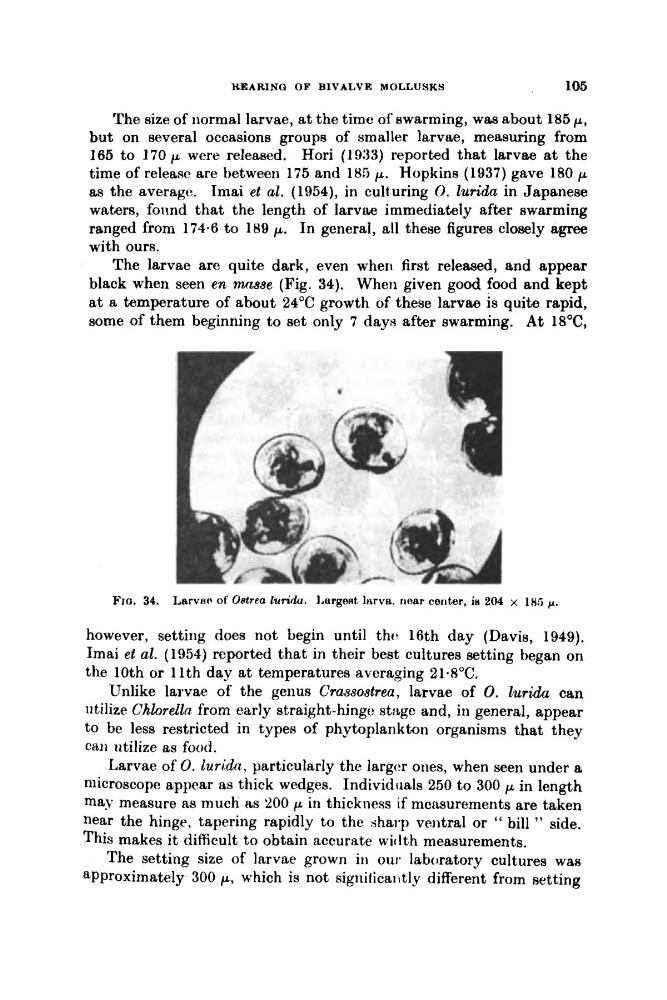
black when seen en m s e (Fig. 34). When given good food and kept
at a temperature of about 24°C growth of these larvae is quite rapid,
some of them beginning to set only 7 days after swarming. At 1 8 ' C ,
FJQ. 34. Larvw of Omea l u r i h . 1,argest h v a . rmar cerlter, is 204 x 185 p.
however, setting does not begin until thfn 16th day (Davis, 1949).
Imai et al. (1954) reported that in their best cultures setting began on
the 10th or 11th day at temperatures averaging 21.8OC.
Unlike larvae of the genus Crassostrea, larvae of 0. lurida can
utilize Chlorelln from early straight-hinge stage and, in general, appear
to be less restricted in types of phytoplankton organisms that they
can utilize as food.
Larvae of 0. luridtr., particularly the 1argc:r ones, when seen under a
microscope appear as thick wedges. Individiials 250 to 300 p in length
may measure as much as 'LOO p in thickness L f measurements are taken
near the hinge, tapering rapidly to the sharp ventral or " bill " side.
This makes it difficult to obtain accurate wiclth measurements.
The setting size of larvae grown in our laboratory cultures was
approximately 300 p, which is not significai ttly different from setting
106
The size of normal larvae, at the time oS swarming, waa about 185 p,
but on several occasions groups of smaller larvae, measuring from
165 to 170 p were released. Hori (1993) reported that larvae at the
time of release are between 175 and 185 p. Hopkins (1937) gave 180 p
as the average. Imai et al. (1954), in culturing 0. Zurida in Japanese
waters, fonnd that the length of larvae immediately after swarming
ranged from 174.6 to 189 p. In general, all these figures closely agree
with ours.
The larvae are quite dark, even when first releaaed, and appear
black when seen en m s e (Fig. 34). When given good food and kept
at a temperature of about 24°C growth of these larvae is quite rapid,
some of them beginning to set only 7 days after swarming. At 1 8 ' C ,
FJQ. 34. Larvw of Omea l u r i h . 1,argest h v a . rmar cerlter, is 204 x 185 p.
however, setting does not begin until thfn 16th day (Davis, 1949).
Imai et al. (1954) reported that in their best cultures setting began on
the 10th or 11th day at temperatures averaging 21.8OC.
Unlike larvae of the genus Crassostrea, larvae of 0. lurida can
utilize Chlorelln from early straight-hinge stage and, in general, appear
to be less restricted in types of phytoplankton organisms that they
can utilize as food.
Larvae of 0. luridtr., particularly the 1argc:r ones, when seen under a
microscope appear as thick wedges. Individiials 250 to 300 p in length
may measure as much as 'LOO p in thickness L f measurements are taken
near the hinge, tapering rapidly to the sharp ventral or " bill " side.
This makes it difficult to obtain accurate wiclth measurements.
The setting size of larvae grown in our laboratory cultures was
approximately 300 p, which is not significai ttly different from setting