

70
GERALD L. YOUNG
where R is the total effective resistance and k is a proportionality constant
relating capacity and resistance. The problem is still to find measurable
values for each variable: the assumption is that values could be formulated from present empirical data in psychology, but that, until such are
provided, both of the above equations also remain essentially symbolic.
As a conceptual tool, however, it is believed that the above equations
do have validity, however immeasurable. Human interaction is a
reaction to differences; human beings do vary in their capacity for
exchange; such variation may be based on income, employment, childhood environment, provincialism etc. It could be possible to devise a
proportionality constant relating capacity for interaction with an
individual’s or group’s resistance to such interaction. One only has to
think of groups such as the Amish to accept such a resistancelcapacity
ratio as an understandable if not measurable variable of human interaction, here one based on a belief-system contrary to the normative
primacy of the general system of order. More concrete success has been
gained in formulation of measures of group interaction. The most
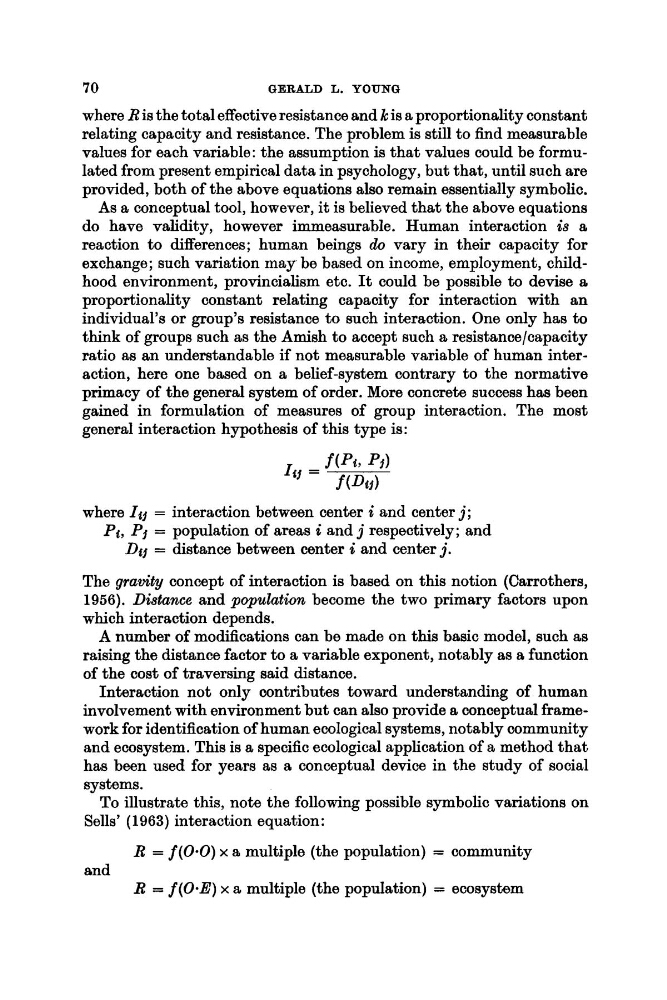
general interaction hypothesis of this type is:
where Ig5 = interaction between center i and center j;
Pt, P5 = population of areas i and j respectively; and
Dt5 = distance between center i and center j.
The gravity concept of interaction is based on this notion (Carrothers,
1956). Distance and population become the two primary factors upon
which interaction depends.
A number of modifications can be made on this basic model, such as
raising the distance factor to a variable exponent, notably as a function
of the cost of traversing said distance.
Interaction not only contributes toward understanding of human
involvement with environment but can also provide a conceptual framework for identification of human ecological systems, notably community
and ecosystem. This is a specific ecological application of a method that
has been used for years as a conceptual device in the study of social
systems.
To illustrate this, note the following possible symbolic variations on
Sells’ (1963) interaction equation:
R = f (0.0) x a multiple (the population) = community
R = f (0.E) x a multiple (the population) = ecosystem
and
GERALD L. YOUNG
where R is the total effective resistance and k is a proportionality constant
relating capacity and resistance. The problem is still to find measurable
values for each variable: the assumption is that values could be formulated from present empirical data in psychology, but that, until such are
provided, both of the above equations also remain essentially symbolic.
As a conceptual tool, however, it is believed that the above equations
do have validity, however immeasurable. Human interaction is a
reaction to differences; human beings do vary in their capacity for
exchange; such variation may be based on income, employment, childhood environment, provincialism etc. It could be possible to devise a
proportionality constant relating capacity for interaction with an
individual’s or group’s resistance to such interaction. One only has to
think of groups such as the Amish to accept such a resistancelcapacity
ratio as an understandable if not measurable variable of human interaction, here one based on a belief-system contrary to the normative
primacy of the general system of order. More concrete success has been
gained in formulation of measures of group interaction. The most
general interaction hypothesis of this type is:
where Ig5 = interaction between center i and center j;
Pt, P5 = population of areas i and j respectively; and
Dt5 = distance between center i and center j.
The gravity concept of interaction is based on this notion (Carrothers,
1956). Distance and population become the two primary factors upon
which interaction depends.
A number of modifications can be made on this basic model, such as
raising the distance factor to a variable exponent, notably as a function
of the cost of traversing said distance.
Interaction not only contributes toward understanding of human
involvement with environment but can also provide a conceptual framework for identification of human ecological systems, notably community
and ecosystem. This is a specific ecological application of a method that
has been used for years as a conceptual device in the study of social
systems.
To illustrate this, note the following possible symbolic variations on
Sells’ (1963) interaction equation:
R = f (0.0) x a multiple (the population) = community
R = f (0.E) x a multiple (the population) = ecosystem
and