

HUMAN ECOLOGY AS AN INTERDISUIPLINARY CONCEPT
69
must be measurable, i.e. quantifiable. To what extent is this possible at
the present time?
The problem may be divided. It may not be possible to describe the
interactions of individuals in mathematical terms, though it appears
quite acceptable to describe the interactions of groups in a quantitative
way. The second must, of course, be qualified by the first, by the power
of the individual for personal decision-making. But how? To what
extent?
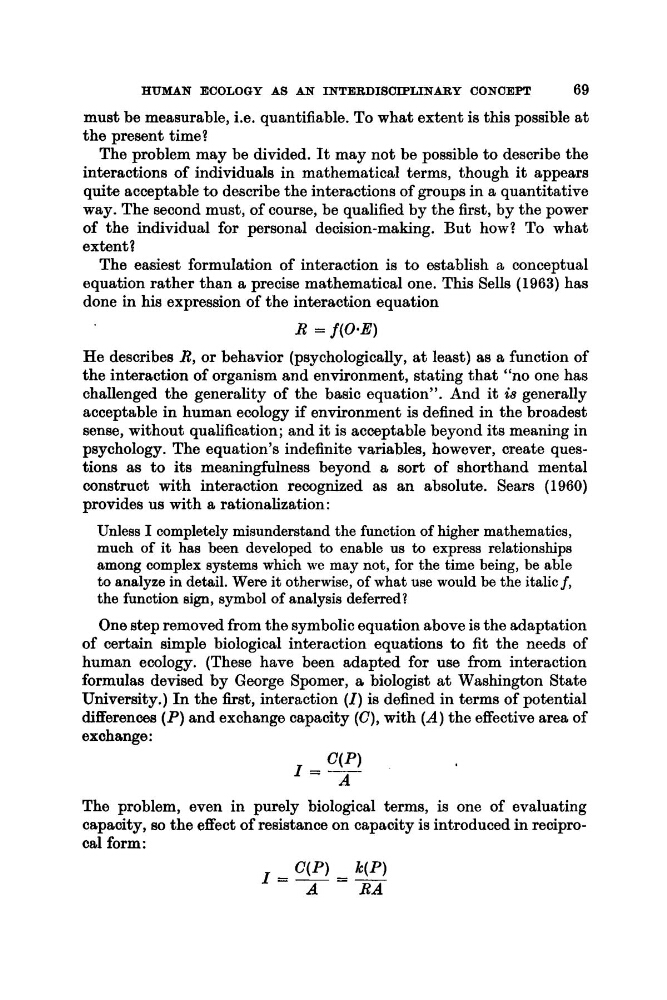
The easiest formulation of interaction is to establish a conceptual
equation rather than a precise mathematical one. This Sells (1963) has
done in his expression of the interaction equation
R = f ( O . E )
He describes R, or behavior (psychologically, a t least) as a function of
the interaction of organism and environment, stating that “no one has
challenged the generality of the basic equation”. And it is generally
acceptable in human ecology if environment is defined in the broadest
sense, without qualification; and it is acceptable beyond its meaning in
psychology. The equation’s indefinite variables, however, create questions as to its meaningfulness beyond a sort of shorthand mental
construct with interaction recognized as an absolute. Sears (1960)
provides us with a rationalization:
Unless I completely misunderstand the function of higher mathematics,
much of it has been developed to enable us to express relationships
among complex systems which we may not, for the time being, be able
to analyze in detail. Were it otherwise, of what use would be the italic f,
the function sign, symbol of analysis deferred?
One step removed from the symbolic equation above is the adaptation
of certain simple biological interaction equations to fit the needs of
human ecology. (These have been adapted for use from interaction
formulas devised by George Spomer, a biologist at Washington State
University.) In the first, interaction ( I ) is defined in terms of potential
differences (P) and exchange capacity (C), with ( A ) the effective area of
exchange:
C ( P )
I = - A
The problem, even in purely biological terms, is one of evaluating
capacity, so the effect of resistance on capacity is introduced in reciprocal form:
C ( P ) - W )
I = T - - RA
69
must be measurable, i.e. quantifiable. To what extent is this possible at
the present time?
The problem may be divided. It may not be possible to describe the
interactions of individuals in mathematical terms, though it appears
quite acceptable to describe the interactions of groups in a quantitative
way. The second must, of course, be qualified by the first, by the power
of the individual for personal decision-making. But how? To what
extent?
The easiest formulation of interaction is to establish a conceptual
equation rather than a precise mathematical one. This Sells (1963) has
done in his expression of the interaction equation
R = f ( O . E )
He describes R, or behavior (psychologically, a t least) as a function of
the interaction of organism and environment, stating that “no one has
challenged the generality of the basic equation”. And it is generally
acceptable in human ecology if environment is defined in the broadest
sense, without qualification; and it is acceptable beyond its meaning in
psychology. The equation’s indefinite variables, however, create questions as to its meaningfulness beyond a sort of shorthand mental
construct with interaction recognized as an absolute. Sears (1960)
provides us with a rationalization:
Unless I completely misunderstand the function of higher mathematics,
much of it has been developed to enable us to express relationships
among complex systems which we may not, for the time being, be able
to analyze in detail. Were it otherwise, of what use would be the italic f,
the function sign, symbol of analysis deferred?
One step removed from the symbolic equation above is the adaptation
of certain simple biological interaction equations to fit the needs of
human ecology. (These have been adapted for use from interaction
formulas devised by George Spomer, a biologist at Washington State
University.) In the first, interaction ( I ) is defined in terms of potential
differences (P) and exchange capacity (C), with ( A ) the effective area of
exchange:
C ( P )
I = - A
The problem, even in purely biological terms, is one of evaluating
capacity, so the effect of resistance on capacity is introduced in reciprocal form:
C ( P ) - W )
I = T - - RA