

376
CRARLES J. KREBS AND JUDITH H. MYERS
00
& ‘ A .
i
.A34
I
I
I
JAN.
FEB.
MARCH APRIL
MAY
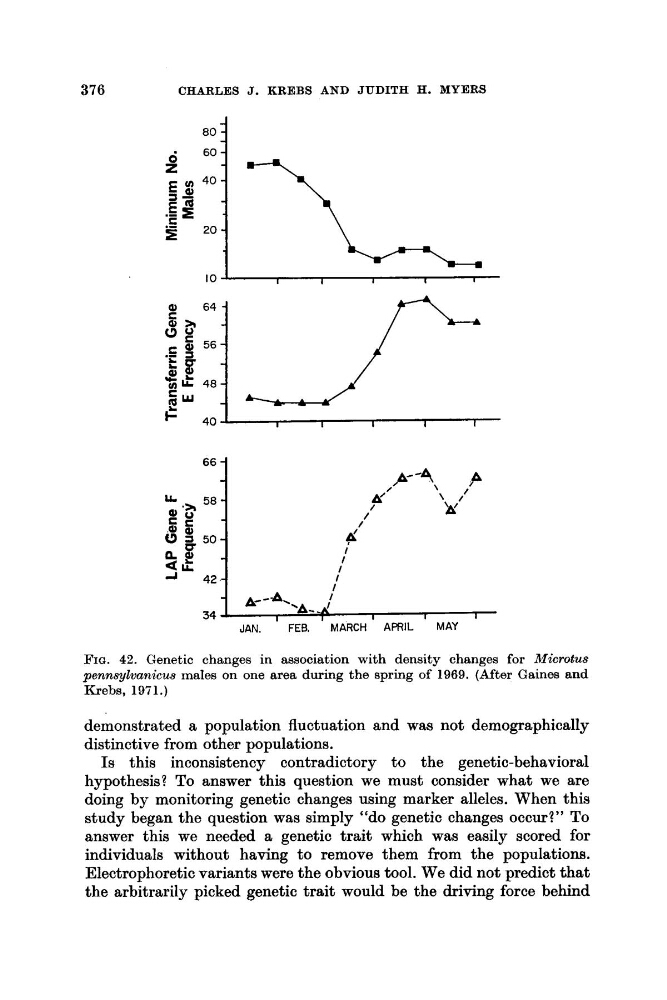
FIG. 42. Genetic changes in association with density changes for Microtus
pennsylvanicus males on one area during the spring of 1969. (After Gaines and
Krebs, 1971.)
demonstrated a population fluctuation and was not demographically
distinctive from other populations.
Is this inconsistency contradictory to the genetic-behavioral
hypothesis? To answer this question we must consider what we are
doing by monitoring genetic changes using marker alleles. When this
study began the question was simply “do genetic changes OCCUT?’’ To
answer this we needed a genetic trait which was easily scored for
individuals without having to remove them from the populations.
Electrophoretic variants were the obvious tool. We did not predict that
the arbitrarily picked genetic trait would be the driving force behind
CRARLES J. KREBS AND JUDITH H. MYERS
00
& ‘ A .
i
.A34
I
I
I
JAN.
FEB.
MARCH APRIL
MAY
FIG. 42. Genetic changes in association with density changes for Microtus
pennsylvanicus males on one area during the spring of 1969. (After Gaines and
Krebs, 1971.)
demonstrated a population fluctuation and was not demographically
distinctive from other populations.
Is this inconsistency contradictory to the genetic-behavioral
hypothesis? To answer this question we must consider what we are
doing by monitoring genetic changes using marker alleles. When this
study began the question was simply “do genetic changes OCCUT?’’ To
answer this we needed a genetic trait which was easily scored for
individuals without having to remove them from the populations.
Electrophoretic variants were the obvious tool. We did not predict that
the arbitrarily picked genetic trait would be the driving force behind