

POPULATION CYCLES IN SMALL MAMMALS
36 1
elevated leucocyte levels. The number of circulating leucocytes declined
in animals brought into the laboratory from the 1960 peak population.
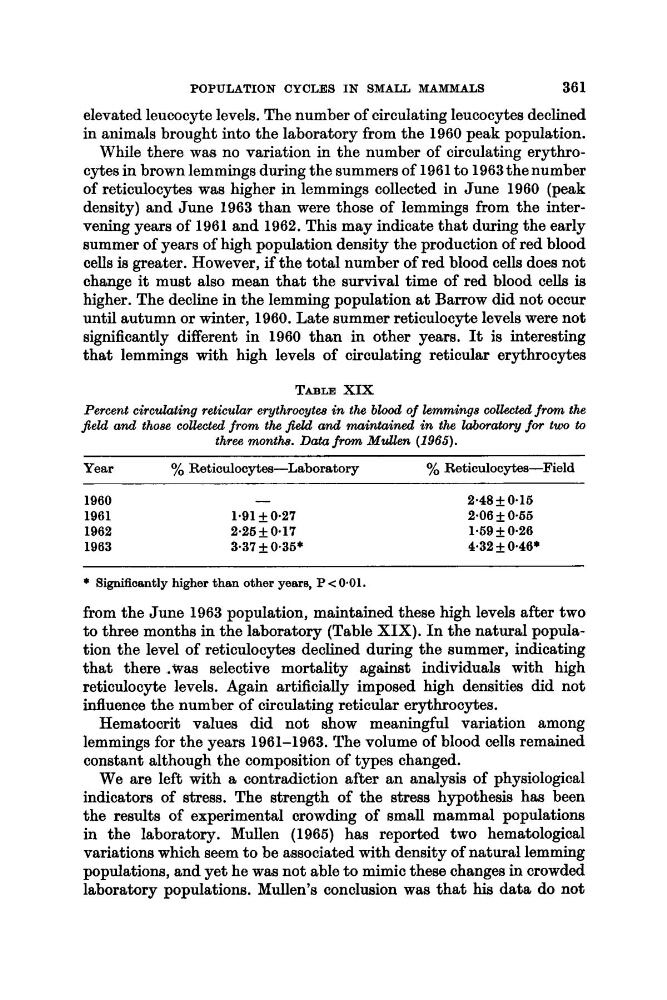
While there was no variation in the number of circulating erythrocytes in brown lemmings during the summers of 1961 to 1963 the number
of reticulocytes was higher in lemmings collected in June 1960 (peak
density) and June 1963 than were those of lemmings from the intervening years of 1961 and 1962. This may indicate that during the early
summer of years of high population density the production of red blood
cells is greater. However, if the total number of red blood cells does not
change it must also mean that the survival time of red blood cells is
higher. The decline in the lemming population at Barrow did not occur
until autumn or Winter, 1960. Late summer reticulocyte levels were not
significantly different in 1960 than in other years. It is interesting
that lemmings with high levels of circulating reticular erythrocytes
TABLE XIX
Percent circulating reticular erythrocyte% in the blood of lemmings collected f r m the
field and those collected from the field and maintained in the laboratory for two to
three month. Data; from Mullen (1965).
~~~~~~~~
~
Year
yo Reticulocytes-Laboratory
yo Reticulocytes-Field
1960
1961
1962
1963
-
1.91 f 0.27
2.26 0.17
3.37 f 0-36*
2.48 k 0.16
2.06 f 0.65
1.69 f 0.26
4.32 k 0.46*
* Signirioently higher then other years, P < 0.01.
from the June 1963 population, maintained these high levels after two
to three months in the laboratory (Table XIX). In the natural population the level of reticulocytes declined during the summer, indicating
that there .was selective mortality against individuals with high
reticulocyte levels. Again artificially imposed high densities did not
influence the number of circulating reticular erythrocytes.
Hematocrit values did not show meaningful variation among
lemmings for the years 1961-1963. The volume of blood cells remained
constant although the composition of types changed.
We are left with a contradiction after an analysis of physiological
indicators of stress. The strength of the stress hypothesis has been
the results of experimental crowding of small mammal populations
in the laboratory. Mullen (1965) has reported two hematological
variations which seem to be associated with density of natural lemming
populations, and yet he waa not able to mimic these changes in crowded
laboratory populations. Mullen’s conclusion was that his data do not
36 1
elevated leucocyte levels. The number of circulating leucocytes declined
in animals brought into the laboratory from the 1960 peak population.
While there was no variation in the number of circulating erythrocytes in brown lemmings during the summers of 1961 to 1963 the number
of reticulocytes was higher in lemmings collected in June 1960 (peak
density) and June 1963 than were those of lemmings from the intervening years of 1961 and 1962. This may indicate that during the early
summer of years of high population density the production of red blood
cells is greater. However, if the total number of red blood cells does not
change it must also mean that the survival time of red blood cells is
higher. The decline in the lemming population at Barrow did not occur
until autumn or Winter, 1960. Late summer reticulocyte levels were not
significantly different in 1960 than in other years. It is interesting
that lemmings with high levels of circulating reticular erythrocytes
TABLE XIX
Percent circulating reticular erythrocyte% in the blood of lemmings collected f r m the
field and those collected from the field and maintained in the laboratory for two to
three month. Data; from Mullen (1965).
~~~~~~~~
~
Year
yo Reticulocytes-Laboratory
yo Reticulocytes-Field
1960
1961
1962
1963
-
1.91 f 0.27
2.26 0.17
3.37 f 0-36*
2.48 k 0.16
2.06 f 0.65
1.69 f 0.26
4.32 k 0.46*
* Signirioently higher then other years, P < 0.01.
from the June 1963 population, maintained these high levels after two
to three months in the laboratory (Table XIX). In the natural population the level of reticulocytes declined during the summer, indicating
that there .was selective mortality against individuals with high
reticulocyte levels. Again artificially imposed high densities did not
influence the number of circulating reticular erythrocytes.
Hematocrit values did not show meaningful variation among
lemmings for the years 1961-1963. The volume of blood cells remained
constant although the composition of types changed.
We are left with a contradiction after an analysis of physiological
indicators of stress. The strength of the stress hypothesis has been
the results of experimental crowding of small mammal populations
in the laboratory. Mullen (1965) has reported two hematological
variations which seem to be associated with density of natural lemming
populations, and yet he waa not able to mimic these changes in crowded
laboratory populations. Mullen’s conclusion was that his data do not