

POPULATION CYCLES IN SMALL MAMMALS
331
urine. With the coming of the spring melt-off the nutrients contained
in the excretory products were readily made available to the plants:
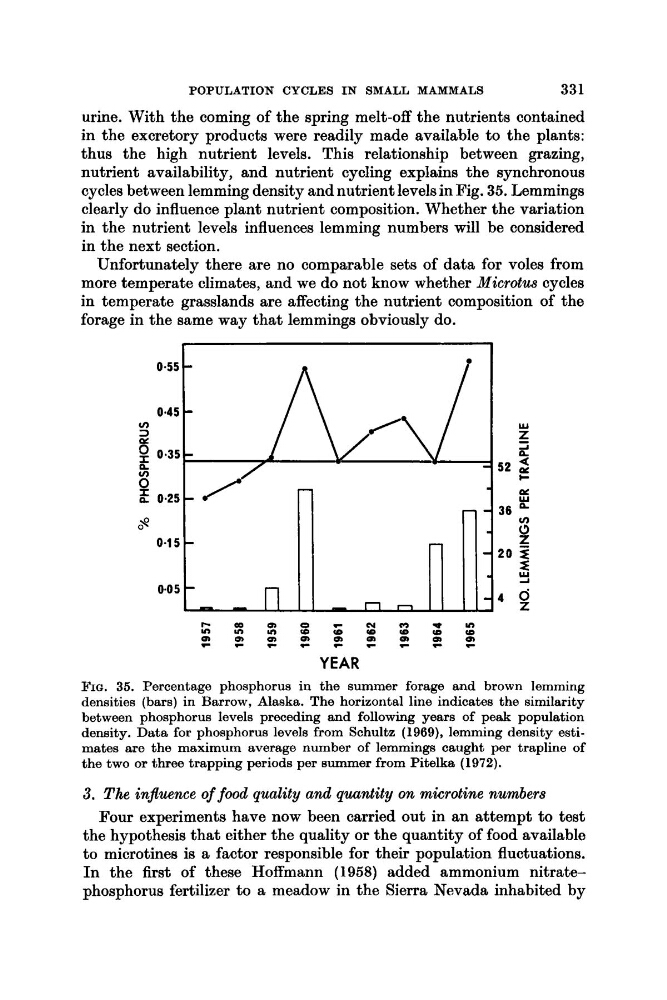
thus the high nutrient levels. This relationship between grazing,
nutrient availability, and nutrient cycling explains the synchronous
cycles between lemming density and nutrient levels in Fig. 35. Lemmings
clearly do influence plant nutrient composition. Whether the variation
in the nutrient levels influences lemming numbers will be considered
in the next section.
Unfortunately there are no comparable sets of data for voles from
more temperate climates, and we do not know whether Microtus cycles
in temperate grasslands are affecting the nutrient composition of the
forage in the same way that lemmings obviously do.
YEAR
FIG. 35. Percentage phosphorus in the summer forage and brown lemming
densities (bars) in Barrow, Alaska. The horizontal line indicates the similarity
between phosphorus levels preceding and following years of peak population
density. Data for phosphorus levels from Schultz (1969), lemming density estimates are the maximum average number of lemmings caught per trapline of
the two or three trapping periods per summer from Pitelka (1972).
3. The injluence of food quality and quantity on microtine numbers
Four experiments have now been carried out in an attempt to test
the hypothesis that either the quality or the quantity of food available
to microtines is a factor responsible for their population fluctuations.
In the first of these Hoffmann (1958) added ammonium nitratephosphorus fertilizer to a meadow in the Sierra Nevada inhabited by
331
urine. With the coming of the spring melt-off the nutrients contained
in the excretory products were readily made available to the plants:
thus the high nutrient levels. This relationship between grazing,
nutrient availability, and nutrient cycling explains the synchronous
cycles between lemming density and nutrient levels in Fig. 35. Lemmings
clearly do influence plant nutrient composition. Whether the variation
in the nutrient levels influences lemming numbers will be considered
in the next section.
Unfortunately there are no comparable sets of data for voles from
more temperate climates, and we do not know whether Microtus cycles
in temperate grasslands are affecting the nutrient composition of the
forage in the same way that lemmings obviously do.
YEAR
FIG. 35. Percentage phosphorus in the summer forage and brown lemming
densities (bars) in Barrow, Alaska. The horizontal line indicates the similarity
between phosphorus levels preceding and following years of peak population
density. Data for phosphorus levels from Schultz (1969), lemming density estimates are the maximum average number of lemmings caught per trapline of
the two or three trapping periods per summer from Pitelka (1972).
3. The injluence of food quality and quantity on microtine numbers
Four experiments have now been carried out in an attempt to test
the hypothesis that either the quality or the quantity of food available
to microtines is a factor responsible for their population fluctuations.
In the first of these Hoffmann (1958) added ammonium nitratephosphorus fertilizer to a meadow in the Sierra Nevada inhabited by