

330
CHARLES J. KREBS AND JUDITH H. MYERS
10
20
30
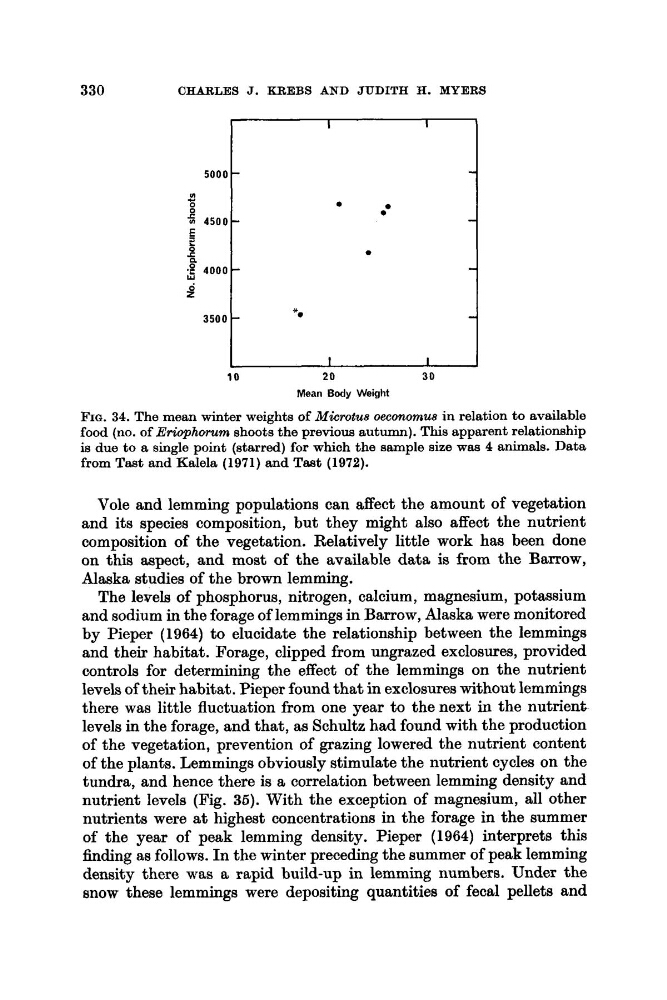
Mean Body Weight
FIQ. 34. The mean winter weights of Mkrotu8 oeconomu8 in relation to available
food (no. of Eriophorum shoots the previous autumn). This apparent relationship
is due to a single point (starred) for which the sample size was 4 animals. Data
from Tast and Kalela (1971) and Tast (1972).
Vole and lemming populations can affect the amount of vegetation
and its species composition, but they might also affect the nutrient
composition of the vegetation. Relatively little work has been done
on this aspect, and most of the available data is from the Barrow,
Alaska studies of the brown lemming.
The levels of phosphorus, nitrogen, calcium, magnesium, potassium
and sodium in the forage of lemmings in Barrow, Alaska were monitored
by Pieper (1964) to elucidate the relationship between the lemmings
and their habitat. Forage, clipped from ungrazed exclosures, provided
controls for determining the effect of the lemmings on the nutrient
levels of their habitat. Pieper found that in exclosures without lemmings
there was little fluctuation from one year to the next in the nutrient.
levels in the forage, and that, as Schultz had found with the production
of the vegetation, prevention of grazing lowered the nutrient content
of the plants. Lemmings obviously stimulate the nutrient cycles on the
tundra, and hence there is a correlation between lemming density and
nutrient levels (Fig. 36). With the exception of magnesium, all other
nutrients were at highest concentrations in the forage in the summer
of the year of peak lemming density. Pieper (1964) interprets this
h d i n g as follows. In the winter preceding the summer of peak lemming
density there was a rapid build-up in lemming numbers. Under the
snow these lemmings were depositing quantities of fecal pellets and
CHARLES J. KREBS AND JUDITH H. MYERS
10
20
30
Mean Body Weight
FIQ. 34. The mean winter weights of Mkrotu8 oeconomu8 in relation to available
food (no. of Eriophorum shoots the previous autumn). This apparent relationship
is due to a single point (starred) for which the sample size was 4 animals. Data
from Tast and Kalela (1971) and Tast (1972).
Vole and lemming populations can affect the amount of vegetation
and its species composition, but they might also affect the nutrient
composition of the vegetation. Relatively little work has been done
on this aspect, and most of the available data is from the Barrow,
Alaska studies of the brown lemming.
The levels of phosphorus, nitrogen, calcium, magnesium, potassium
and sodium in the forage of lemmings in Barrow, Alaska were monitored
by Pieper (1964) to elucidate the relationship between the lemmings
and their habitat. Forage, clipped from ungrazed exclosures, provided
controls for determining the effect of the lemmings on the nutrient
levels of their habitat. Pieper found that in exclosures without lemmings
there was little fluctuation from one year to the next in the nutrient.
levels in the forage, and that, as Schultz had found with the production
of the vegetation, prevention of grazing lowered the nutrient content
of the plants. Lemmings obviously stimulate the nutrient cycles on the
tundra, and hence there is a correlation between lemming density and
nutrient levels (Fig. 36). With the exception of magnesium, all other
nutrients were at highest concentrations in the forage in the summer
of the year of peak lemming density. Pieper (1964) interprets this
h d i n g as follows. In the winter preceding the summer of peak lemming
density there was a rapid build-up in lemming numbers. Under the
snow these lemmings were depositing quantities of fecal pellets and