

318
CHARLES J. KREBS AND JUDITH H. MYERS
Differences in body weight have not been the only criterion by
which one could recognize rodents from peak populations. Zimmermann
(1955) found that mandible lengths in Microtus arwalis changed over
the population cycle in the same way that body weight changed.
Krebs (1964b) investigated the relationships between body size and
skull size in brown and varying lemming populations from northern
Canada. Lemmings were larger in peak populations, when measured
by body weight, body length, or skull dimensions. But surprisingly
the relationships between skull and body measurements changed
systematically in relation to population density. Lemmings of a given
160 -
E
E
f 140D
c
0)
_I
0 120P
c
100 -
I8O 1
LEMMUS Males
8 0 1 , ,
I
,
I
,
1
I
,
,
,
I
I
,
22
24
26
28
30
32
34
Condylobosal Length , mm
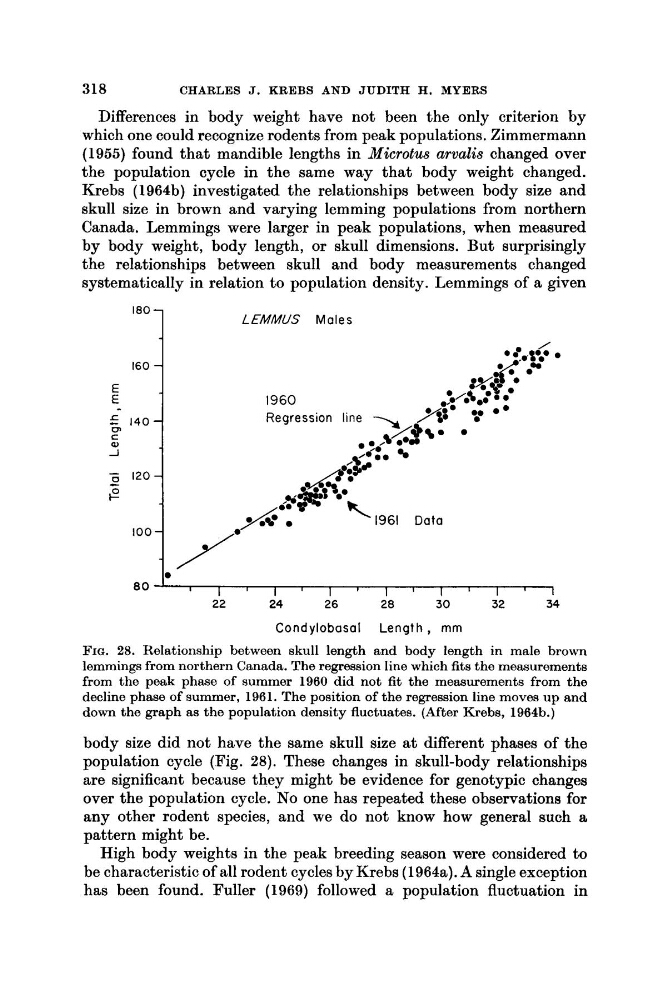
FIG. 28. Relationship between skull length and body length in male brown
lemmings from northern Canada. The regression line which fits the measurements
from the peak phase of summer 1960 did not fit the measurements from the
decline phase of summer, 1961. The position of the regression line moves up and
down the graph as the population density fluctuates. (After Krebs, 1964b.)
body size did not have the same skull size at different phases of the
population cycle (Fig. 28). These changes in skull-body relationships
are significant because they might be evidence for genotypic changes
over the population cycle. No one has repeated these observations for
any other rodent species, and we do not know how general such a
pattern might be.
High body weights in the peak breeding season were considered to
be characteristic of all rodent cycles by Krebs (1964a). A single exception
has been found. Fuller (1969) followed a population fluctuation in
CHARLES J. KREBS AND JUDITH H. MYERS
Differences in body weight have not been the only criterion by
which one could recognize rodents from peak populations. Zimmermann
(1955) found that mandible lengths in Microtus arwalis changed over
the population cycle in the same way that body weight changed.
Krebs (1964b) investigated the relationships between body size and
skull size in brown and varying lemming populations from northern
Canada. Lemmings were larger in peak populations, when measured
by body weight, body length, or skull dimensions. But surprisingly
the relationships between skull and body measurements changed
systematically in relation to population density. Lemmings of a given
160 -
E
E
f 140D
c
0)
_I
0 120P
c
100 -
I8O 1
LEMMUS Males
8 0 1 , ,
I
,
I
,
1
I
,
,
,
I
I
,
22
24
26
28
30
32
34
Condylobosal Length , mm
FIG. 28. Relationship between skull length and body length in male brown
lemmings from northern Canada. The regression line which fits the measurements
from the peak phase of summer 1960 did not fit the measurements from the
decline phase of summer, 1961. The position of the regression line moves up and
down the graph as the population density fluctuates. (After Krebs, 1964b.)
body size did not have the same skull size at different phases of the
population cycle (Fig. 28). These changes in skull-body relationships
are significant because they might be evidence for genotypic changes
over the population cycle. No one has repeated these observations for
any other rodent species, and we do not know how general such a
pattern might be.
High body weights in the peak breeding season were considered to
be characteristic of all rodent cycles by Krebs (1964a). A single exception
has been found. Fuller (1969) followed a population fluctuation in