

POPULATION CYCLES IN SMALL MAMMALS
315
size since it is a measure of skeletal development, while weight is a
measure of robustness and a relatively poor measure of size. Weight
is easy to determine for live animals in the field and it is also easily
standardized among different observers. Length, by contrast, is more
difficult to measure on live animals and almost impossible to standardize among observers (Jewel1 and Fullagar, 1966). The ideal study
would consist of one observer measuring weights and lengths on all
individuals, but in most cases only weight data are collected.
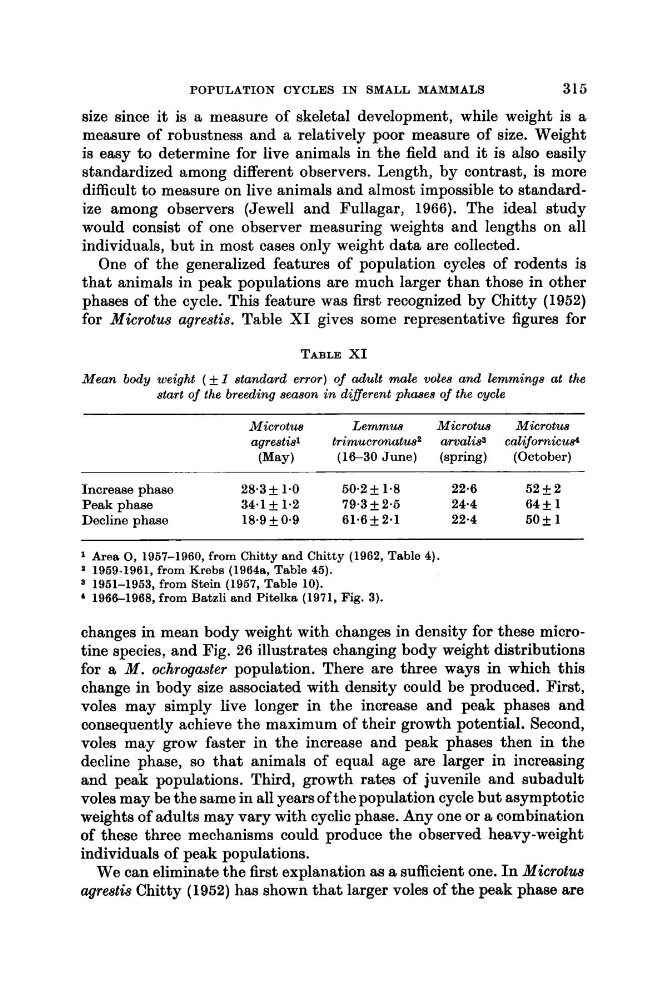
One of the generalized features of population cycles of rodents is
that animals in peak populations are much larger than those in other
phases of the cycle. This feature was first recognized by Chitty (1952)
for Microtus agrestis. Table XI gives some representative figures for
TABLE X I
Mean body weight ( f 1 standard error) of adult m l e volea and lemminga at the
atart of the breeding season in different phaeea of the cycle
Microtua
Lemmw
Microtw
Microtw
agreetial
trimucronatua2 arvaliaa calqoornicu+
(May)
(1&30 June)
(spring)
(October)
Increase phase
28.3 f 1.0
50-2 f 1.8
22-6
5 2 + 2
Peak phase
34-1 f 1.2
79.3 f 2.5
24.4
6 4 k 1
Decline phase
18.9 f 0.9
6 1 . 6 k 2.1
22-4
60+ 1
1 Area 0, 1957-1960, from Chitty and Chitty (1962, Table 4).
* 1959-1961, from Krebs (1964a, Table 45).
1951-1953, from Stain (1957, Table 10).
4 1966-1968, from Batzli and Pitalka (1971, Fig. 3).
changes in mean body weight with changes in density for these microtine species, and Fig. 26 illustrates changing body weight distributions
for a M . ochrogmter population. There are three ways in which this
change in body size associated with density could be produced. First,
voles may simply live longer in the increase and peak phases and
consequently achieve the maximum of their growth potential. Second,
voles may grow faster in the increase and peak phases then in the
decline phase, so that animals of equal age are larger in increasing
and peak populations. Third, growth rates of juvenile and subadult
voles may be the same in all years of the population cycle but asymptotic
weights of adults may vary with cyclic phase. Any one or a combination
of these three mechanisms could produce the observed heavy-weight
individuals of peak populations.
We can eliminate the first explanation as a sufficient one. I n Microtzls
agrestis Chitty (1952) has shown that larger voles of the peak phase are
315
size since it is a measure of skeletal development, while weight is a
measure of robustness and a relatively poor measure of size. Weight
is easy to determine for live animals in the field and it is also easily
standardized among different observers. Length, by contrast, is more
difficult to measure on live animals and almost impossible to standardize among observers (Jewel1 and Fullagar, 1966). The ideal study
would consist of one observer measuring weights and lengths on all
individuals, but in most cases only weight data are collected.
One of the generalized features of population cycles of rodents is
that animals in peak populations are much larger than those in other
phases of the cycle. This feature was first recognized by Chitty (1952)
for Microtus agrestis. Table XI gives some representative figures for
TABLE X I
Mean body weight ( f 1 standard error) of adult m l e volea and lemminga at the
atart of the breeding season in different phaeea of the cycle
Microtua
Lemmw
Microtw
Microtw
agreetial
trimucronatua2 arvaliaa calqoornicu+
(May)
(1&30 June)
(spring)
(October)
Increase phase
28.3 f 1.0
50-2 f 1.8
22-6
5 2 + 2
Peak phase
34-1 f 1.2
79.3 f 2.5
24.4
6 4 k 1
Decline phase
18.9 f 0.9
6 1 . 6 k 2.1
22-4
60+ 1
1 Area 0, 1957-1960, from Chitty and Chitty (1962, Table 4).
* 1959-1961, from Krebs (1964a, Table 45).
1951-1953, from Stain (1957, Table 10).
4 1966-1968, from Batzli and Pitalka (1971, Fig. 3).
changes in mean body weight with changes in density for these microtine species, and Fig. 26 illustrates changing body weight distributions
for a M . ochrogmter population. There are three ways in which this
change in body size associated with density could be produced. First,
voles may simply live longer in the increase and peak phases and
consequently achieve the maximum of their growth potential. Second,
voles may grow faster in the increase and peak phases then in the
decline phase, so that animals of equal age are larger in increasing
and peak populations. Third, growth rates of juvenile and subadult
voles may be the same in all years of the population cycle but asymptotic
weights of adults may vary with cyclic phase. Any one or a combination
of these three mechanisms could produce the observed heavy-weight
individuals of peak populations.
We can eliminate the first explanation as a sufficient one. I n Microtzls
agrestis Chitty (1952) has shown that larger voles of the peak phase are