

POPULATION CYCLES IN SMALL MAMMALS
279
must describe them in detail. A t what season does the increase begin?
How jong is the peak phase? When does the decline begin and how
rapid is it? We now attempt to answer some of these questions.
1. Increase phase
The increase phase is defined as a period of large increase in numbers
from one spring to the next (Chitty and Chitty, 1962). There are two
views on the structure of the increase phase. The increme phase might
be a gradual, exponential build-up from low numbers over two or even
three years. Koshkina (1966) suggests that the number of Clethrionomys
M M J S N ~ M M J S N J M M J S N ~ M M J S N
- - - \
/
1933
1934
1935
1936
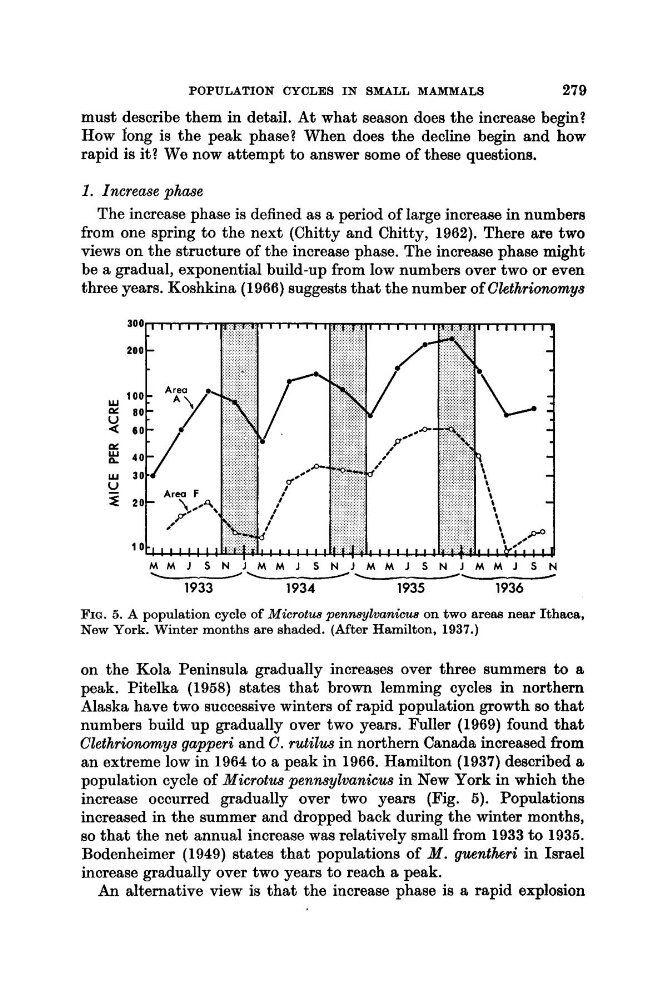
FIG. 5. A population cycle of Microtw, penmylvankua on two areas near Ithaca,
New York. Winter months are shaded. (After Hamilton, 1937.)
on the Kola Peninsula gradually increases over three summers to a
peak. Pitelka (1958) states that brown lemming cycles in northern
Alaska have two successive winters of rapid population growth so that
numbers build up gradually over two years. Fuller (1969) found that
Clethrionomys gapperi and C . rutilus in northern Canada increased from
an extreme low in 1964 to a peak in 1966. Hamilton (1937) described a
population cycle of Microtus pennsylvanicus in New York in which the
increase occurred gradually over two years (Fig. 5). Populations
increased in the summer and dropped back during the winter months,
so that the net annual increase was relatively small from 1933 to 1935.
Bodenheimer (1949) states that populations of H. guentheri in Israel
increase gradually over two years to reach a peak.
An alternative view is that the increase phase is a rapid explosion
279
must describe them in detail. A t what season does the increase begin?
How jong is the peak phase? When does the decline begin and how
rapid is it? We now attempt to answer some of these questions.
1. Increase phase
The increase phase is defined as a period of large increase in numbers
from one spring to the next (Chitty and Chitty, 1962). There are two
views on the structure of the increase phase. The increme phase might
be a gradual, exponential build-up from low numbers over two or even
three years. Koshkina (1966) suggests that the number of Clethrionomys
M M J S N ~ M M J S N J M M J S N ~ M M J S N
- - - \
/
1933
1934
1935
1936
FIG. 5. A population cycle of Microtw, penmylvankua on two areas near Ithaca,
New York. Winter months are shaded. (After Hamilton, 1937.)
on the Kola Peninsula gradually increases over three summers to a
peak. Pitelka (1958) states that brown lemming cycles in northern
Alaska have two successive winters of rapid population growth so that
numbers build up gradually over two years. Fuller (1969) found that
Clethrionomys gapperi and C . rutilus in northern Canada increased from
an extreme low in 1964 to a peak in 1966. Hamilton (1937) described a
population cycle of Microtus pennsylvanicus in New York in which the
increase occurred gradually over two years (Fig. 5). Populations
increased in the summer and dropped back during the winter months,
so that the net annual increase was relatively small from 1933 to 1935.
Bodenheimer (1949) states that populations of H. guentheri in Israel
increase gradually over two years to reach a peak.
An alternative view is that the increase phase is a rapid explosion