

266
WILLIAM STREIFER
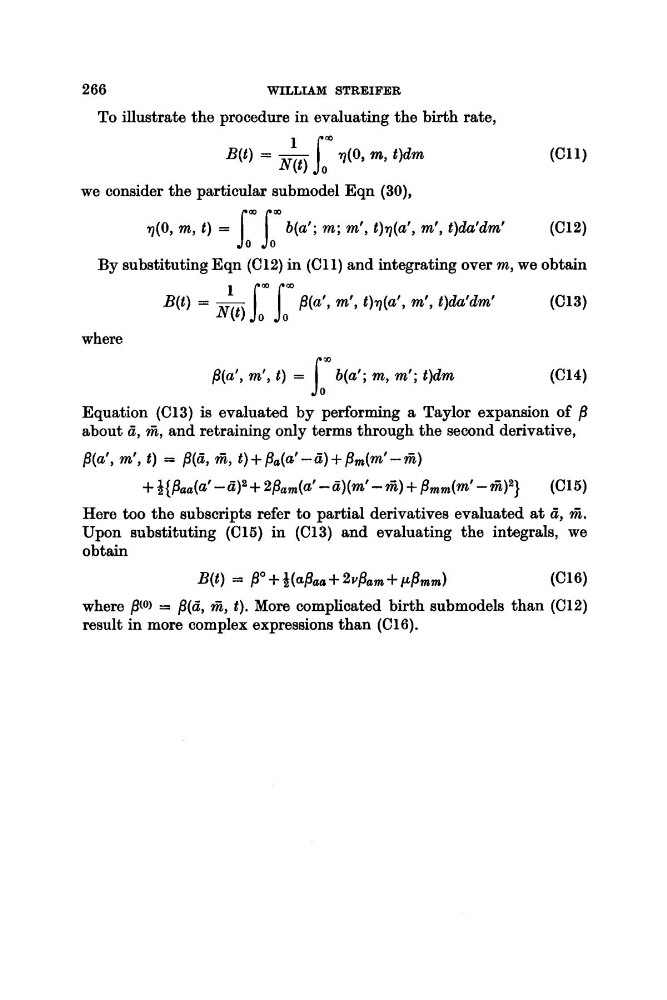
To illustrate the procedure in evaluating the birth rate,
we consider the particular submodel Eqn (30),
q(0, m, t ) = JOm JOm b(a’; m; m’, t)q(a‘, m‘, t)da‘dm’
B(t) = N(t) Jo Jo
JO*
( C W
By substituting Eqn (Cl2) in ( C l l ) and integrating over m, we obtain
p ( d , m’, t)q(u’, m’, t)da’dm’
((313)
1
m
m
where
,B(a‘, m’, t ) =
b(a’; m, m’; t)dm
((314)
Equation (C13) is evaluated by performing a Taylor expansion of p
about 6, rii, and retraining only terms through the second derivative,
/3(af, m’, t ) = p(G, 6, t)+/3a(B’-G)+/3m(m‘-rii)
++(paB,,(u’-G)2+ 2pam(u’-G)(m‘-rii) + ~ m m ( m ‘ - r i i ) 2 } ((215)
Here too the subscripts refer to partial derivatives evaluated at G, rii.
Upon substituting (C15) in (C13) and evaluating the integrals, we
obtain
= B” + +(.Pas,, + 2vpam + PBmm)
(C16)
where 8‘0) = /3(G, 6, t). More complicated birth submodels than (C12)
result in more complex expressions than (Cl6).
WILLIAM STREIFER
To illustrate the procedure in evaluating the birth rate,
we consider the particular submodel Eqn (30),
q(0, m, t ) = JOm JOm b(a’; m; m’, t)q(a‘, m‘, t)da‘dm’
B(t) = N(t) Jo Jo
JO*
( C W
By substituting Eqn (Cl2) in ( C l l ) and integrating over m, we obtain
p ( d , m’, t)q(u’, m’, t)da’dm’
((313)
1
m
m
where
,B(a‘, m’, t ) =
b(a’; m, m’; t)dm
((314)
Equation (C13) is evaluated by performing a Taylor expansion of p
about 6, rii, and retraining only terms through the second derivative,
/3(af, m’, t ) = p(G, 6, t)+/3a(B’-G)+/3m(m‘-rii)
++(paB,,(u’-G)2+ 2pam(u’-G)(m‘-rii) + ~ m m ( m ‘ - r i i ) 2 } ((215)
Here too the subscripts refer to partial derivatives evaluated at G, rii.
Upon substituting (C15) in (C13) and evaluating the integrals, we
obtain
= B” + +(.Pas,, + 2vpam + PBmm)
(C16)
where 8‘0) = /3(G, 6, t). More complicated birth submodels than (C12)
result in more complex expressions than (Cl6).