

REALISTIC MODELS IN POPULATION ECOLOGY
265
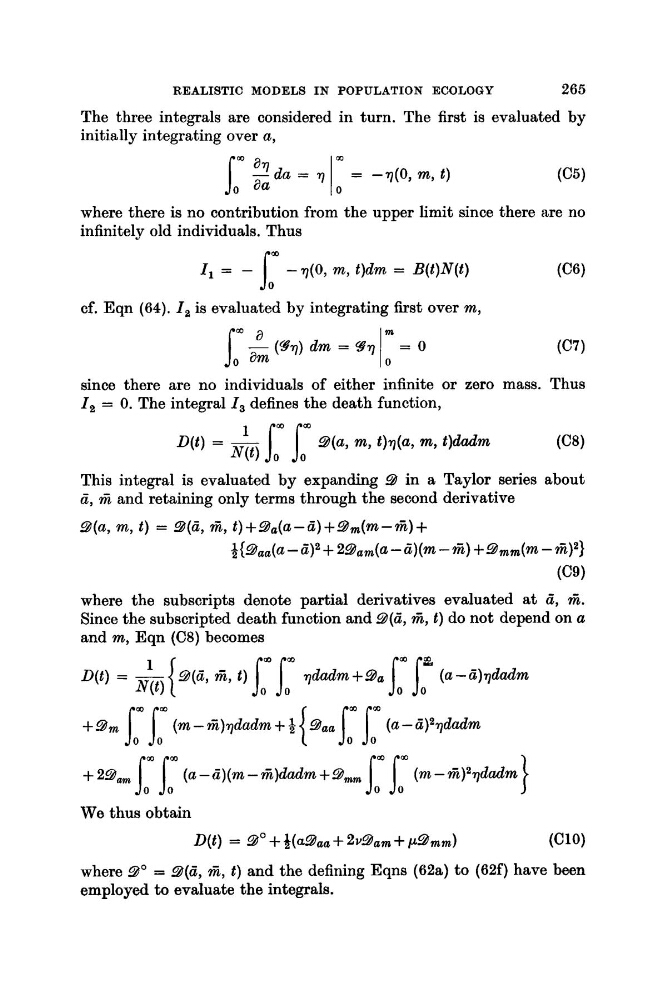
The three integrals are considered in turn. The first is evaluated by
initially integrating over a ,
where there is no contribution from the upper limit since there are no
infinitely old individuals. Thus
I , = - JOm - q ( O , m, t)dm = B(t)N(t)
(C6)
cf. Eqn (64). I, is evaluated by integrating first over m,
since there are no individuals of either infinite or zero mass. Thus
I, = 0. The integral I, defines the death function,
(C8)
1
*
m
D(t) = N(t) Jo Jo a a , m, t)q(a, t)&m
This integral is evaluated by expanding 9 in a Taylor series about
6, f i and retaining only terms through the second derivative
9 ( a , m, t ) = a(& f i , t ) + g a ( a - d ) + g m ( m - f i ) +
+ { g a a ( a - 6)' + 2 9 a m ( a - d ) ( m - f i ) +9mm(m - fi)2}
((39)
where the subscripts denote partial derivatives evaluated at d, fi.
Since the subscripted death function and 9(6, 6, t ) do not depend on a
and m, Eqn (C8) becomes
~ ( t )
= 1 {9(ti, f i , t ) JOm J0" q ~ m
+ 9 a lom J': (a-ci)vddm
"
+ g m J om Jom (m - fi)qdadm + 4 { g a a JOm lom (a - + p ~ m
I
+ 29,, JOm JOm (a - 6 ) ( m -fi)dadm +gmm JOm Jorn (m - fi)2qda&m
We thus obtain
D(t) = 9' + S(a9aa + 2 Q a m + @mm)
( C W
where 9' = 9(6, 6, t ) and the defining Eqns (62a) to (62f) have been
employed to evaluate the integrals.
265
The three integrals are considered in turn. The first is evaluated by
initially integrating over a ,
where there is no contribution from the upper limit since there are no
infinitely old individuals. Thus
I , = - JOm - q ( O , m, t)dm = B(t)N(t)
(C6)
cf. Eqn (64). I, is evaluated by integrating first over m,
since there are no individuals of either infinite or zero mass. Thus
I, = 0. The integral I, defines the death function,
(C8)
1
*
m
D(t) = N(t) Jo Jo a a , m, t)q(a, t)&m
This integral is evaluated by expanding 9 in a Taylor series about
6, f i and retaining only terms through the second derivative
9 ( a , m, t ) = a(& f i , t ) + g a ( a - d ) + g m ( m - f i ) +
+ { g a a ( a - 6)' + 2 9 a m ( a - d ) ( m - f i ) +9mm(m - fi)2}
((39)
where the subscripts denote partial derivatives evaluated at d, fi.
Since the subscripted death function and 9(6, 6, t ) do not depend on a
and m, Eqn (C8) becomes
~ ( t )
= 1 {9(ti, f i , t ) JOm J0" q ~ m
+ 9 a lom J': (a-ci)vddm
"
+ g m J om Jom (m - fi)qdadm + 4 { g a a JOm lom (a - + p ~ m
I
+ 29,, JOm JOm (a - 6 ) ( m -fi)dadm +gmm JOm Jorn (m - fi)2qda&m
We thus obtain
D(t) = 9' + S(a9aa + 2 Q a m + @mm)
( C W
where 9' = 9(6, 6, t ) and the defining Eqns (62a) to (62f) have been
employed to evaluate the integrals.