

204
WILLIAM STREIFER
These equations represent a competition situation if r,, r, > 0 and
k,, k, < 0; they represent predator-prey interactions if rl < 0, k, > 0,
r2 > 0 and k, < 0. Here N , is the predator population. A generalization of
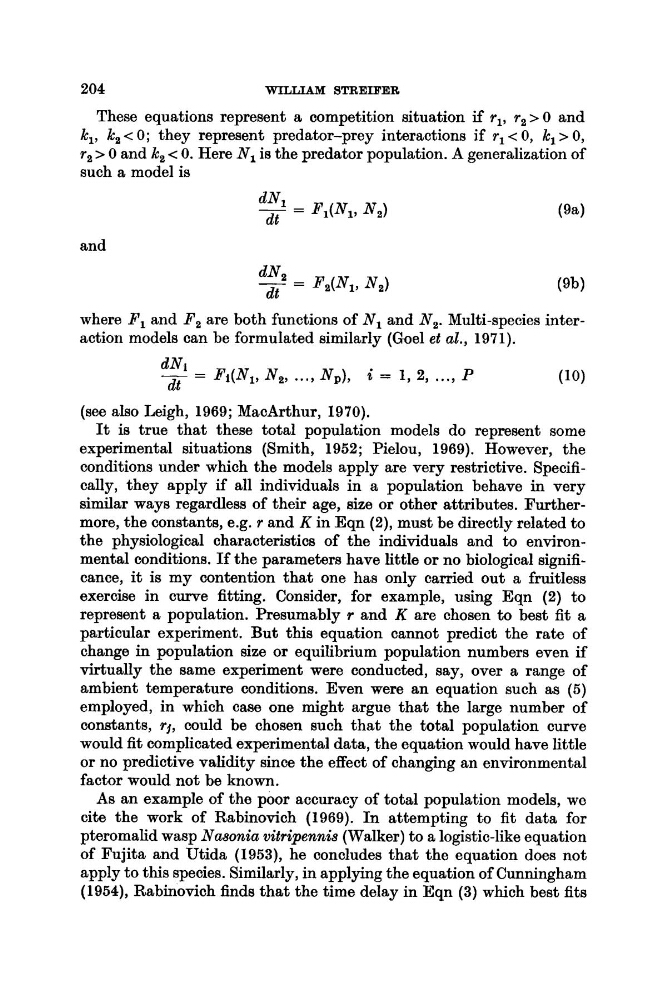
such a model is
and
where F, and F, are both functions of N , and N,. Multi-species interaction models can be formulated similarly (Goel et al., 1971).
(see also Leigh, 1969; MacArthur, 1970).
It is true that these total population models do represent some
experimental situations (Smith, 1952; Pielou, 1969). However, the
conditions under which the models apply are very restrictive. Specifically, they apply if all individuals in a population behave in very
similar ways regardless of their age, size or other attributes. Furthermore, the constants, e.g. r and K in Eqn (2), must be directly related to
the physiological characteristics of the individuals and to environmental conditions. If the parameters have little or no biological significance, it is my contention that one has only carried out a fruitless
exercise in curve fitting. Consider, for example, using Eqn (2) to
represent a population. Presumably r and K are chosen to best fit a
particular experiment. But this equation cannot predict the rate of
change in population size or equilibrium population numbers even if
virtually the same experiment were conducted, say, over a range of
ambient temperature conditions. Even were an equation such as (5)
employed, in which case one might argue that the large number of
constants, rj, could be chosen such that the total population curve
would fit complicated experimental data, the equation would have little
or no predictive validity since the effect of changing an environmental
factor would not be known.
As an example of the poor accuracy of total population models, we
cite the work of Rabinovich (1969). In attempting to fit data for
pteromalid wasp Nasonia vitripennis (Walker) to a logistic-like equation
of Fujita and Utida (1953), he concludes that the equation does not
apply to this species. Similarly, in applying the equation of Cunningham
(1954), Rabinovich finds that the time delay in Eqn (3) which best fits
WILLIAM STREIFER
These equations represent a competition situation if r,, r, > 0 and
k,, k, < 0; they represent predator-prey interactions if rl < 0, k, > 0,
r2 > 0 and k, < 0. Here N , is the predator population. A generalization of
such a model is
and
where F, and F, are both functions of N , and N,. Multi-species interaction models can be formulated similarly (Goel et al., 1971).
(see also Leigh, 1969; MacArthur, 1970).
It is true that these total population models do represent some
experimental situations (Smith, 1952; Pielou, 1969). However, the
conditions under which the models apply are very restrictive. Specifically, they apply if all individuals in a population behave in very
similar ways regardless of their age, size or other attributes. Furthermore, the constants, e.g. r and K in Eqn (2), must be directly related to
the physiological characteristics of the individuals and to environmental conditions. If the parameters have little or no biological significance, it is my contention that one has only carried out a fruitless
exercise in curve fitting. Consider, for example, using Eqn (2) to
represent a population. Presumably r and K are chosen to best fit a
particular experiment. But this equation cannot predict the rate of
change in population size or equilibrium population numbers even if
virtually the same experiment were conducted, say, over a range of
ambient temperature conditions. Even were an equation such as (5)
employed, in which case one might argue that the large number of
constants, rj, could be chosen such that the total population curve
would fit complicated experimental data, the equation would have little
or no predictive validity since the effect of changing an environmental
factor would not be known.
As an example of the poor accuracy of total population models, we
cite the work of Rabinovich (1969). In attempting to fit data for
pteromalid wasp Nasonia vitripennis (Walker) to a logistic-like equation
of Fujita and Utida (1953), he concludes that the equation does not
apply to this species. Similarly, in applying the equation of Cunningham
(1954), Rabinovich finds that the time delay in Eqn (3) which best fits