

REALISTIC MODELS IN POPULATION ECOLOGY
203
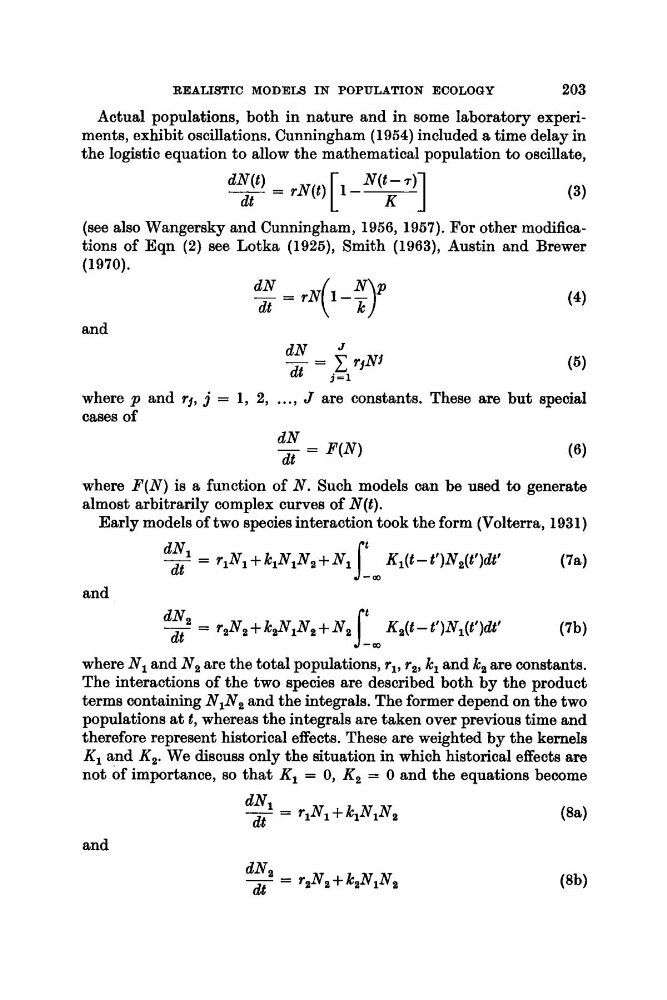
Actual populations, both in nature and in some laboratory experiments, exhibit oscillations. Cunningham (1954) included a time delay in
the logistic equation to allow the mathematical population to oscillate,
(see also Wangersky and Cunningham, 1956, 1967). For other modifications of Eqn (2) see Lotka (1926), Smith (1963), Austin and Brewer
(1970).
and
where p and q, j = 1, 2, ..., J are constants. These are but special
cases of
where P(N) is a function of N. Such models can be used to generate
almost arbitrarily complex curves of N(t).
Early models of two species interaction took the form (Volterra, 1931)
t
( 7 4
dN1
dt = r,N, + k,N,N, + N , J-, K,(t - t')N,(t')dt'
and
t
(7b)
d N ,
- = r J , + k,N,N, + N, I-, K,(t - t')N,(t')dt'
where N , and N , are the total populations, r,, r,, k, and k, are constants.
The interactions of the two species are described both by the product
terms containing N1N2 and the integrals. The former depend on the two
populations at t, whereas the integrals are taken over previous time and
therefore represent historical effects. These are weighted by the kernels
K , and K,. We discuss only the situation in which historical effects are
not of importance, so that K , = 0, K , = 0 and the equations become
- =
aN1 r,N, + klN,N,
at
and
- -
aN2 - r,N,+k,N,N,
at
203
Actual populations, both in nature and in some laboratory experiments, exhibit oscillations. Cunningham (1954) included a time delay in
the logistic equation to allow the mathematical population to oscillate,
(see also Wangersky and Cunningham, 1956, 1967). For other modifications of Eqn (2) see Lotka (1926), Smith (1963), Austin and Brewer
(1970).
and
where p and q, j = 1, 2, ..., J are constants. These are but special
cases of
where P(N) is a function of N. Such models can be used to generate
almost arbitrarily complex curves of N(t).
Early models of two species interaction took the form (Volterra, 1931)
t
( 7 4
dN1
dt = r,N, + k,N,N, + N , J-, K,(t - t')N,(t')dt'
and
t
(7b)
d N ,
- = r J , + k,N,N, + N, I-, K,(t - t')N,(t')dt'
where N , and N , are the total populations, r,, r,, k, and k, are constants.
The interactions of the two species are described both by the product
terms containing N1N2 and the integrals. The former depend on the two
populations at t, whereas the integrals are taken over previous time and
therefore represent historical effects. These are weighted by the kernels
K , and K,. We discuss only the situation in which historical effects are
not of importance, so that K , = 0, K , = 0 and the equations become
- =
aN1 r,N, + klN,N,
at
and
- -
aN2 - r,N,+k,N,N,
at