

STUDIES ON THE CEREdL ECOSYSTEM
169
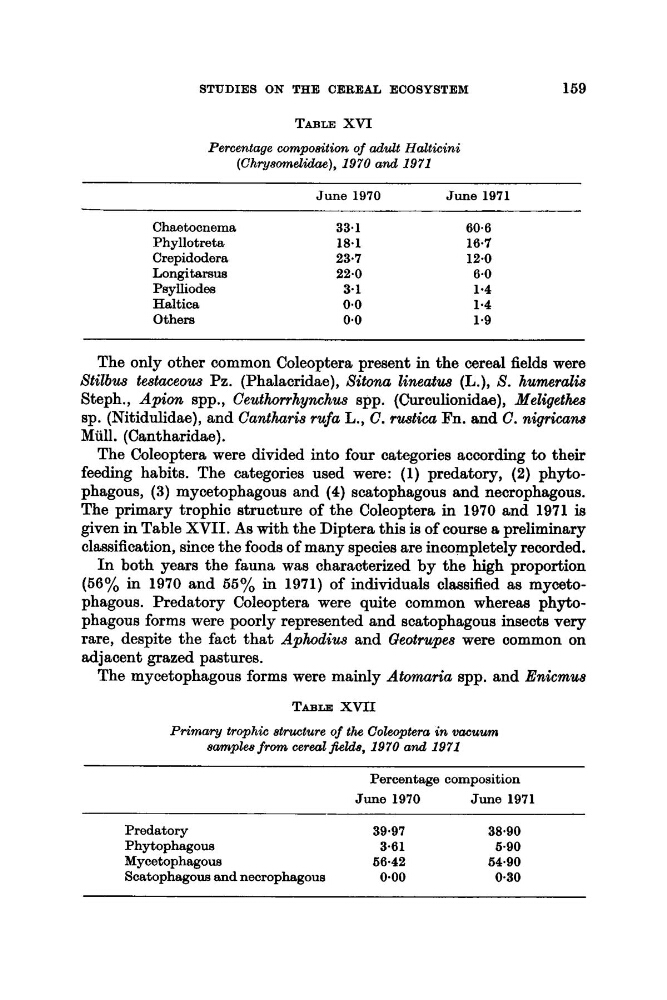
TABLE XVI
Percentage compoeition of adult Halticini
(Chrysomelidae), 1970 and 1971
June 1970
Chaetocnema
Phyllotrete
Crepidodera
Longi tarsus
Psylliodes
Hdtica
Others
33.1
18.1
23.7
22.0
3- 1
0.0
0.0
June 1971
60.6
16.7
12.0
6.0
1.4
1-4
1 -9
The only other common Coleoptera present in the cereal fields were
Stilbus testaceow Pz. (Phalacridae), Sitona lineatus (L.), S . humeralis
Steph., Apion spp., Ceuthorrhynchm spp. (Curculionidae), Meligetha
sp. (Nitidulidae), and Cantharis rufa L., C . rustica Fn. and C. nigricans
Mull. (Cantharidae).
The Coleoptera were divided into four categories according to their
feeding habits. The categories used were: (1) predatory, (2) phytophagous, (3) mycetophagous and (4) scatophagous and necrophagous.
The primary trophic structure of the Coleoptera in 1970 and 1971 is
given in Table XVII. As with the Diptera this is of course a preliminary
classification, since the foods of many species are incompletely recorded.
In both years the fauna was characterized by the high proportion
(66% in 1970 and 55% in 1971) of individuals classified as mycetophagous. Predatory Coleoptera were quite common whereas phytophagous forms were poorly represented and scatophagous insects very
rare, despite the fact that Aphodius and Qeotrupes were common on
adjacent grazed pastures.
The mycetophagous forms were mainly Atomaria spp. and Enicmue
TABLE XVII
Primary trophic structure of the Cokoptera in vacuum
sampk.9 f r m cereal $el&, 1970 and 1971
Percentage composition
June 1970
June 1971
Predatory
39-97
38.90
Phytophagoue
3.61
6.90
Mycetophagous
66.42
64.90
Scatophagous and necrophagous
0.00
0.30
169
TABLE XVI
Percentage compoeition of adult Halticini
(Chrysomelidae), 1970 and 1971
June 1970
Chaetocnema
Phyllotrete
Crepidodera
Longi tarsus
Psylliodes
Hdtica
Others
33.1
18.1
23.7
22.0
3- 1
0.0
0.0
June 1971
60.6
16.7
12.0
6.0
1.4
1-4
1 -9
The only other common Coleoptera present in the cereal fields were
Stilbus testaceow Pz. (Phalacridae), Sitona lineatus (L.), S . humeralis
Steph., Apion spp., Ceuthorrhynchm spp. (Curculionidae), Meligetha
sp. (Nitidulidae), and Cantharis rufa L., C . rustica Fn. and C. nigricans
Mull. (Cantharidae).
The Coleoptera were divided into four categories according to their
feeding habits. The categories used were: (1) predatory, (2) phytophagous, (3) mycetophagous and (4) scatophagous and necrophagous.
The primary trophic structure of the Coleoptera in 1970 and 1971 is
given in Table XVII. As with the Diptera this is of course a preliminary
classification, since the foods of many species are incompletely recorded.
In both years the fauna was characterized by the high proportion
(66% in 1970 and 55% in 1971) of individuals classified as mycetophagous. Predatory Coleoptera were quite common whereas phytophagous forms were poorly represented and scatophagous insects very
rare, despite the fact that Aphodius and Qeotrupes were common on
adjacent grazed pastures.
The mycetophagous forms were mainly Atomaria spp. and Enicmue
TABLE XVII
Primary trophic structure of the Cokoptera in vacuum
sampk.9 f r m cereal $el&, 1970 and 1971
Percentage composition
June 1970
June 1971
Predatory
39-97
38.90
Phytophagoue
3.61
6.90
Mycetophagous
66.42
64.90
Scatophagous and necrophagous
0.00
0.30