

158
Q. R. POTTS AND a. P. VICPERMAN
linearis Steph. and A . Jimetarii Hbst. Atomaria atricapilla was the
commonest species. Atomaria linearis and A . rujkornis have been
recorded from spring oat crops (Jones, 1965).
The Lathridiidae consisted chiefly of three species, Stephostethw
lardariw (Deg.), Enicmus transversus (01.) and Lathridius bifasciatus
Reith. Of these, Lathridius bifasciatus was dominant in 1970 whilst
E . transversus predominated in 197 1.
Although the Carabidae did not account for a large proportion of the
Coleoptera in either 1970 or 1971, the family was represented by quite a
large number of species. Of these the commonest were Risophilus
atricapillus (L.), Bembidion lampros (Hbst.) and B . obtwum Ser. Other
species occasionally common were Trechw pdristriatw (Schrank. ),
Agonum dorsale (Pont.) and Amara aenea (De G.).
TABLE XV
Percentage composition of adult Coccinellidae, 1970 and 1971
June 1970
June 1971
Rhizobiw, litura (F.)
17.3
T h a 22-p~n~tata (L.)
6.2
Propylea 14-punctata (L.)
66-9
Tytt-h
16-punctata (L.)
13.8
Coccinellia 7-punctata L.
3.4
CocoineUa 11-pmtata L.
3.4
Coccidh rufa (Herbst)
0- 0
3.1
3.1
26.0
59.6
3.1
3.1
3.1
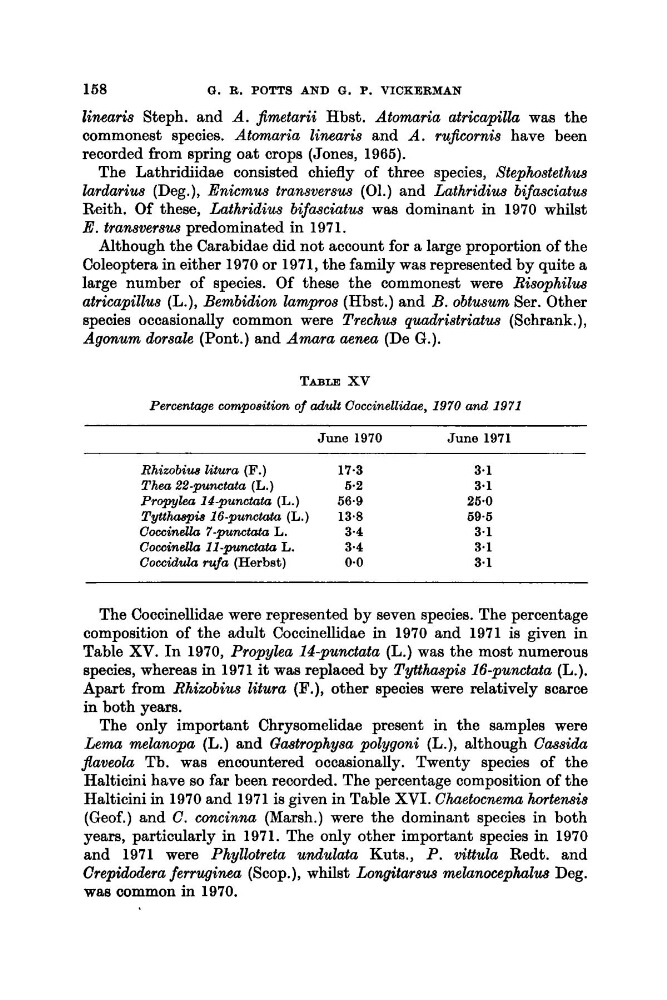
The Coccinellidae were represented by seven species. The percentage
composition of the adult Coccinellidae in 1970 and 1971 is given in
Table XV. In 1970, Propylea 14-punctata (L.) was the most numerous
species, whereas in 1971 it was replaced by Tytthmpis 16-punctata (L.).
Apart from Rhizobiw litura (F.), other species were relatively scarce
in both years.
The only important Chrysomelidae present in the samples were
Lema melanopa (L.) and Gastrophysa polygoni (L.), although Cmsida
jiaveola Tb. was encountered occasionally. Twenty species of the
Halticini have so far been recorded. The percentage composition of the
Halticini in 1970 and 1971 is given in Table XVI. Chaetocnema hortensis
(Geof.) and C . concinna (Marsh.) were the dominant species in both
years, particularly in 1971. The only other important species in 1970
and 1971 were Phyllotreta undulata Kuts., P . vittula Redt. and
Crepidodera ferruginea (Scop.), whilst Longitursw melanocephalw Deg.
was common in 1970.
Q. R. POTTS AND a. P. VICPERMAN
linearis Steph. and A . Jimetarii Hbst. Atomaria atricapilla was the
commonest species. Atomaria linearis and A . rujkornis have been
recorded from spring oat crops (Jones, 1965).
The Lathridiidae consisted chiefly of three species, Stephostethw
lardariw (Deg.), Enicmus transversus (01.) and Lathridius bifasciatus
Reith. Of these, Lathridius bifasciatus was dominant in 1970 whilst
E . transversus predominated in 197 1.
Although the Carabidae did not account for a large proportion of the
Coleoptera in either 1970 or 1971, the family was represented by quite a
large number of species. Of these the commonest were Risophilus
atricapillus (L.), Bembidion lampros (Hbst.) and B . obtwum Ser. Other
species occasionally common were Trechw pdristriatw (Schrank. ),
Agonum dorsale (Pont.) and Amara aenea (De G.).
TABLE XV
Percentage composition of adult Coccinellidae, 1970 and 1971
June 1970
June 1971
Rhizobiw, litura (F.)
17.3
T h a 22-p~n~tata (L.)
6.2
Propylea 14-punctata (L.)
66-9
Tytt-h
16-punctata (L.)
13.8
Coccinellia 7-punctata L.
3.4
CocoineUa 11-pmtata L.
3.4
Coccidh rufa (Herbst)
0- 0
3.1
3.1
26.0
59.6
3.1
3.1
3.1
The Coccinellidae were represented by seven species. The percentage
composition of the adult Coccinellidae in 1970 and 1971 is given in
Table XV. In 1970, Propylea 14-punctata (L.) was the most numerous
species, whereas in 1971 it was replaced by Tytthmpis 16-punctata (L.).
Apart from Rhizobiw litura (F.), other species were relatively scarce
in both years.
The only important Chrysomelidae present in the samples were
Lema melanopa (L.) and Gastrophysa polygoni (L.), although Cmsida
jiaveola Tb. was encountered occasionally. Twenty species of the
Halticini have so far been recorded. The percentage composition of the
Halticini in 1970 and 1971 is given in Table XVI. Chaetocnema hortensis
(Geof.) and C . concinna (Marsh.) were the dominant species in both
years, particularly in 1971. The only other important species in 1970
and 1971 were Phyllotreta undulata Kuts., P . vittula Redt. and
Crepidodera ferruginea (Scop.), whilst Longitursw melanocephalw Deg.
was common in 1970.