

152
a. R. POTTS AND a. P. VICKERMAN
Parasitica were found on members of the Umbelliferae by Allen (1954).
However, we have not been able to demonstrate any simple correlation
between the abundance of weeds and the distribution of hymenopterous parasites.
3. Sawjies
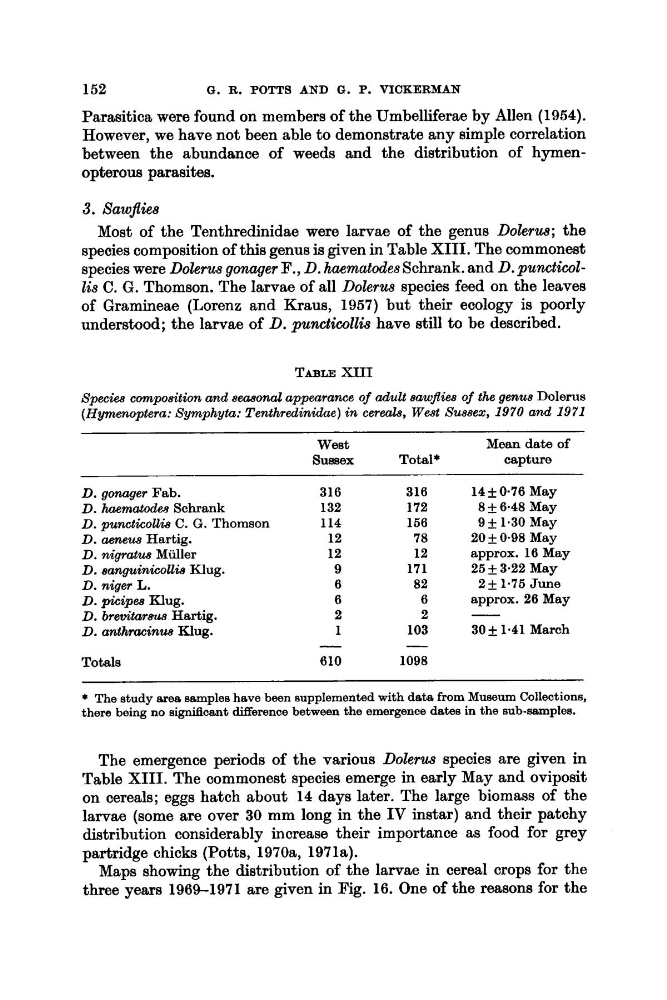
Most of the Tenthredinidae were larvae of the genus Dolerus; the
species composition of this genus is given in Table XIII. The commonest
species were Dolerus golzager F., D . haematodes Schrank. and D . punctiwllis C . G . Thomson. The larvae of all Dolerus species feed on the leaves
of Gramineae (Lorenz and Kraus, 1957) but their ecology is poorly
understood; the larvae of D . puncticollis have still to be described.
TABLE XIII
Species composition and aeaaonal appearance of adult eawflies of the genua Dolerus
(Hymenoptera: Symphytcc: Tenthredinidae) in cereak, West Sussex, 1970 and 1971
West
Sussex
Total*
D. gonuger Fab.
D. haernatoder, Schrank
D. puncticollis C. G . Thomson
D . amem Hartig.
D . nigratua Miiller
D. sanguinicollis Klug.
D. niger L.
D. picipea Klug.
D. brewitar8ua Hartig.
D. anthracinm Klug.
Totals
316
316
132
172
114
156
12
78
12
12
9
171
6
82
6
6
2
2
1
103
610
1098
-
-
Mean date of
capture
14 k 0.76 May
8 k 6.48 May
9 & 1.30 May
20 k 0-98 May
approx. 16 May
26 k 3.22 May
2 k 1-75 June
approx. 26 May
30 k 1.41 March
* The study me8 s8mples have been supplemented with d8t8 from Museum Collections,
there being no significant difference between the emergence dates in the sub-samples.
The emergence periods of the various Dolerus species are given in
Table XIII. The commonest species emerge in early May and oviposit
on cereals; eggs hatch about 14 days later. The large biomass of the
larvae (some are over 30 mm long in the I V instar) and their patchy
distribution considerably increase their importance as food for grey
partridge chicks (Potts, 1970a, 1971s).
Maps showing the distribution of the larvae in cereal crops for the
three years 1969-1971 are given in Fig. 16. One of the reasons for the
a. R. POTTS AND a. P. VICKERMAN
Parasitica were found on members of the Umbelliferae by Allen (1954).
However, we have not been able to demonstrate any simple correlation
between the abundance of weeds and the distribution of hymenopterous parasites.
3. Sawjies
Most of the Tenthredinidae were larvae of the genus Dolerus; the
species composition of this genus is given in Table XIII. The commonest
species were Dolerus golzager F., D . haematodes Schrank. and D . punctiwllis C . G . Thomson. The larvae of all Dolerus species feed on the leaves
of Gramineae (Lorenz and Kraus, 1957) but their ecology is poorly
understood; the larvae of D . puncticollis have still to be described.
TABLE XIII
Species composition and aeaaonal appearance of adult eawflies of the genua Dolerus
(Hymenoptera: Symphytcc: Tenthredinidae) in cereak, West Sussex, 1970 and 1971
West
Sussex
Total*
D. gonuger Fab.
D. haernatoder, Schrank
D. puncticollis C. G . Thomson
D . amem Hartig.
D . nigratua Miiller
D. sanguinicollis Klug.
D. niger L.
D. picipea Klug.
D. brewitar8ua Hartig.
D. anthracinm Klug.
Totals
316
316
132
172
114
156
12
78
12
12
9
171
6
82
6
6
2
2
1
103
610
1098
-
-
Mean date of
capture
14 k 0.76 May
8 k 6.48 May
9 & 1.30 May
20 k 0-98 May
approx. 16 May
26 k 3.22 May
2 k 1-75 June
approx. 26 May
30 k 1.41 March
* The study me8 s8mples have been supplemented with d8t8 from Museum Collections,
there being no significant difference between the emergence dates in the sub-samples.
The emergence periods of the various Dolerus species are given in
Table XIII. The commonest species emerge in early May and oviposit
on cereals; eggs hatch about 14 days later. The large biomass of the
larvae (some are over 30 mm long in the I V instar) and their patchy
distribution considerably increase their importance as food for grey
partridge chicks (Potts, 1970a, 1971s).
Maps showing the distribution of the larvae in cereal crops for the
three years 1969-1971 are given in Fig. 16. One of the reasons for the