

STUDIES ON THE CEREAL ECOSYSTEM
181
Mans Huntsman) on the study area, was 24.7%. The parasites concerned were mainly Chasmdon apterzcs Nees, Halticoptera circula
Graham and a few Rhoptromeris eucera Htg.
A number of the parasites (e.g. H . circula, R. eucera and Cyrtogaster
vulgaris Walk.) of 0. frit are not specific and develop in the immature
stages of other stem-borers and Drosophilidae (Simmonds, 1952).
According to Lundbeck (1916), Lonchopteridae were often heavily
parasitized; C. vulgaris was amongst the parasites recorded.
2 8
E
10 2.7N
-
. .
0
0
2 6 -
2 2 5 -
E
- -
-
3 2 4 -
3 -
CJl
2 3 -
- - v) : $ 2 2 -
2 1 -
E
$ 2 0 -
. . -
g 19J
7
.
: /
* *
Y o
0
.
.
;
.
.
.= .// 0
/o:**oo.
O m
0
a
.
.
r=+-063
P < O O O I
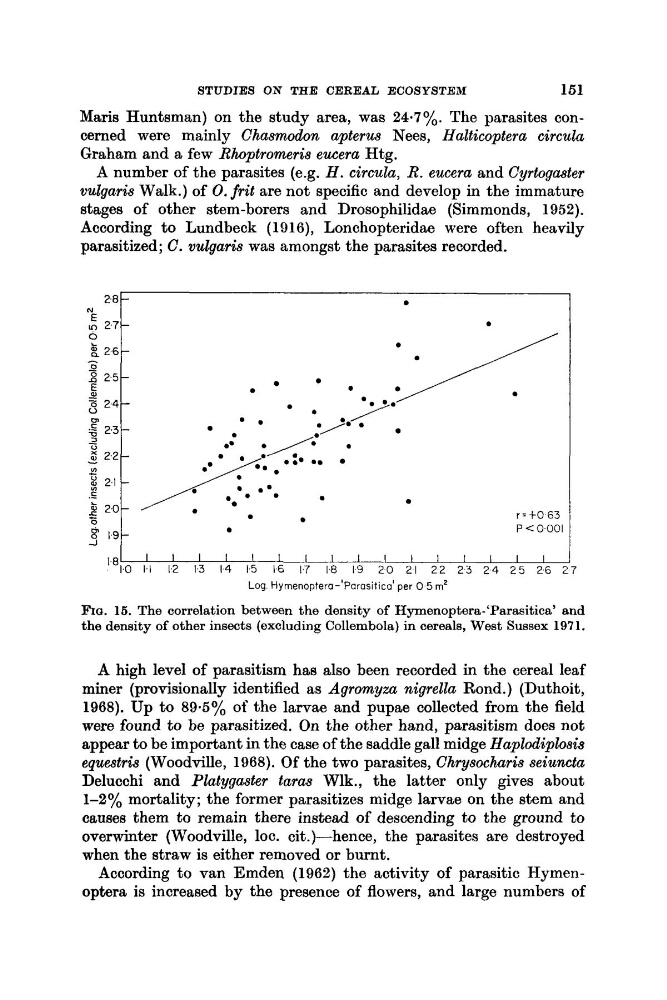
FIQ. 15. The correlation between the density of Hymenoptera-'Parasitica' and
the density of other insects (excluding Collembola) in cereals, West Sussex 1971.
A high level of parasitism has also been recorded in the cereal leaf
miner (provisionally identified as Agromyza nigrella Rond.) (Duthoit,
1968). Up to 89.5% of the larvae and pupae collected from the field
were found to be parasitized. On the other hand, parasitism does not
appear to be important in the case of the saddle gall midge Haplodiplosis
equestris (Woodville, 1968). Of the two parasites, Chrysocharis seiuncta
Delucchi and Platygmter Earas Wlk., the latter only gives about
1-2% mortality; the former parasitizes midge larvae on the stem and
causes them to remain there instead of descending to the ground to
overwinter (Woodville, loc. cit.)-hence, the parasites are destroyed
when the straw is either removed or burnt.
According to van Emden (1962) the activity of parasitic Hymenoptera is increased by the presence of flowers, and large numbers of
181
Mans Huntsman) on the study area, was 24.7%. The parasites concerned were mainly Chasmdon apterzcs Nees, Halticoptera circula
Graham and a few Rhoptromeris eucera Htg.
A number of the parasites (e.g. H . circula, R. eucera and Cyrtogaster
vulgaris Walk.) of 0. frit are not specific and develop in the immature
stages of other stem-borers and Drosophilidae (Simmonds, 1952).
According to Lundbeck (1916), Lonchopteridae were often heavily
parasitized; C. vulgaris was amongst the parasites recorded.
2 8
E
10 2.7N
-
. .
0
0
2 6 -
2 2 5 -
E
- -
-
3 2 4 -
3 -
CJl
2 3 -
- - v) : $ 2 2 -
2 1 -
E
$ 2 0 -
. . -
g 19J
7
.
: /
* *
Y o
0
.
.
;
.
.
.= .// 0
/o:**oo.
O m
0
a
.
.
r=+-063
P < O O O I
FIQ. 15. The correlation between the density of Hymenoptera-'Parasitica' and
the density of other insects (excluding Collembola) in cereals, West Sussex 1971.
A high level of parasitism has also been recorded in the cereal leaf
miner (provisionally identified as Agromyza nigrella Rond.) (Duthoit,
1968). Up to 89.5% of the larvae and pupae collected from the field
were found to be parasitized. On the other hand, parasitism does not
appear to be important in the case of the saddle gall midge Haplodiplosis
equestris (Woodville, 1968). Of the two parasites, Chrysocharis seiuncta
Delucchi and Platygmter Earas Wlk., the latter only gives about
1-2% mortality; the former parasitizes midge larvae on the stem and
causes them to remain there instead of descending to the ground to
overwinter (Woodville, loc. cit.)-hence, the parasites are destroyed
when the straw is either removed or burnt.
According to van Emden (1962) the activity of parasitic Hymenoptera is increased by the presence of flowers, and large numbers of