

STUDIES ON THE CEREAL ECOSYSTEM
149
occurred in July 1972 and are probably not unusual. Some samples
also contained Anwphothrips obscurus (Muller).
Bey Bienko (1961) recorded densities up t o 1600 thrips/m2 in wheat
in Kazakhstan and gave the average as 300/m2, almost entirely
Haplothrips tritici Kurd. Tanskiy (1961) considered that the increased
number of thrips on wheat compared to virgin Steppe was partly due
to reduced predator-pressure. On the virgin Steppe the ratio of thrips
to known thrip predators was 0.25 : 1, whereas in wheat crops the ratio
was 19.5 : 1.
Sharga (1933) discusses early records of damage to cereals by thrips
but their present economic importance in Britain is not known; the
effect on grain quality could be important. Several outbreaks of other
species occurred on beans and peas in the study area and these crops
had to be treated to avoid serious damage.
E. H Y M E N O P T E R A
1. Introduction
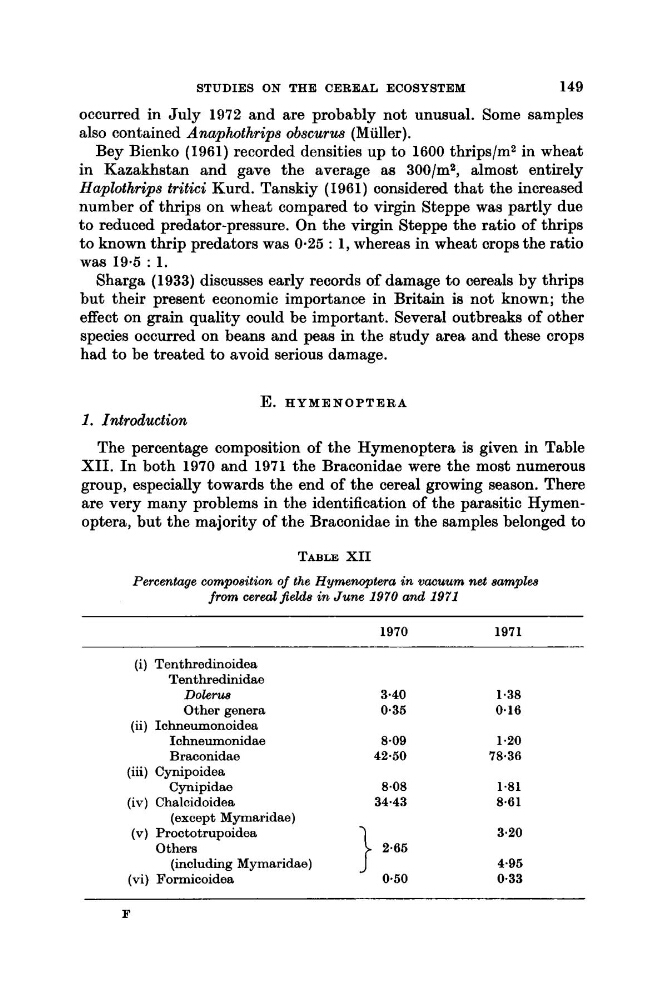
The percentage composition of the Hymenoptera is given in Table
XII. In both 1970 and 1971 the Braconidae were the most numerous
group, especially towards the end of the cereal growing season. There
are very many problems in the identification of the parasitic Hymenoptera, but the majority of the Braconidae in the samples belonged to
TABLE XI1
Percentage composition of the Hymenoptera in vacuum net samplea
from cereal fields in June 1970 and 1971
1970
1971
(i) Tenthredinoidea
Tenthredinidae
Dolerua
Other genera
Ichneumonidae
Braconidae
(iii) Cynipoidea
Cynipidae
(iv) Chalcidoidea
(except Mymaridae)
(v) Proctotrupoidea
(ii) Ichneumonoidea
Others
(including Mymaridae)
(vi) Formicoidea
3.40
0.35
8.09
42.50
8.08
34.43
1 2.65
J
0.50
1.38
0.16
1.20
78.36
1.81
8.61
3.20
4.95
0.33
F
149
occurred in July 1972 and are probably not unusual. Some samples
also contained Anwphothrips obscurus (Muller).
Bey Bienko (1961) recorded densities up t o 1600 thrips/m2 in wheat
in Kazakhstan and gave the average as 300/m2, almost entirely
Haplothrips tritici Kurd. Tanskiy (1961) considered that the increased
number of thrips on wheat compared to virgin Steppe was partly due
to reduced predator-pressure. On the virgin Steppe the ratio of thrips
to known thrip predators was 0.25 : 1, whereas in wheat crops the ratio
was 19.5 : 1.
Sharga (1933) discusses early records of damage to cereals by thrips
but their present economic importance in Britain is not known; the
effect on grain quality could be important. Several outbreaks of other
species occurred on beans and peas in the study area and these crops
had to be treated to avoid serious damage.
E. H Y M E N O P T E R A
1. Introduction
The percentage composition of the Hymenoptera is given in Table
XII. In both 1970 and 1971 the Braconidae were the most numerous
group, especially towards the end of the cereal growing season. There
are very many problems in the identification of the parasitic Hymenoptera, but the majority of the Braconidae in the samples belonged to
TABLE XI1
Percentage composition of the Hymenoptera in vacuum net samplea
from cereal fields in June 1970 and 1971
1970
1971
(i) Tenthredinoidea
Tenthredinidae
Dolerua
Other genera
Ichneumonidae
Braconidae
(iii) Cynipoidea
Cynipidae
(iv) Chalcidoidea
(except Mymaridae)
(v) Proctotrupoidea
(ii) Ichneumonoidea
Others
(including Mymaridae)
(vi) Formicoidea
3.40
0.35
8.09
42.50
8.08
34.43
1 2.65
J
0.50
1.38
0.16
1.20
78.36
1.81
8.61
3.20
4.95
0.33
F