

148
G. R. POTTS AND G . P. VICKERMAN
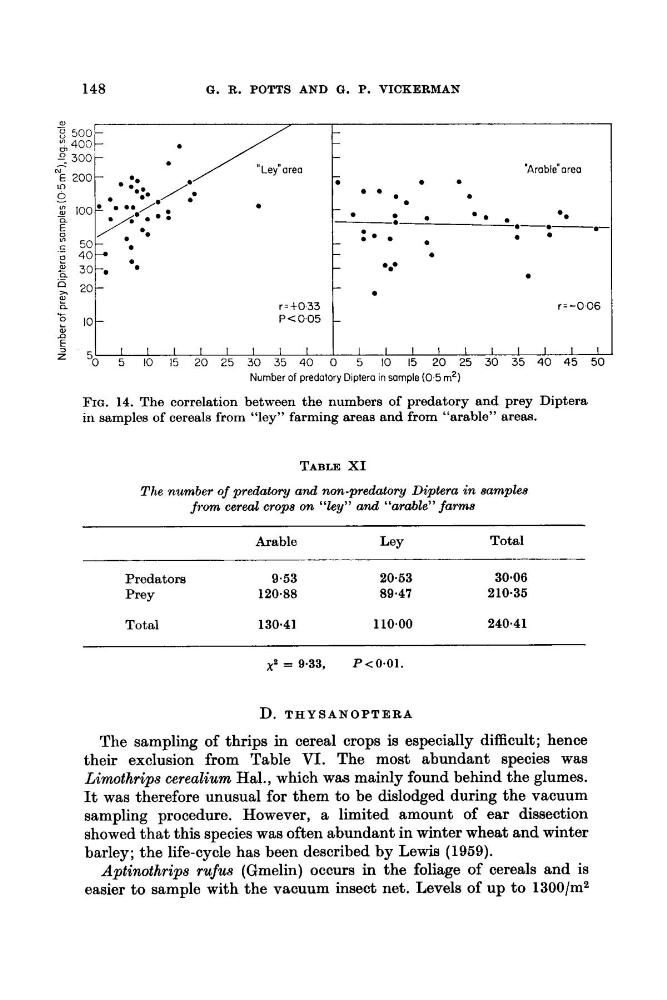
Number of predatory Diptero in sample (0.5 m2)
FIG. 14. The correlation between the numbers of predatory and prey Diptera
in samples of cereals from “ley” farming areas and from “arable” areas.
TABLE XI
The number of predatory and nowpredatory Diptera in aamplea
from cereal crops on “ley” and “arable” farma
Arable
Ley
Total
Predators
9.53
20.53
30-06
Prey
120.88
89.47
210.35
Total
130.41
110.00
240-41
X e = 9.33,
P < O . O l .
D. T H Y S A N O P T E R A
The sampling of thrips in cereal crops is especially difficult; hence
their exclusion from Table VI. The most abundant species was
Limothrips cerealium Hal., which was mainly found behind the glumes.
It was therefore unusual for them to be dislodged during the vacuum
sampling procedure. However, a limited amount of ear dissection
showed that this species was often abundant in winter wheat and winter
barley; the life-cycle has been described by Lewis (1959).
Aptinothrips rufm (Gmelin) occurs in the foliage of cereals and is
easier to sample with the vacuum insect net. Levels of up to 1300/m2
G. R. POTTS AND G . P. VICKERMAN
Number of predatory Diptero in sample (0.5 m2)
FIG. 14. The correlation between the numbers of predatory and prey Diptera
in samples of cereals from “ley” farming areas and from “arable” areas.
TABLE XI
The number of predatory and nowpredatory Diptera in aamplea
from cereal crops on “ley” and “arable” farma
Arable
Ley
Total
Predators
9.53
20.53
30-06
Prey
120.88
89.47
210.35
Total
130.41
110.00
240-41
X e = 9.33,
P < O . O l .
D. T H Y S A N O P T E R A
The sampling of thrips in cereal crops is especially difficult; hence
their exclusion from Table VI. The most abundant species was
Limothrips cerealium Hal., which was mainly found behind the glumes.
It was therefore unusual for them to be dislodged during the vacuum
sampling procedure. However, a limited amount of ear dissection
showed that this species was often abundant in winter wheat and winter
barley; the life-cycle has been described by Lewis (1959).
Aptinothrips rufm (Gmelin) occurs in the foliage of cereals and is
easier to sample with the vacuum insect net. Levels of up to 1300/m2