

STUDIES ON THE CEREAL ECOSYSTEM
125
stantaneous diversity of crops can sometimes approach that of the more
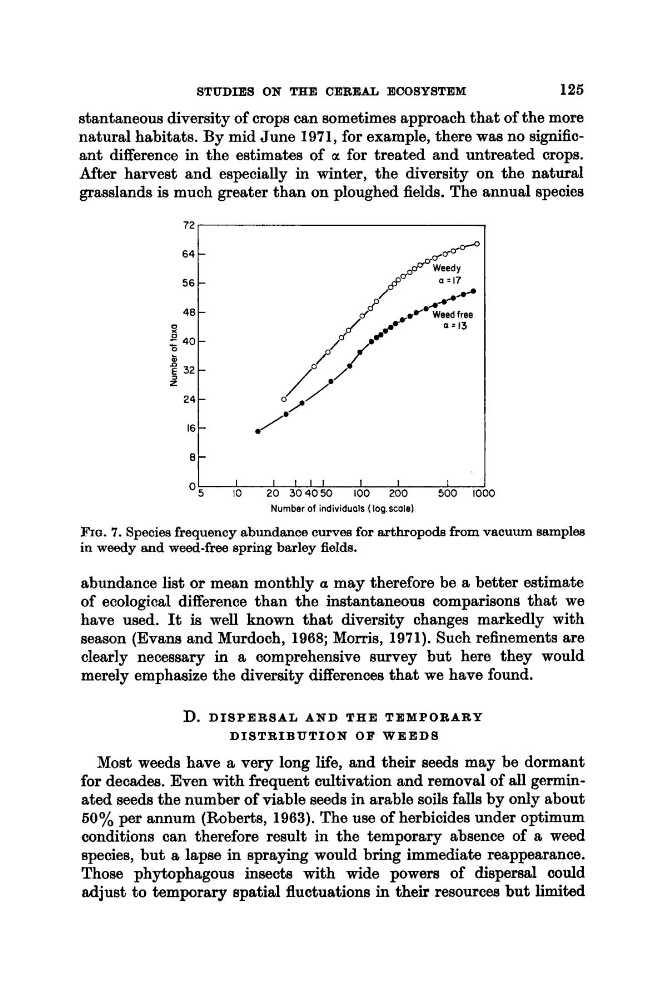
natural habitats. By mid June 1971, for example, there was no significant difference in the estimates of a for treated and untreated crops.
After harvest and especially in winter, the diversity on the natural
grasslands is much greater than on ploughed fields. The annual species
64 -
56
48
2 40&
g 32z
-
-
8
9
24 -
1 6 -
'
5
10
20 304050
100
200
500 IC
Number of individuals (log.scale)
)O
FIG. 7. Species frequency abundance curves for arthropods from vacuum samples
in weedy and weed-free spring barley fields.
abundance list or mean monthly a may therefore be a better estimate
of ecological difference than the instantaneous comparisons that we
have used. It is well known that diversity changes markedly with
season (Evans and Murdoch, 1968; Morris, 1971). Such refinements are
clearly necesmry in a comprehensive survey but here they would
merely emphasize the diversity Merences that we have found.
D. D I S P E R S A L A N D T H E TEMPORARY
D I S T R I B U T I O N O F W E E D S
Most weeds have a very long life, and their seeds may be dormant
for decades. Even with frequent cultivation and removal of all germinated seeds the number of viable seeds in arable soils falls by only about
50% per annum (Roberts, 1963). The use of herbicides under optimum
conditions can therefore result in the temporary absence of a weed
species, but a lapse in spraying would bring immediate reappearance.
Those phytophagous insects with wide powers of dispersal oould
adjust to temporary spatial fluctuations in their resources but limited
125
stantaneous diversity of crops can sometimes approach that of the more
natural habitats. By mid June 1971, for example, there was no significant difference in the estimates of a for treated and untreated crops.
After harvest and especially in winter, the diversity on the natural
grasslands is much greater than on ploughed fields. The annual species
64 -
56
48
2 40&
g 32z
-
-
8
9
24 -
1 6 -
'
5
10
20 304050
100
200
500 IC
Number of individuals (log.scale)
)O
FIG. 7. Species frequency abundance curves for arthropods from vacuum samples
in weedy and weed-free spring barley fields.
abundance list or mean monthly a may therefore be a better estimate
of ecological difference than the instantaneous comparisons that we
have used. It is well known that diversity changes markedly with
season (Evans and Murdoch, 1968; Morris, 1971). Such refinements are
clearly necesmry in a comprehensive survey but here they would
merely emphasize the diversity Merences that we have found.
D. D I S P E R S A L A N D T H E TEMPORARY
D I S T R I B U T I O N O F W E E D S
Most weeds have a very long life, and their seeds may be dormant
for decades. Even with frequent cultivation and removal of all germinated seeds the number of viable seeds in arable soils falls by only about
50% per annum (Roberts, 1963). The use of herbicides under optimum
conditions can therefore result in the temporary absence of a weed
species, but a lapse in spraying would bring immediate reappearance.
Those phytophagous insects with wide powers of dispersal oould
adjust to temporary spatial fluctuations in their resources but limited