

124
0. R. POTTS AND 0. P. VICKERMAN
I
I
I
I
I
l
l
5 10
50 100
500
2000
1000
4000
Number of, individuals (log.sCOle)
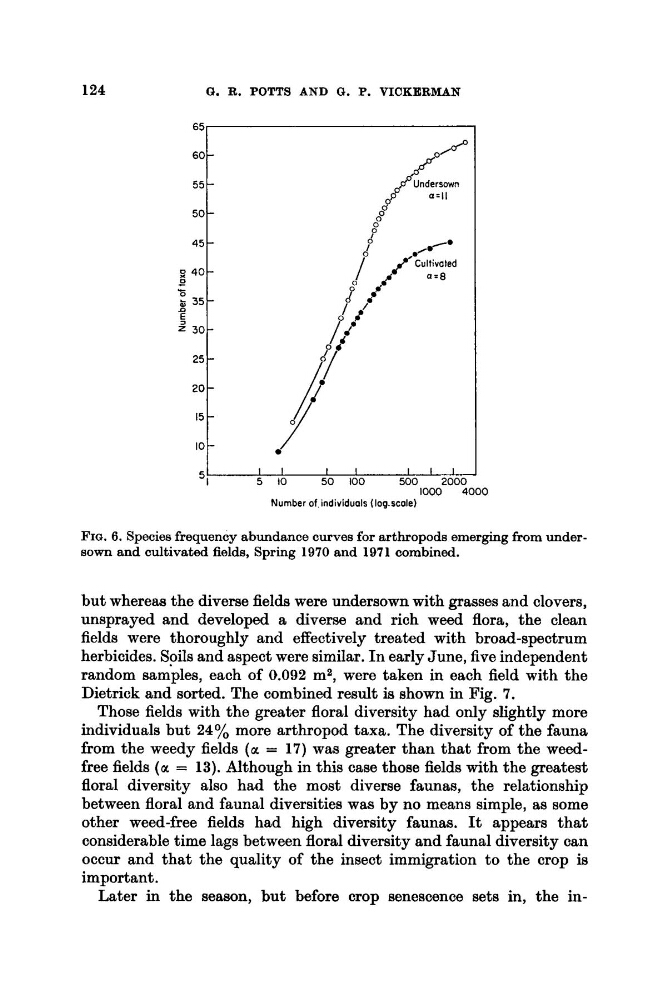
FIQ. 6. Species frequency abundance curves for arthropods emerging from undersown and cultivated fields, Spring 1970 and 1971 combined.
but whereas the diverse fields were undersown with grasses and clovers,
unsprayed and developed a diverse and rich weed flora, the clean
fields were thoroughly and effectively treated with broad-spectrum
herbicides. Soils and aspect were similar. In early June, five independent
random samples, each of 0.092 m2, were taken in each field with the
Dietrick and sorted. The combined result is shown in Fig. 7.
Those fields with the greater floral diversity had only slightly more
individuals but 24% more arthropod taxa. The diversity of the fauna
from the weedy fields (a = 17) was greater than that from the weedfree fields (a = 13). Although in this case those fields with the greatest
floral diversity also had the most diverse faunas, the relationship
between floral and faunal diversities was by no means simple, as some
other weed-free fields had high diversity faunas. It appears that
considerable time lags between floral diversity and faunal diversity can
occur and that the quality of the insect immigration to the crop is
important.
Later in the season, but before crop senescence sets in, the in-
0. R. POTTS AND 0. P. VICKERMAN
I
I
I
I
I
l
l
5 10
50 100
500
2000
1000
4000
Number of, individuals (log.sCOle)
FIQ. 6. Species frequency abundance curves for arthropods emerging from undersown and cultivated fields, Spring 1970 and 1971 combined.
but whereas the diverse fields were undersown with grasses and clovers,
unsprayed and developed a diverse and rich weed flora, the clean
fields were thoroughly and effectively treated with broad-spectrum
herbicides. Soils and aspect were similar. In early June, five independent
random samples, each of 0.092 m2, were taken in each field with the
Dietrick and sorted. The combined result is shown in Fig. 7.
Those fields with the greater floral diversity had only slightly more
individuals but 24% more arthropod taxa. The diversity of the fauna
from the weedy fields (a = 17) was greater than that from the weedfree fields (a = 13). Although in this case those fields with the greatest
floral diversity also had the most diverse faunas, the relationship
between floral and faunal diversities was by no means simple, as some
other weed-free fields had high diversity faunas. It appears that
considerable time lags between floral diversity and faunal diversity can
occur and that the quality of the insect immigration to the crop is
important.
Later in the season, but before crop senescence sets in, the in-