

112
Q. R. POTTS AND a. P. VICKERMAN
Variations on these themes are almost limitless. For example, two
successive wheats are often grown and in the ley system these often
follow zt root crop such as fodder rape. Winter oats can be used as an
arable break and the number of successive spring barleys can be
varied; in some areas spring barley has been grown continuously for
over ten years. A hybrid rotation is often found round the dairy farms
in which the grass may be direct drilled and where kale is grown for
the cattle.
There were 66 fields of grass or grass-legume mixtures in 1971,
and 21 were permanent. Of the remainder, the leys, 28 were established
with a cereal nurse crop ( = undersowing) and 16 were direct drilled,
i.e. without a nurse crop.
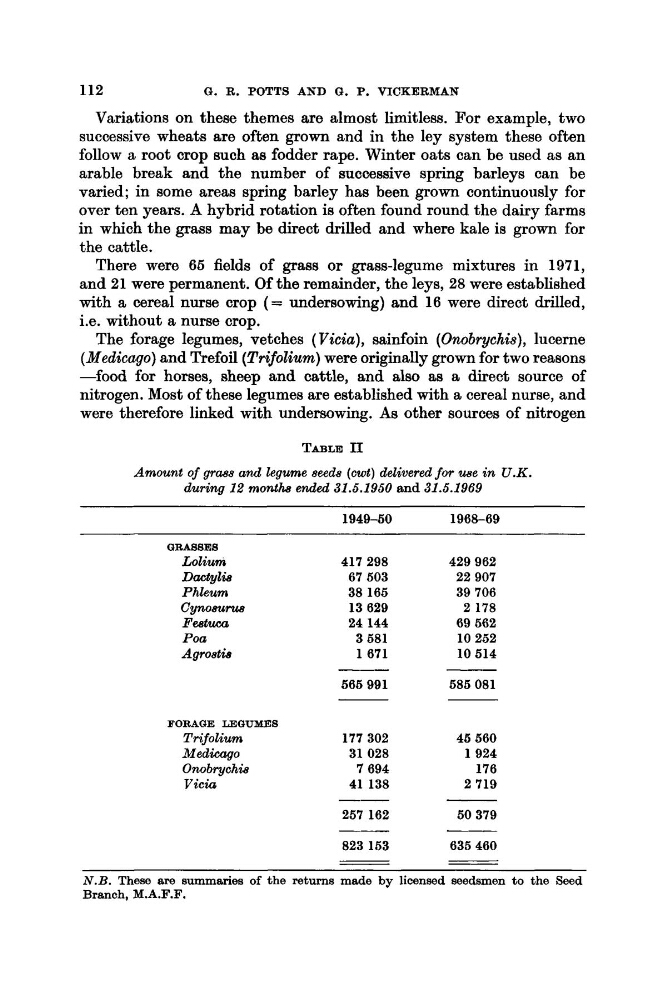
The forage legumes, vetches ( Vicia), sainfoin (Onobrychis), lucerne
(Medicago) and Trefoil (Trifolium) were originally grown for two reasons
-food for horses, sheep and cattle, and also as a direct source of
nitrogen. Most of these legumes are established with a cereal nurse, and
were therefore linked with undersowing. As other sources of nitrogen
T-LE 11
Amount of grass and legume seeds (cwt) delivered for me in U.K.
during 12 months ended 31.5.1950 and 31.5.1969
1949-60
1968-69
QRA8SES
Lolium
417 298
429 962
Dactylis
67 603
22 907
Phleum
38 166
39 706
cpoauru%
13 629
2 178
Featuco
24 144
69 562
Poa
3 681
10 262
Agroetie
1671
10 614
-566 991
685 081
FORAUE LEUUXES
Trifolium
Medioago
Onobrychis
Vicia
177 302
46 560
31 028
1924
7 694
176
41 138
2 719
267 162
60 379
-823 163
635 460
N . B . These 8 s ~
summaries of the returns made by licensed seedsmen to the Seed
Branch, M.A.F.F.
Q. R. POTTS AND a. P. VICKERMAN
Variations on these themes are almost limitless. For example, two
successive wheats are often grown and in the ley system these often
follow zt root crop such as fodder rape. Winter oats can be used as an
arable break and the number of successive spring barleys can be
varied; in some areas spring barley has been grown continuously for
over ten years. A hybrid rotation is often found round the dairy farms
in which the grass may be direct drilled and where kale is grown for
the cattle.
There were 66 fields of grass or grass-legume mixtures in 1971,
and 21 were permanent. Of the remainder, the leys, 28 were established
with a cereal nurse crop ( = undersowing) and 16 were direct drilled,
i.e. without a nurse crop.
The forage legumes, vetches ( Vicia), sainfoin (Onobrychis), lucerne
(Medicago) and Trefoil (Trifolium) were originally grown for two reasons
-food for horses, sheep and cattle, and also as a direct source of
nitrogen. Most of these legumes are established with a cereal nurse, and
were therefore linked with undersowing. As other sources of nitrogen
T-LE 11
Amount of grass and legume seeds (cwt) delivered for me in U.K.
during 12 months ended 31.5.1950 and 31.5.1969
1949-60
1968-69
QRA8SES
Lolium
417 298
429 962
Dactylis
67 603
22 907
Phleum
38 166
39 706
cpoauru%
13 629
2 178
Featuco
24 144
69 562
Poa
3 681
10 262
Agroetie
1671
10 614
-566 991
685 081
FORAUE LEUUXES
Trifolium
Medioago
Onobrychis
Vicia
177 302
46 560
31 028
1924
7 694
176
41 138
2 719
267 162
60 379
-823 163
635 460
N . B . These 8 s ~
summaries of the returns made by licensed seedsmen to the Seed
Branch, M.A.F.F.