

STUDIES ON THE CEREAL ECOSYSTEM
111
complex at first-for example continuous spring barley-but they a,lso
appeared to be less stable. New break-crops, such as oil-seed rape
and beans have now been introduced on some of the farms (Fig. 1).
Sheep, once the mainstay of the rural economy of the area, declined
from twelve to three flocks, the low point being 1969 or 1970; some
revival is now expected.
B. C R O P S
I n 1971 cereals were grown in 66% of the 262 fields in the West
Sussex study area; grasses account for a further 25%.
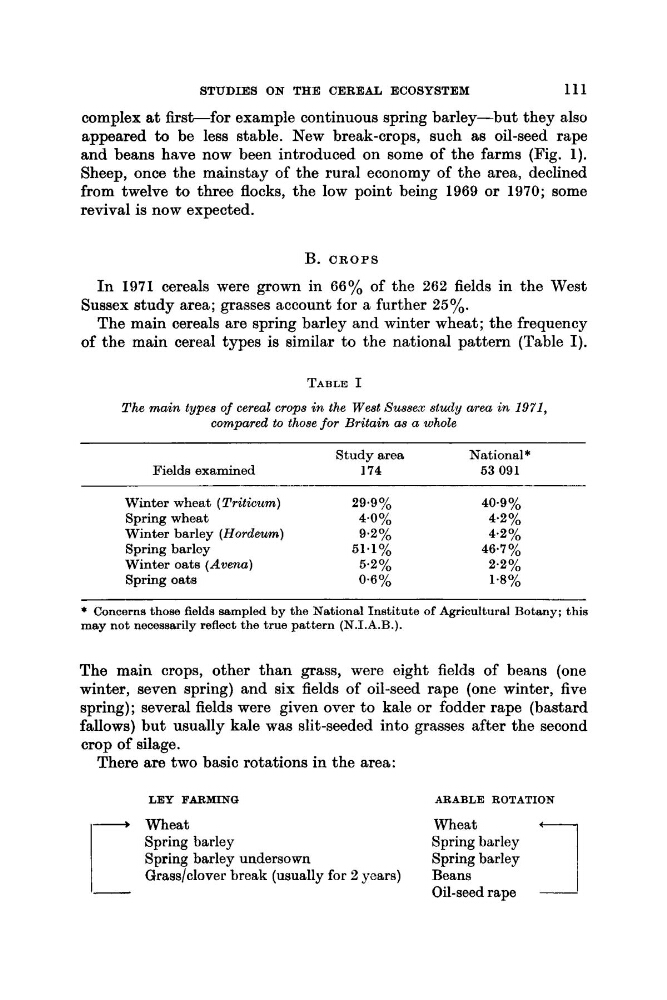
The main cereals are spring barley and winter wheat; the frequency
of the main cereal types is similar to the national pattern (Table I).
TABLE I
The main types of cereal crops in the West Sussea study area in 1971,
compared to those for Britain as a whole
Study area
Fields examined
174
National*
63 091
Winter wheat (Triticum)
29.9%
Spring wheat
4.0%
Winter barley (Hordeum)
9.2%
Spring barley
61.1%
Winter oats (Avena)
5.2 yo
Spring oats
0.6%
40-9 yo
4.2 yo
4.2 yo
46.7 yo
1.8%
2.2%
* Concerns those fields sampled by the National Institute of Agricultural Botany; this
may not necessarily reflect the true pattern (N.I.A.B.).
The main crops, other than grass, were eight fields of beans (one
winter, seven spring) and six fields of oil-seed rape (one winter, five
spring); several fields were given over to kale or fodder rape (bastard
fallows) but usually kale was slit-seeded into grasses after the second
crop of silage.
There are two basic rotations in the area:
LEY FARMING
ARABLE ROTATION
Wheat
Wheat
Spring barley
Spring barley
Spring barley undersown
Spring barley
Grass/clover break (usually for 2 years)
-
Oil-seed rape -
Beans
111
complex at first-for example continuous spring barley-but they a,lso
appeared to be less stable. New break-crops, such as oil-seed rape
and beans have now been introduced on some of the farms (Fig. 1).
Sheep, once the mainstay of the rural economy of the area, declined
from twelve to three flocks, the low point being 1969 or 1970; some
revival is now expected.
B. C R O P S
I n 1971 cereals were grown in 66% of the 262 fields in the West
Sussex study area; grasses account for a further 25%.
The main cereals are spring barley and winter wheat; the frequency
of the main cereal types is similar to the national pattern (Table I).
TABLE I
The main types of cereal crops in the West Sussea study area in 1971,
compared to those for Britain as a whole
Study area
Fields examined
174
National*
63 091
Winter wheat (Triticum)
29.9%
Spring wheat
4.0%
Winter barley (Hordeum)
9.2%
Spring barley
61.1%
Winter oats (Avena)
5.2 yo
Spring oats
0.6%
40-9 yo
4.2 yo
4.2 yo
46.7 yo
1.8%
2.2%
* Concerns those fields sampled by the National Institute of Agricultural Botany; this
may not necessarily reflect the true pattern (N.I.A.B.).
The main crops, other than grass, were eight fields of beans (one
winter, seven spring) and six fields of oil-seed rape (one winter, five
spring); several fields were given over to kale or fodder rape (bastard
fallows) but usually kale was slit-seeded into grasses after the second
crop of silage.
There are two basic rotations in the area:
LEY FARMING
ARABLE ROTATION
Wheat
Wheat
Spring barley
Spring barley
Spring barley undersown
Spring barley
Grass/clover break (usually for 2 years)
-
Oil-seed rape -
Beans