

TOWARD U”DEBBTAXOMC4 ECOSYSTEMS
27
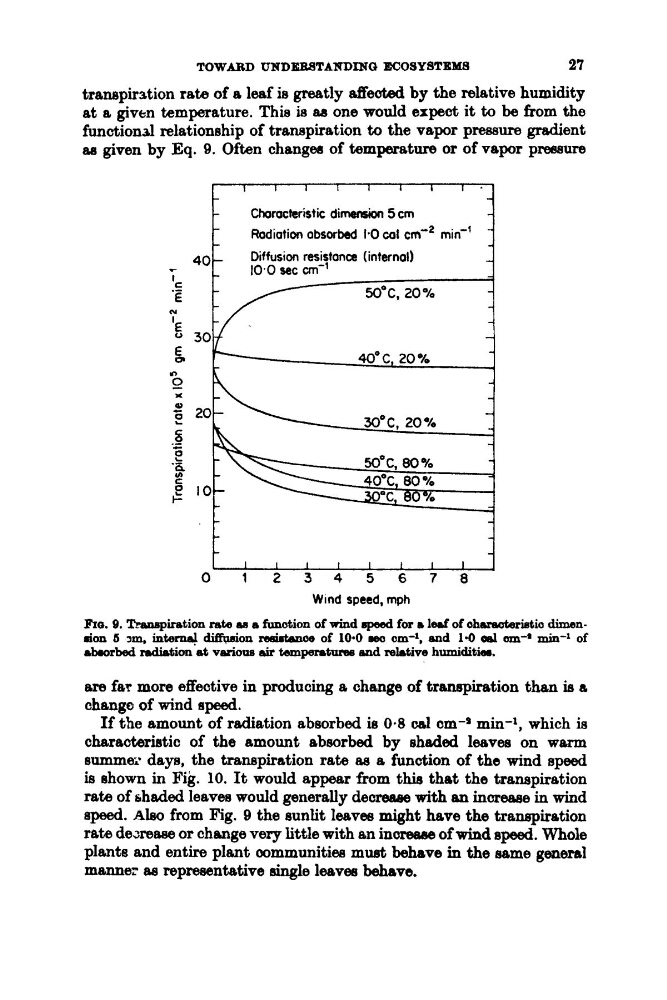
tranepirstion rate of a leaf is greatly effeded by the relative humidity
at a given temperature. This is aa one would expect it to be from the
functiond relationship of trampiretion fo the vapor pressure grsdient
aa given by Eq. 9. Often changes of temperature or of vapor preesure
Characteristic dimedon 5 cm
Radiation absorbad 1.0 UJI cm-‘ min-‘
Diffusion resistance (internal)
.E
(u
30
I
.- ; I L 5o0C.80%
I
I
I
I
1
I
0
1
2
3
4
5
6
7
8
Wind speed, mph
ha. 9. Tm~piration mta M a fupotion of wind qmed for a led of oheuwtarhtio dimendon 6 ’~m. i n -
-on
redmtnnoe of 10.0 y)o om-’, end 1.0 d om-’ min-1 of
abrorbed radiation at vsrioum sir tsmperrturae end relative humiditia.
are fay more effective in producing a ohange of transpiration than is a
change of wind a@.
min-’, which ia
characterhtic of the amount absorbed by shaded l a v a on warm
summei- days, the trampiration rate aa a function of the wind speed
is ehown in Fig. 10. It would appear from this that the trampiration
rate of ehaded leaves would generally decreaee with an increase in wind
speed. ~ l e o
from Fig. 9 the sunlit leaves might have the transpiration
rate dexease or change very little with an inorease of wind apeed. Whole
plants and entire plant oommunitiea must behave in the aame general
manner aa representative single leavee behave.
If the amount of radiation absorbed is 0.8 ml
27
tranepirstion rate of a leaf is greatly effeded by the relative humidity
at a given temperature. This is aa one would expect it to be from the
functiond relationship of trampiretion fo the vapor pressure grsdient
aa given by Eq. 9. Often changes of temperature or of vapor preesure
Characteristic dimedon 5 cm
Radiation absorbad 1.0 UJI cm-‘ min-‘
Diffusion resistance (internal)
.E
(u
30
I
.- ; I L 5o0C.80%
I
I
I
I
1
I
0
1
2
3
4
5
6
7
8
Wind speed, mph
ha. 9. Tm~piration mta M a fupotion of wind qmed for a led of oheuwtarhtio dimendon 6 ’~m. i n -
-on
redmtnnoe of 10.0 y)o om-’, end 1.0 d om-’ min-1 of
abrorbed radiation at vsrioum sir tsmperrturae end relative humiditia.
are fay more effective in producing a ohange of transpiration than is a
change of wind a@.
min-’, which ia
characterhtic of the amount absorbed by shaded l a v a on warm
summei- days, the trampiration rate aa a function of the wind speed
is ehown in Fig. 10. It would appear from this that the trampiration
rate of ehaded leaves would generally decreaee with an increase in wind
speed. ~ l e o
from Fig. 9 the sunlit leaves might have the transpiration
rate dexease or change very little with an inorease of wind apeed. Whole
plants and entire plant oommunitiea must behave in the aame general
manner aa representative single leavee behave.
If the amount of radiation absorbed is 0.8 ml