

26
DAVID Y. QATES
X e C . 60%
t
I
I
1
I
I
I
0
1
2
3
4
5
6
7
0
Wind sped (m.p.h.l
Chorocterirtic dimension 0.5 cm
Radiotion absorbed 1.0 col cm-* min-’
Diffusion resisloncc (intcrro0 2.0 SIC cm-’
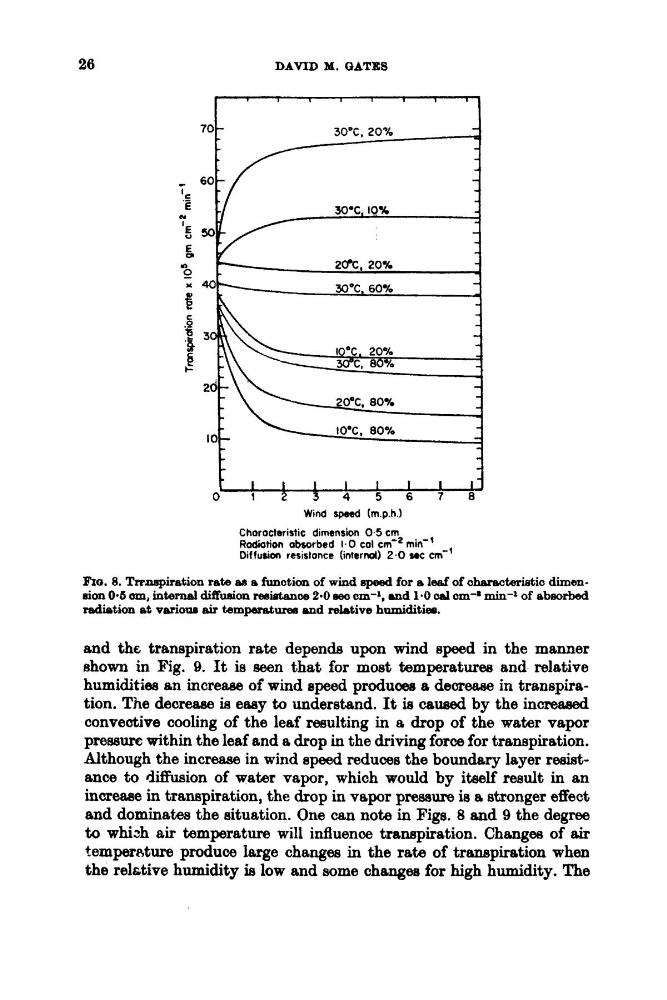
Fro. 8. Trosepiretion rate M a funotion of wind speed for a led of oharaoteristio dimension 0.6 om, intend diffusion naiatanoe 2.0 m om-’, and 1.0 d om4 6 - 1 of absorbed
radiation et verioos air temperatures and mbtive humidhim.
and the transpiration rate depende upon wind speed in the manner
shown in Fig. 9. It is seen that for most temperatures and relative
humidities an incream of wind speed produces a demeam in transpiration. The decrease is easy to understand. It is caused by the i n d
conveotive cooling of the leaf resulting in a drop of the water vapor
pressure within the leaf and a drop in the driving forw for transpiration.
Although the increase in wind speed reduces the boundary layer resistance to diffusion of water vapor, which would by itself result in an
increase in transpiration, the drop in vapor pressure is a stronger effect
and dominates the situation. One can note in Figs. 8 and 9 the degree
to which air temperature will influence trampiration. Changes of air
tempemture produce large changes in the rate of transpiration when
the relative humidity is low and some chhanges for high humidity. The
DAVID Y. QATES
X e C . 60%
t
I
I
1
I
I
I
0
1
2
3
4
5
6
7
0
Wind sped (m.p.h.l
Chorocterirtic dimension 0.5 cm
Radiotion absorbed 1.0 col cm-* min-’
Diffusion resisloncc (intcrro0 2.0 SIC cm-’
Fro. 8. Trosepiretion rate M a funotion of wind speed for a led of oharaoteristio dimension 0.6 om, intend diffusion naiatanoe 2.0 m om-’, and 1.0 d om4 6 - 1 of absorbed
radiation et verioos air temperatures and mbtive humidhim.
and the transpiration rate depende upon wind speed in the manner
shown in Fig. 9. It is seen that for most temperatures and relative
humidities an incream of wind speed produces a demeam in transpiration. The decrease is easy to understand. It is caused by the i n d
conveotive cooling of the leaf resulting in a drop of the water vapor
pressure within the leaf and a drop in the driving forw for transpiration.
Although the increase in wind speed reduces the boundary layer resistance to diffusion of water vapor, which would by itself result in an
increase in transpiration, the drop in vapor pressure is a stronger effect
and dominates the situation. One can note in Figs. 8 and 9 the degree
to which air temperature will influence trampiration. Changes of air
tempemture produce large changes in the rate of transpiration when
the relative humidity is low and some chhanges for high humidity. The