

186
N. WALOPF
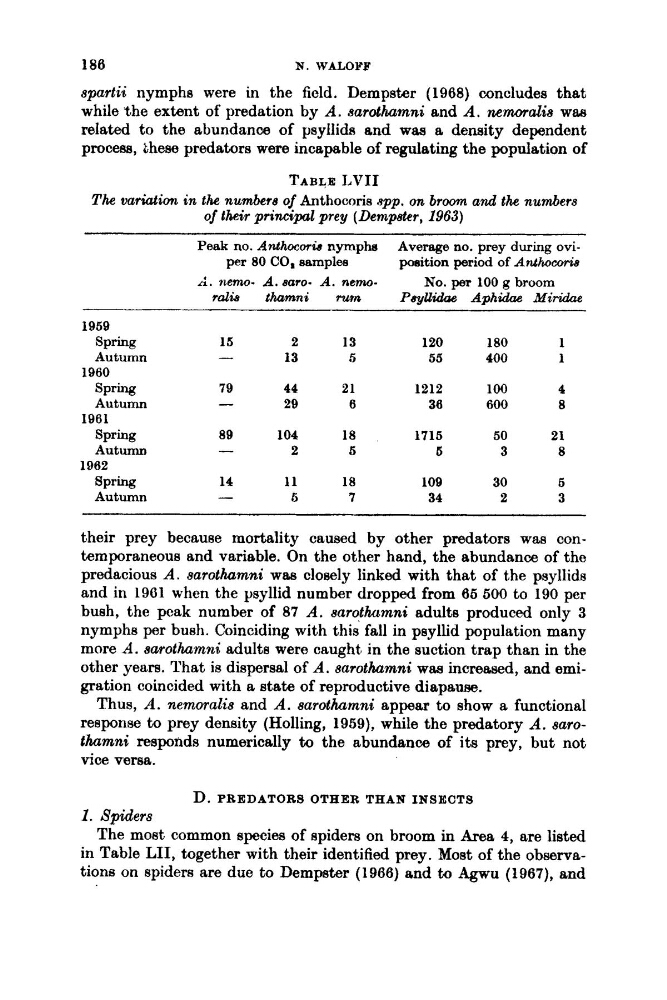
spartii nymphs were in the field. Dempster (1968) concludes that
while the extent of predation by A. sardhamni and A . nemoralis ww
related to the abundance of psyllids and waa a density dependent
process, these predators were incapable of regulating the population of
TABLE LVII
The variation in the nuder8 of Anthocorie spp. on broom and the numbers
of their principal prey (Dempster, 1963)
Peak no. Anthocorw nymphe
per 80 CO, eamplee
A . nemo- A . earo- A . nemuAverage no. prey during oviposition period of Anthocori.9
No. per 100 g broom
r d k
thanmi
rum
Payuidae Aphidae Miridae
1959
Spring
Autumn
1960
Spring
Autumn
Spring
Autumn
1961
1962
Spring
Autumn
15
-
79
-
80
-
14
-
2
13
13
5
44
21
29
6
104
18
2
6
11
18
5
7
120
180
55
400
1212
100
36
600
1716
50
6
3
100
30
34
2
1
1
4
8
21
8
6
3
their prey because mortality caused by other predators was contemporaneous and variable. On the other hand, the abundance of the
predacious A. sarothamni wm closely linked with that of the psyllide
and in 1901 when the psyllid number dropped from 65 500 to 190 per
bush, the peak number of 87 A. surothumni adults produced only 3
nymphs per bush. Coinciding with this' fall in psyllid population many
more A . sarothamni adults were caught in the suction trap than in the
other years. That is dispersal of A. sarothamni waa increased, and emigration coincided with a state of reproductive d i a p a w .
Thus, A. nemoralis and A . earothzmni appear to show a functional
response to prey density (Holling, 1959), while the predatory A. B ~ P O -
f h m n i responds numerically to the abundance of its prey, but not
vice versa.
D. PREDATORS OTHER THAN INSECTS
1. Spiders
The most common species of spiders on broom in Area 4, are listed
in Table LII, together with their identified prey. Most of the observations on spiders are due to Dempater (1966) and to Agwu (1967), and
N. WALOPF
spartii nymphs were in the field. Dempster (1968) concludes that
while the extent of predation by A. sardhamni and A . nemoralis ww
related to the abundance of psyllids and waa a density dependent
process, these predators were incapable of regulating the population of
TABLE LVII
The variation in the nuder8 of Anthocorie spp. on broom and the numbers
of their principal prey (Dempster, 1963)
Peak no. Anthocorw nymphe
per 80 CO, eamplee
A . nemo- A . earo- A . nemuAverage no. prey during oviposition period of Anthocori.9
No. per 100 g broom
r d k
thanmi
rum
Payuidae Aphidae Miridae
1959
Spring
Autumn
1960
Spring
Autumn
Spring
Autumn
1961
1962
Spring
Autumn
15
-
79
-
80
-
14
-
2
13
13
5
44
21
29
6
104
18
2
6
11
18
5
7
120
180
55
400
1212
100
36
600
1716
50
6
3
100
30
34
2
1
1
4
8
21
8
6
3
their prey because mortality caused by other predators was contemporaneous and variable. On the other hand, the abundance of the
predacious A. sarothamni wm closely linked with that of the psyllide
and in 1901 when the psyllid number dropped from 65 500 to 190 per
bush, the peak number of 87 A. surothumni adults produced only 3
nymphs per bush. Coinciding with this' fall in psyllid population many
more A . sarothamni adults were caught in the suction trap than in the
other years. That is dispersal of A. sarothamni waa increased, and emigration coincided with a state of reproductive d i a p a w .
Thus, A. nemoralis and A . earothzmni appear to show a functional
response to prey density (Holling, 1959), while the predatory A. B ~ P O -
f h m n i responds numerically to the abundance of its prey, but not
vice versa.
D. PREDATORS OTHER THAN INSECTS
1. Spiders
The most common species of spiders on broom in Area 4, are listed
in Table LII, together with their identified prey. Most of the observations on spiders are due to Dempater (1966) and to Agwu (1967), and