

STUDIES ON TEE INSECT FAUNA ON SCOTCH BROOM
186
was ~ignificantly higher when it waa fed on psyllida than when fed on
crphide. Further, he found that if pyllid prey w a ~
not available during
late wmmer, females entered reproductive diapauee until the following
spring. Ysyllids on broom comprise the chief prey of A. sarothumni. If
their numbers are small when the first-generation anthocorids mature,
the size of the second generation is correspondingly reduced.
c. INTER-RELATIONS BETWEEN ANTHOCOBIDS AND
PSY LLIDS
Dempster (1963; 1968) further examined the feeding habits of the
three speciee of Anthocotis and confirmed Anderson’s deductions. The
precipitin tests indicated that both A. sarothumni and A . nemoralis fed
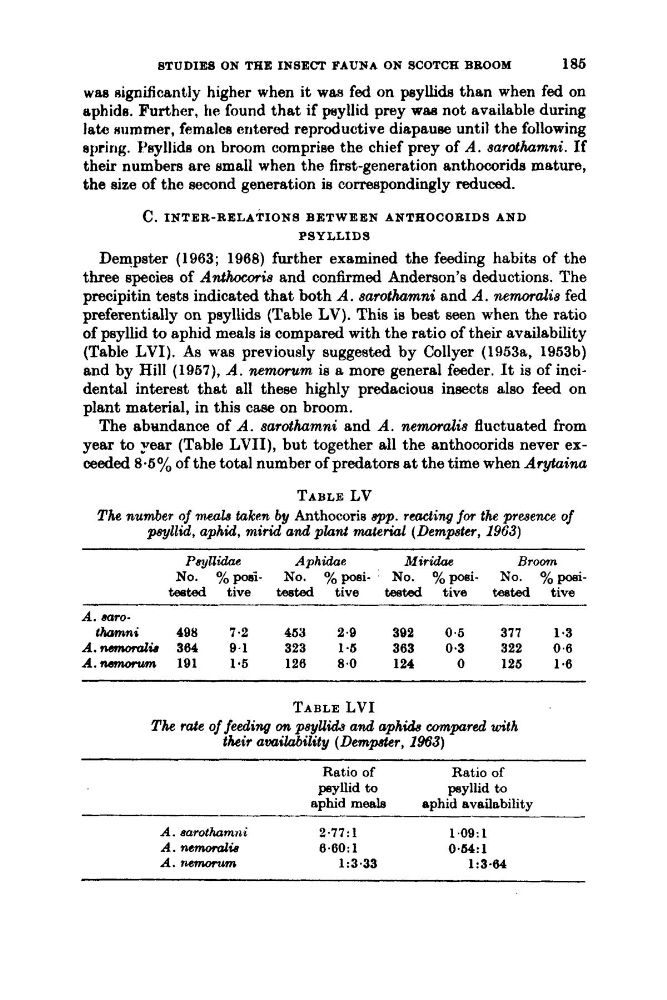
preferentially on psyllids (Table LV). This is best seen when the ratio
of psyllid to aphid meals ie compared with the ratio of their availability
(Table LVI). As was previously suggested by Collyer (1953a’ 1953b)
and by Hill (1957), A. n e m m m is a more general feeder. It is of incidental interest that all these highly predacious insects also feed on
plant material, in this c&8e on broom.
The abundance of A. sarothumni and A . n e m a l i s fluctuated from
year to Fear (Table LVII), but together all the anthocorids never exceeded 8.5% of the total number of predators at the time when Arytainu
TABLE LV
The nuder of meals taken by Anthocorie spp. reacting for the presence of
p y l l i d , aphid, mirid and plant material (Dempater, 1963)
rayaidAphidae
Miridcle
Broom
teafed tive
teeted tive tested tive teatad tive
I h n i
498
7.2
463
2.9
392
0.6
377
1.3
No. yo pi- No. yo p i - No. yo p s i - No. yo p i -
A . wroA . d W 364
9.1
323
1.6
363
0.3
322
0.6
A . W T W ~ W ~
191
1.5
126
8.0
124
0
126
1-6
TABLE LVI
The rate of feeding 012 psyUk5 and aphide compared with
their availability (Dempter, 1963)
Ratio of
Ratio of
peyllid to
psyllid to
aphid meala
aphid availability
A . aarothamni
2.77:l
1.09:1
A . nc71unaliB
6.60: 1
0.64: 1
A . ncnunum
1:3*33
1:3-64
186
was ~ignificantly higher when it waa fed on psyllida than when fed on
crphide. Further, he found that if pyllid prey w a ~
not available during
late wmmer, females entered reproductive diapauee until the following
spring. Ysyllids on broom comprise the chief prey of A. sarothumni. If
their numbers are small when the first-generation anthocorids mature,
the size of the second generation is correspondingly reduced.
c. INTER-RELATIONS BETWEEN ANTHOCOBIDS AND
PSY LLIDS
Dempster (1963; 1968) further examined the feeding habits of the
three speciee of Anthocotis and confirmed Anderson’s deductions. The
precipitin tests indicated that both A. sarothumni and A . nemoralis fed
preferentially on psyllids (Table LV). This is best seen when the ratio
of psyllid to aphid meals ie compared with the ratio of their availability
(Table LVI). As was previously suggested by Collyer (1953a’ 1953b)
and by Hill (1957), A. n e m m m is a more general feeder. It is of incidental interest that all these highly predacious insects also feed on
plant material, in this c&8e on broom.
The abundance of A. sarothumni and A . n e m a l i s fluctuated from
year to Fear (Table LVII), but together all the anthocorids never exceeded 8.5% of the total number of predators at the time when Arytainu
TABLE LV
The nuder of meals taken by Anthocorie spp. reacting for the presence of
p y l l i d , aphid, mirid and plant material (Dempater, 1963)
rayaidAphidae
Miridcle
Broom
teafed tive
teeted tive tested tive teatad tive
I h n i
498
7.2
463
2.9
392
0.6
377
1.3
No. yo pi- No. yo p i - No. yo p s i - No. yo p i -
A . wroA . d W 364
9.1
323
1.6
363
0.3
322
0.6
A . W T W ~ W ~
191
1.5
126
8.0
124
0
126
1-6
TABLE LVI
The rate of feeding 012 psyUk5 and aphide compared with
their availability (Dempter, 1963)
Ratio of
Ratio of
peyllid to
psyllid to
aphid meala
aphid availability
A . aarothamni
2.77:l
1.09:1
A . nc71unaliB
6.60: 1
0.64: 1
A . ncnunum
1:3*33
1:3-64