

160
N. WALOFF
Simulta-wously, bird attack reduced the effects of parasites (Table XLI)
and of the predatory L. ater, whose larvae lie motionleas in the parent
galleries.
M. R. Smith considers that, at least in small areas of broom, b i d s
probably reduce the numbers of beetles each winter to a similar low
level, even though they take a greater proportion of the parasite and
predator populations.
(c) Other causes of w t d i t y including intra-epwijic competition
Several factors are included under this heading; 2.9% of Phbeophthorus eggs were sterile and failed to hatch. A small proportion of
the larval population of this species (0.6%) failed to e d y m at the last
moult and in 1967 about 3% died from the results of intraspecific competition for food and space. This mortality was caused by larvae killing
other larvae and occurred only where the population waa locally dense.
When galleries are denee and intercross PhbeopMhurw larvae may be
killed by others within the same gallery system or by those from the
neighbouring systems. Larger larvae kill the smaller ones and a few
pupae may also be destroyed in this way. This intraspecific competition
50r
:“iL
10
0
(b)
400
c
E
E
2 300
7 200
P
IooL 0
x
E
7 200P
100 -
0
iI
Total beetles in 1 rn x 1 0 mrn
XJ
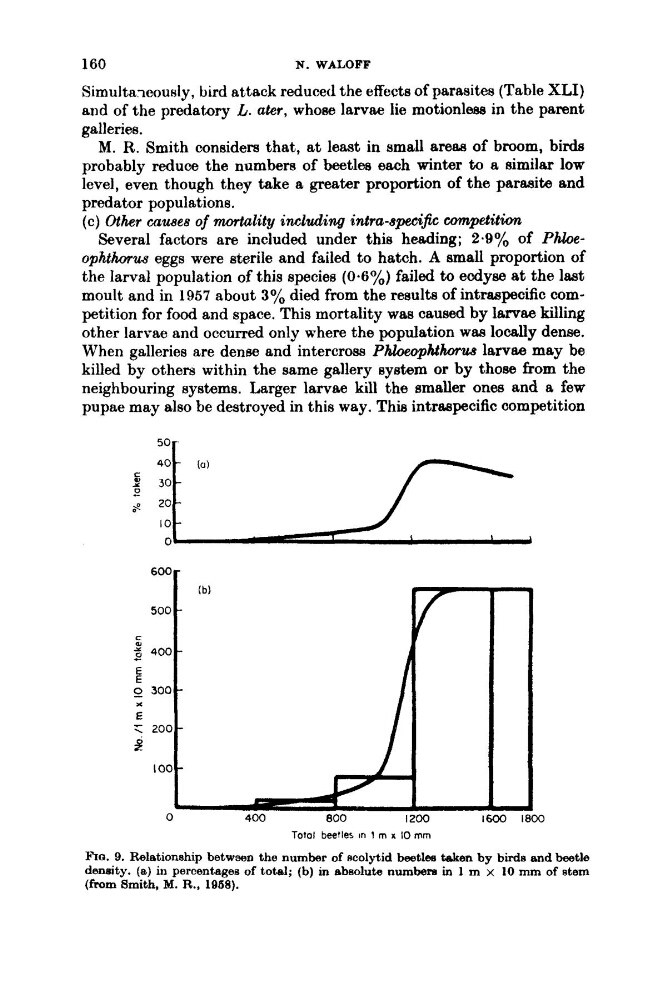
FIQ. 9. Relationahip between the number of acolytid beetles taken by birds and beetle
deneity. (a) in percentages of totd; (b) in absolute numbera in 1 m x 10 mm of stem
(ftorn Smith, M. R., 1058).
N. WALOFF
Simulta-wously, bird attack reduced the effects of parasites (Table XLI)
and of the predatory L. ater, whose larvae lie motionleas in the parent
galleries.
M. R. Smith considers that, at least in small areas of broom, b i d s
probably reduce the numbers of beetles each winter to a similar low
level, even though they take a greater proportion of the parasite and
predator populations.
(c) Other causes of w t d i t y including intra-epwijic competition
Several factors are included under this heading; 2.9% of Phbeophthorus eggs were sterile and failed to hatch. A small proportion of
the larval population of this species (0.6%) failed to e d y m at the last
moult and in 1967 about 3% died from the results of intraspecific competition for food and space. This mortality was caused by larvae killing
other larvae and occurred only where the population waa locally dense.
When galleries are denee and intercross PhbeopMhurw larvae may be
killed by others within the same gallery system or by those from the
neighbouring systems. Larger larvae kill the smaller ones and a few
pupae may also be destroyed in this way. This intraspecific competition
50r
:“iL
10
0
(b)
400
c
E
E
2 300
7 200
P
IooL 0
x
E
7 200P
100 -
0
iI
Total beetles in 1 rn x 1 0 mrn
XJ
FIQ. 9. Relationahip between the number of acolytid beetles taken by birds and beetle
deneity. (a) in percentages of totd; (b) in absolute numbera in 1 m x 10 mm of stem
(ftorn Smith, M. R., 1058).