

STUDIES ON THE INSECT FAUNA ON SCOTCH BBOOM
169
TABLE XLI
Comparkn of the ratio of (a) live prasitea to (b) livc haste (ignoring b e thd
had emerged) in wood damaged by bircb in u&maqed woal
~~~
~
~~
~
~
Wooddamaged
Undamaged
Ratiotukm
Date
by birda
Woad
by birda
19 August 1967
190:1232
261:1699
71:587
1:6*6
1:B-1
1:6-2
29 August 1967
491:1662
621 : 1809
130:167
1:3.4
1:24
1:1*2
9 [Jepfember 1967
491 :3673
773:4489
287:911
1:7*3
1:s.a
1:3*2
(a:b)
(8:b)
(s:b)
- - . - - ~
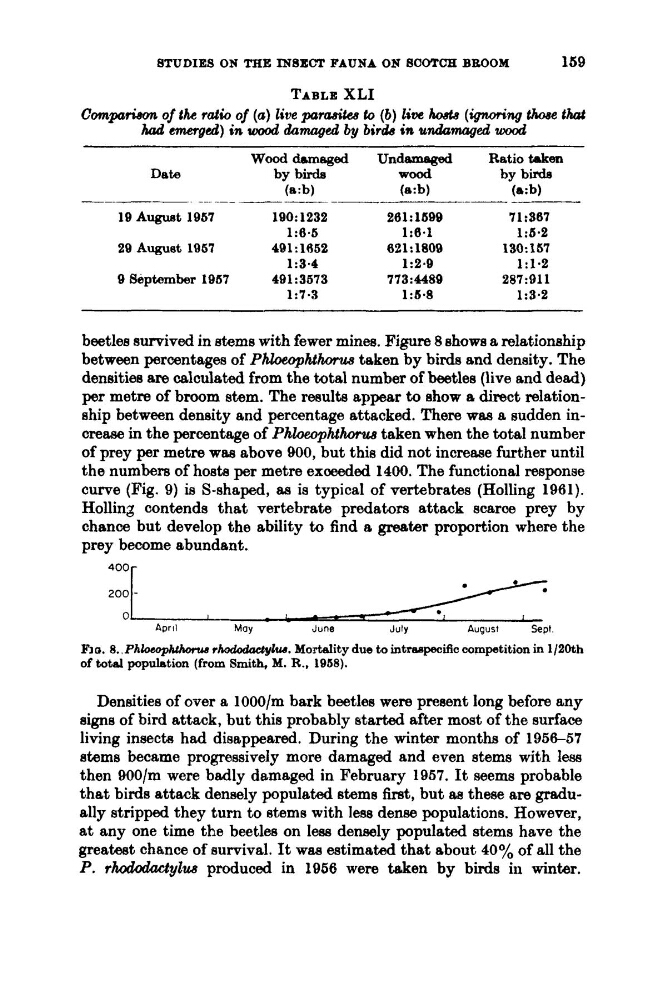
-beetles survived in stems with fewer mines. Figure 8 shows a relationship
between percentages of PAloeqpMhomcs taken by birds and density. The
densitiea are calculated from the total number of beetles (live and dead)
per metre of broom stem. The reaulta appear to ehow a direct relationship between density and percentage attacked. "here waa a sudden increase in the percentage of Phhphthomce taken when the total number
of prey per metre waa above 900, but this did not increase further until
the numbers of hosta per metre exceeded 1400. The functional response
curve (Fig. 9) is S-shaped, aa is typical of vertebrates (Holling 1961).
Holling contends that vertebrate predators attack scarce prey by
chance but develop the ability to find a p t a r proportion where the
prey become abundant.
400r
200
0
-
April
June
July
August
Sept
FI Q. 8.. Phloeophthonw rhmMaetglu8. Mortality due to intraepecific competition in 1/2Oth
of total population (from Smith, M. R.. 1958).
Densities of over a lOOO/m bark beetles were present long before any
signs of bird attack, but this probably startad after most of the surface
living insecta had disappeared. During the winter months of 1956-57
stems became progressively more damaged and even stems with less
then 900/m were badly damaged in February 1957. It seems probable
that birds attack densely populated stems first, but as these are gradually stripped they turn to stems with less dense populations. However,
at any one time the beetles on leas densely populated stems have the
greatest chance of survival. It waa estimated that about 40% of all the
P. rhixihhdylus produced in 1956 were taken by birds in winter.
169
TABLE XLI
Comparkn of the ratio of (a) live prasitea to (b) livc haste (ignoring b e thd
had emerged) in wood damaged by bircb in u&maqed woal
~~~
~
~~
~
~
Wooddamaged
Undamaged
Ratiotukm
Date
by birda
Woad
by birda
19 August 1967
190:1232
261:1699
71:587
1:6*6
1:B-1
1:6-2
29 August 1967
491:1662
621 : 1809
130:167
1:3.4
1:24
1:1*2
9 [Jepfember 1967
491 :3673
773:4489
287:911
1:7*3
1:s.a
1:3*2
(a:b)
(8:b)
(s:b)
- - . - - ~
-beetles survived in stems with fewer mines. Figure 8 shows a relationship
between percentages of PAloeqpMhomcs taken by birds and density. The
densitiea are calculated from the total number of beetles (live and dead)
per metre of broom stem. The reaulta appear to ehow a direct relationship between density and percentage attacked. "here waa a sudden increase in the percentage of Phhphthomce taken when the total number
of prey per metre waa above 900, but this did not increase further until
the numbers of hosta per metre exceeded 1400. The functional response
curve (Fig. 9) is S-shaped, aa is typical of vertebrates (Holling 1961).
Holling contends that vertebrate predators attack scarce prey by
chance but develop the ability to find a p t a r proportion where the
prey become abundant.
400r
200
0
-
April
June
July
August
Sept
FI Q. 8.. Phloeophthonw rhmMaetglu8. Mortality due to intraepecific competition in 1/2Oth
of total population (from Smith, M. R.. 1958).
Densities of over a lOOO/m bark beetles were present long before any
signs of bird attack, but this probably startad after most of the surface
living insecta had disappeared. During the winter months of 1956-57
stems became progressively more damaged and even stems with less
then 900/m were badly damaged in February 1957. It seems probable
that birds attack densely populated stems first, but as these are gradually stripped they turn to stems with less dense populations. However,
at any one time the beetles on leas densely populated stems have the
greatest chance of survival. It waa estimated that about 40% of all the
P. rhixihhdylus produced in 1956 were taken by birds in winter.