

RTIlDIES ON THE INSECT FAUNA ON SCOTCH BROOM
167
was estimated that 15.8% of the recruited Phloeophthmua population
waa killed by the combined action of the parasites; of these 3.2% were
stung, but had no eggs laid on them. No estimate could be made of the
percentage kill by parasites of Hyhtinua, as ita numbers were low, but
M. R. Smith considers that parasitism is probably the primary cause of
mortality in this species.
The most important parasites of P h Z o e o p W s were Tefrastichw, sp.
nr. .flumriua and Raphitelua maeuldus but neither of them occurred
on Hylaetinus. The Tetrastichwr sp. was not hyperparasitised, but in
common with all the other parasitic species in mines, a large proportion
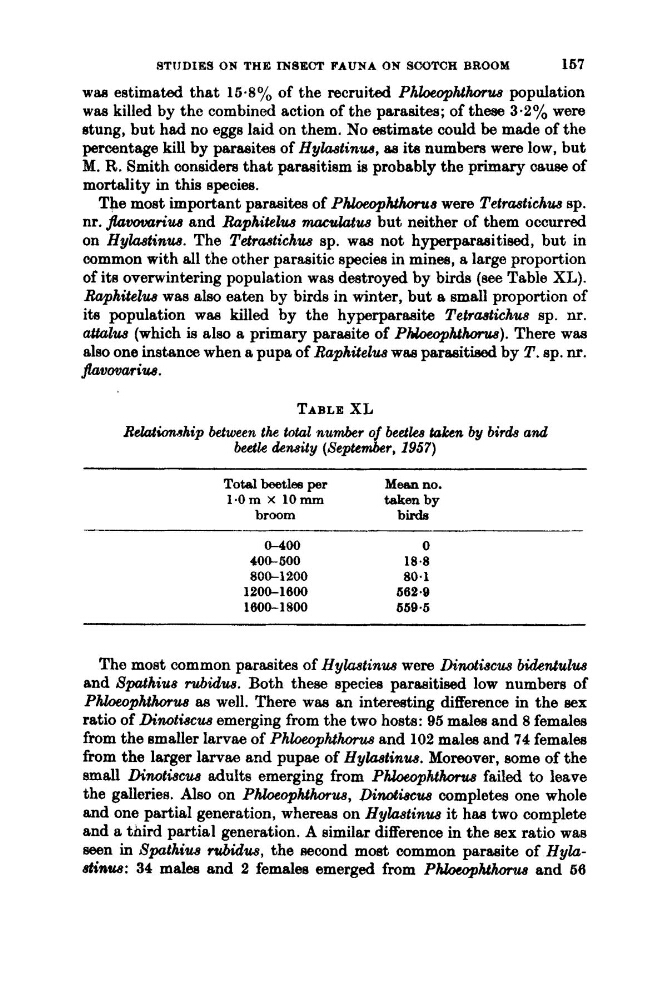
of its overwintering population was destroyed by b i r h (see Table XL).
Raphite1u.a was also eaten by birds in winter, but a small proportion of
its population was killed by the hyperparasite Tetrastichus sp. nr.
attalus (which is also a primary parasite of P h b e o p h t h ) . There waa
also one instance when a pupa of Raphitelua was parasitiaed by T . sp. nr.
&vovariwr.
TABLE XL
Relatiowhip between the total number of beetla faken by bir& a d
b&le density (September, 1957)
Totel beetles per
1.0m X 10broom
0-400
400- 500
800-1200
1200-1 6OO
1600-1 800
Mean no.
taken by
birde
0
18.8
80-1
662.9
660.5
Tho most common parasites of H y h t i n u s were Dindiscus bidentulwr
and 8pathhius rubidwr. Both these speciea parasitised low numbers of
Ph2oeop-w
aa well. There waa an interesting difference in the sex
ratio of D i m t i m u emerging from the two hosts: 95 males and 8 females
from the smaller larvae of P h h p h t h w and 102 males and 74 females
from the larger larvae and pupae of Hybtinua. Moreover, some of the
small Bmttkcua adults emerging from Phloeophthorus failed to leave
the galleries. Also on PhEoeophthua, Dindieeta completes one whole
and one partial generation, whereas on Hyhtinua it haa two complete
and a third partial generation. A similar difference in the sex ratio was
seen in &athius rubidus, the second most common parasite of Hyla&nus: 34 malea and 2 femalee emerged from P h l a q p h t h and 66
167
was estimated that 15.8% of the recruited Phloeophthmua population
waa killed by the combined action of the parasites; of these 3.2% were
stung, but had no eggs laid on them. No estimate could be made of the
percentage kill by parasites of Hyhtinua, as ita numbers were low, but
M. R. Smith considers that parasitism is probably the primary cause of
mortality in this species.
The most important parasites of P h Z o e o p W s were Tefrastichw, sp.
nr. .flumriua and Raphitelua maeuldus but neither of them occurred
on Hylaetinus. The Tetrastichwr sp. was not hyperparasitised, but in
common with all the other parasitic species in mines, a large proportion
of its overwintering population was destroyed by b i r h (see Table XL).
Raphite1u.a was also eaten by birds in winter, but a small proportion of
its population was killed by the hyperparasite Tetrastichus sp. nr.
attalus (which is also a primary parasite of P h b e o p h t h ) . There waa
also one instance when a pupa of Raphitelua was parasitiaed by T . sp. nr.
&vovariwr.
TABLE XL
Relatiowhip between the total number of beetla faken by bir& a d
b&le density (September, 1957)
Totel beetles per
1.0m X 10broom
0-400
400- 500
800-1200
1200-1 6OO
1600-1 800
Mean no.
taken by
birde
0
18.8
80-1
662.9
660.5
Tho most common parasites of H y h t i n u s were Dindiscus bidentulwr
and 8pathhius rubidwr. Both these speciea parasitised low numbers of
Ph2oeop-w
aa well. There waa an interesting difference in the sex
ratio of D i m t i m u emerging from the two hosts: 95 males and 8 females
from the smaller larvae of P h h p h t h w and 102 males and 74 females
from the larger larvae and pupae of Hybtinua. Moreover, some of the
small Bmttkcua adults emerging from Phloeophthorus failed to leave
the galleries. Also on PhEoeophthua, Dindieeta completes one whole
and one partial generation, whereas on Hyhtinua it haa two complete
and a third partial generation. A similar difference in the sex ratio was
seen in &athius rubidus, the second most common parasite of Hyla&nus: 34 malea and 2 femalee emerged from P h l a q p h t h and 66