

166
N. WALOFF
be cut down to examine them. Thus quantitative estimates would have
reduced tho population considerably and all the data were obtained
from diaeecting of only a limited number of earnplea.
4. Cames of the mortality of the scolytid8
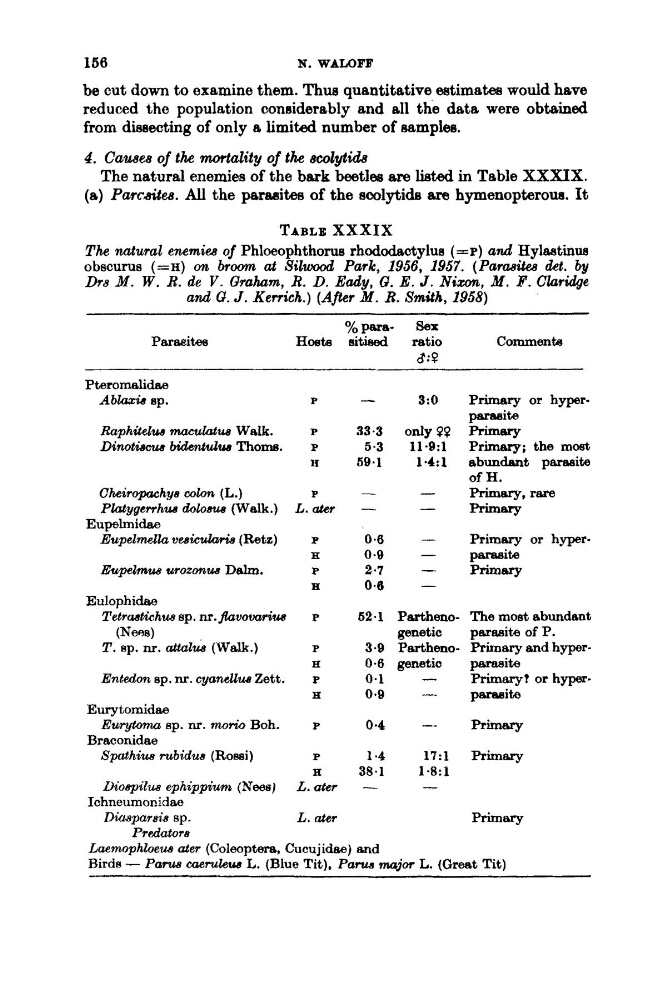
The natural enemies of the bark beetlee are listed in Table XXXIX.
(a) Purcdea. All the parasites of the scolytide am hymenopterous. It
TABLE XXXIX
The natural enemieo of Phloeophthom rhododactylus ( =P) a d Hylaatinue
obsourus (=H) on broom at Silwood Park, 1956, 1957. (Parmites det. by
Dr.9 M . W . R. de V . Graham, R. D. Eady, G. E. J . N i m , M. F. Clardge
an& CT. J . Kerrich.) (After M . R. Smith, 1958)
yo~ara- Sex
c?:?
Pareeitm
Hoe& sitmed
ratio
comments
Pteromalidae
Abluxis sp.
Raphitelvs maculotue Walk.
Dinotiecua bidentulzrs Thorns.
C h k p a c h y 8 w h (L.)
P2atygemhu.a d ~ l o s w ,
(Walk.) L
EupelmeEla vmiculcwie (Retz)
Eupelmidae
Eupelmw urozonua D h .
Eulophidae
Tetraatkhua sp. nr.f&vova~ua
T . sp. nr. &a& (Walk.)
Entedon sp. nr. cyanellua Zett.
(Neos)
Eurytomidae
Braconidae
Euryfmna sp. nr. morio Boh.
Spathius rubidus (Rosei)
P
P
P
H
P
. ater
P
H
P
H
P
P
H
P
H
P
P
a
-
3:O
33.3
only 99
5.3
11*9:1
59-1
1*4:1
0.6
-
0.9
-
2.7
-
0.6
-
62.1 Parthenogenetic
3.9 Partheno0-6 genetio
0.1
-
0.9
-
0.4
-
1 *4
17:l
38.1
1.8:1
Primary or hyperparmite
fiimery
Primary; the most
abundant parasite
of H.
w ,
rare
primery
Primary or hyperparasite
Primary
The most abundant
parasite of P.
Primary end hyperparaaite
Primary? or hyperperaeite
Primary
Primary
Primary
Leemophloeua ater (Coleoptera, Cucujidae) and
Birds - P a m caeruleus L. (Blue Tit), Parus m j o r L. (Great Tit)
N. WALOFF
be cut down to examine them. Thus quantitative estimates would have
reduced tho population considerably and all the data were obtained
from diaeecting of only a limited number of earnplea.
4. Cames of the mortality of the scolytid8
The natural enemies of the bark beetlee are listed in Table XXXIX.
(a) Purcdea. All the parasites of the scolytide am hymenopterous. It
TABLE XXXIX
The natural enemieo of Phloeophthom rhododactylus ( =P) a d Hylaatinue
obsourus (=H) on broom at Silwood Park, 1956, 1957. (Parmites det. by
Dr.9 M . W . R. de V . Graham, R. D. Eady, G. E. J . N i m , M. F. Clardge
an& CT. J . Kerrich.) (After M . R. Smith, 1958)
yo~ara- Sex
c?:?
Pareeitm
Hoe& sitmed
ratio
comments
Pteromalidae
Abluxis sp.
Raphitelvs maculotue Walk.
Dinotiecua bidentulzrs Thorns.
C h k p a c h y 8 w h (L.)
P2atygemhu.a d ~ l o s w ,
(Walk.) L
EupelmeEla vmiculcwie (Retz)
Eupelmidae
Eupelmw urozonua D h .
Eulophidae
Tetraatkhua sp. nr.f&vova~ua
T . sp. nr. &a& (Walk.)
Entedon sp. nr. cyanellua Zett.
(Neos)
Eurytomidae
Braconidae
Euryfmna sp. nr. morio Boh.
Spathius rubidus (Rosei)
P
P
P
H
P
. ater
P
H
P
H
P
P
H
P
H
P
P
a
-
3:O
33.3
only 99
5.3
11*9:1
59-1
1*4:1
0.6
-
0.9
-
2.7
-
0.6
-
62.1 Parthenogenetic
3.9 Partheno0-6 genetio
0.1
-
0.9
-
0.4
-
1 *4
17:l
38.1
1.8:1
Primary or hyperparmite
fiimery
Primary; the most
abundant parasite
of H.
w ,
rare
primery
Primary or hyperparasite
Primary
The most abundant
parasite of P.
Primary end hyperparaaite
Primary? or hyperperaeite
Primary
Primary
Primary
Leemophloeua ater (Coleoptera, Cucujidae) and
Birds - P a m caeruleus L. (Blue Tit), Parus m j o r L. (Great Tit)