

BTUDIES OF THE INSECT FAUNA ON SCOTCH BROOM
149
the mite was not investigated, but it impaired flight and possibly reduced fecundity. Chant (1968, 1969) says that it is common on broom
in southern England and that it is primarily a predator of phytophagous, orchard-living mites.
(b) The main cause of mortality in the eggs waa sterility. In 1965
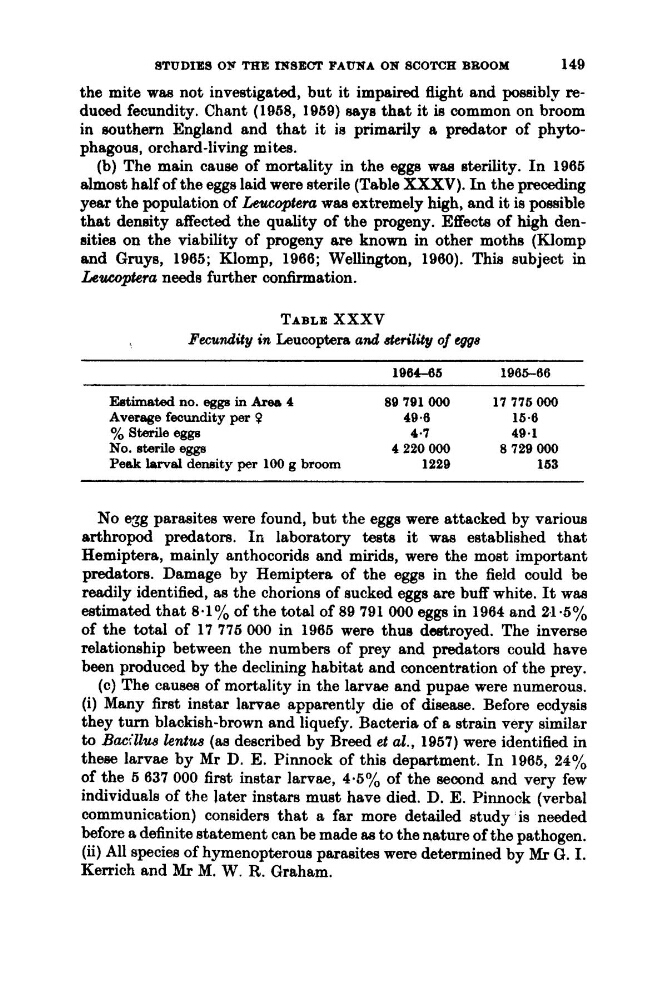
almost half of the eggs laid were sterile (Table XXXV). In the preceding
year the population of Leucqptera waa extremely high, and it is posaible
that density affected the quality of the progeny. Effects of high densities on the viability of progeny are known in other moths (Klomp
end Gruys, 1965; Klomp, 1966; Wellington, 1960). This subject in
Lewptera needs further confirmation.
TABLE XXXV
Fecundity in Leucoptera and sterility of egg8
196446
1966-66
Estimated no. egge in Aree 4
Average fecundity per 9
48.6
16.8
yo sterile egg8
4.7
49.1
No. sterile eggs
4 220 OOO
8 729 000
Peak lorvel density per 100 g broom
1229
163
89 791 OOO
17 776 OOO
No ezg parasites were found, but the eggs were attacked by various
arthropod predators. In laboratory tests it was established that
Hemiptera, mainly anthocorids and mirids, were the most important
predators. Damage by Hemiptera of the eggs in the field could be
readily identified, as the chorions of sucked eggs are buff white. It was
estimated that 8.1y0 of the total of 89 791 000 eggs in 1964 and 2.1.570
of the total of 17 776 000 in 1965 were thus destroyed. The inverse
relationship between the numbers of prey and predators could have
been produced by the declining habitat and concentration of the prey.
(c) The causes of mortality in the larvae and pupae were numerous.
(i) Many first instar larvae apparently die of disease. Before ecdysis
they turn blackish-brown and liquefy. Bacteria of a strain very similar
to Bacillus lentus (as described by Breed et al., 1967) were identified in
these larvae by Mr D. E. Pinnock of this department. In 1965, 24%
of the 6 637 000 first instar larvae, 4.6% of the second and very few
individuals of the later instars must have died. D. E. Pinnock (verbal
communication) considers that a far more detailed study is needed
before a definite statement can be made as to the nature of the pathogen.
(ii) All species of hymenopterous parasites were determined by Mr G. I.
Kerrich and Mr M. W. R. Graham.
149
the mite was not investigated, but it impaired flight and possibly reduced fecundity. Chant (1968, 1969) says that it is common on broom
in southern England and that it is primarily a predator of phytophagous, orchard-living mites.
(b) The main cause of mortality in the eggs waa sterility. In 1965
almost half of the eggs laid were sterile (Table XXXV). In the preceding
year the population of Leucqptera waa extremely high, and it is posaible
that density affected the quality of the progeny. Effects of high densities on the viability of progeny are known in other moths (Klomp
end Gruys, 1965; Klomp, 1966; Wellington, 1960). This subject in
Lewptera needs further confirmation.
TABLE XXXV
Fecundity in Leucoptera and sterility of egg8
196446
1966-66
Estimated no. egge in Aree 4
Average fecundity per 9
48.6
16.8
yo sterile egg8
4.7
49.1
No. sterile eggs
4 220 OOO
8 729 000
Peak lorvel density per 100 g broom
1229
163
89 791 OOO
17 776 OOO
No ezg parasites were found, but the eggs were attacked by various
arthropod predators. In laboratory tests it was established that
Hemiptera, mainly anthocorids and mirids, were the most important
predators. Damage by Hemiptera of the eggs in the field could be
readily identified, as the chorions of sucked eggs are buff white. It was
estimated that 8.1y0 of the total of 89 791 000 eggs in 1964 and 2.1.570
of the total of 17 776 000 in 1965 were thus destroyed. The inverse
relationship between the numbers of prey and predators could have
been produced by the declining habitat and concentration of the prey.
(c) The causes of mortality in the larvae and pupae were numerous.
(i) Many first instar larvae apparently die of disease. Before ecdysis
they turn blackish-brown and liquefy. Bacteria of a strain very similar
to Bacillus lentus (as described by Breed et al., 1967) were identified in
these larvae by Mr D. E. Pinnock of this department. In 1965, 24%
of the 6 637 000 first instar larvae, 4.6% of the second and very few
individuals of the later instars must have died. D. E. Pinnock (verbal
communication) considers that a far more detailed study is needed
before a definite statement can be made as to the nature of the pathogen.
(ii) All species of hymenopterous parasites were determined by Mr G. I.
Kerrich and Mr M. W. R. Graham.