

148
N. WALOFF
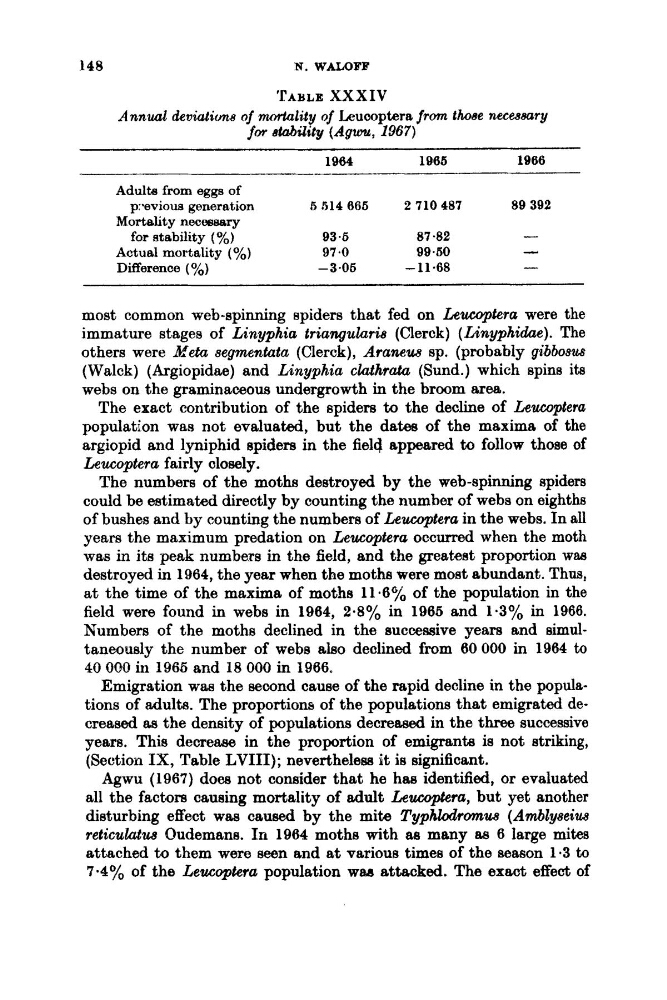
'FABLE XXXIV
Annual deviaticmR of mnrtality of Leuooptera from those neeemary
for aksbility (Agwu, 1967)
1964
1966
1966
Adults from eggs of
Mortality necesesry
p:*evious generation
6 614 666
2 710 487
89 392
for atability (yo)
93 *6
87-82
-
Actual mortality (Yo)
97.0
99.60
-
DSerence (yo)
-3.06
-11.68
-
most common web-spinning spiders that fed on Leucoptera were the
immature stages of Linyphia trianguEari8 (Clerck) (anyphidue). The
others were Xeta segmentatu (Clerck), Araneus sp. (probably gibbosus
(Walck) (Argiopidae) and Linyphia cZathr& (Sund.) which spins its
webs on the graminaceous undergrowth in the broom area.
The exact contribution of the spiders to the decline of Lewptera
population was not evaluated, but the dabs of the maxima of the
argiopid and lyniphid spiders in the fie14 appeared to follow those of
Leucoptera fairly closely.
The numbers of the moths destroyed by the web-spinning spiders
could be estimated directly by counting the number of webs on eighths
of bushes and by counting the numbers of Lewuptera in the webs. In all
years the maximum predation on Leucoptera occurred when the moth
was in its peak numbers in the field, and the greatest proportion was
destroyed in 1964, the year when the moths were most abundant. Thus,
at the time of the maxima of moths 1143yo of the population in the
field were found in webs in 1964, 243% in 1965 and 1.3% in 1966.
Numbers of the moths declined in the successive years and simultaneonsly the number of webs also deolined from 60 000 in 1964 to
40 OQO in 1966 and 18 000 in 1966.
Emigration waa the second cause of the rapid decline in the populations of adults. The proportions of the populations that emigrated decreased as the density of populations decreased in the three successive
yews. This decrease in the proportion of emigrants is not striking,
(Section IX, Table LVIII); nevertheless it is significant.
Agwu (1967) doee not consider that he has identified, or evaluated
all the factors causing mortality of adult L e w r u , but yet another
disturbing effect ww caused by the mite Typh.lodrontus (AmbZy8eiu.s
reticulatus Oudemans. In 1964 moths with as many as 6 large mites
attached to them were seen and at various times of the season 1-3 to
7.4% of the Leucoptera population waa attacked. The exact effect of
N. WALOFF
'FABLE XXXIV
Annual deviaticmR of mnrtality of Leuooptera from those neeemary
for aksbility (Agwu, 1967)
1964
1966
1966
Adults from eggs of
Mortality necesesry
p:*evious generation
6 614 666
2 710 487
89 392
for atability (yo)
93 *6
87-82
-
Actual mortality (Yo)
97.0
99.60
-
DSerence (yo)
-3.06
-11.68
-
most common web-spinning spiders that fed on Leucoptera were the
immature stages of Linyphia trianguEari8 (Clerck) (anyphidue). The
others were Xeta segmentatu (Clerck), Araneus sp. (probably gibbosus
(Walck) (Argiopidae) and Linyphia cZathr& (Sund.) which spins its
webs on the graminaceous undergrowth in the broom area.
The exact contribution of the spiders to the decline of Lewptera
population was not evaluated, but the dabs of the maxima of the
argiopid and lyniphid spiders in the fie14 appeared to follow those of
Leucoptera fairly closely.
The numbers of the moths destroyed by the web-spinning spiders
could be estimated directly by counting the number of webs on eighths
of bushes and by counting the numbers of Lewuptera in the webs. In all
years the maximum predation on Leucoptera occurred when the moth
was in its peak numbers in the field, and the greatest proportion was
destroyed in 1964, the year when the moths were most abundant. Thus,
at the time of the maxima of moths 1143yo of the population in the
field were found in webs in 1964, 243% in 1965 and 1.3% in 1966.
Numbers of the moths declined in the successive years and simultaneonsly the number of webs also deolined from 60 000 in 1964 to
40 OQO in 1966 and 18 000 in 1966.
Emigration waa the second cause of the rapid decline in the populations of adults. The proportions of the populations that emigrated decreased as the density of populations decreased in the three successive
yews. This decrease in the proportion of emigrants is not striking,
(Section IX, Table LVIII); nevertheless it is significant.
Agwu (1967) doee not consider that he has identified, or evaluated
all the factors causing mortality of adult L e w r u , but yet another
disturbing effect ww caused by the mite Typh.lodrontus (AmbZy8eiu.s
reticulatus Oudemans. In 1964 moths with as many as 6 large mites
attached to them were seen and at various times of the season 1-3 to
7.4% of the Leucoptera population waa attacked. The exact effect of