

I30
N. WALOFF
cmvered by a waxy layer. Oviposition extends between June to August
and the nymphs begin to hatch in the following February or March.
Hatching spreads over soVera1 weeks and this results in wide overlapping of all stages of the progeny. Adults appear in May or June,
when a proportion of the population disperses. "he last adults are seen
in late July or early August.
A. genistae is usually bivoltine in Great Britain, sometimes with a
third generation if the autumn is mild. The first generation occurs between March and late June and the second between July and November. The species overwinters &B a mature adult and has no diapause at
any stage. The eggs are laid superficially on leaves, leaf axils and buds.
In winter A. genistue may oviposit in mild periods, but any nymphs
which hatch are killed by low temperatures. In conditions of extreme
cold even the eggs may suffer winter mortality. A proportion of the
first generation adults emigrates out of the habitat, but only a small
number of the second generation and none at all after overwintering.
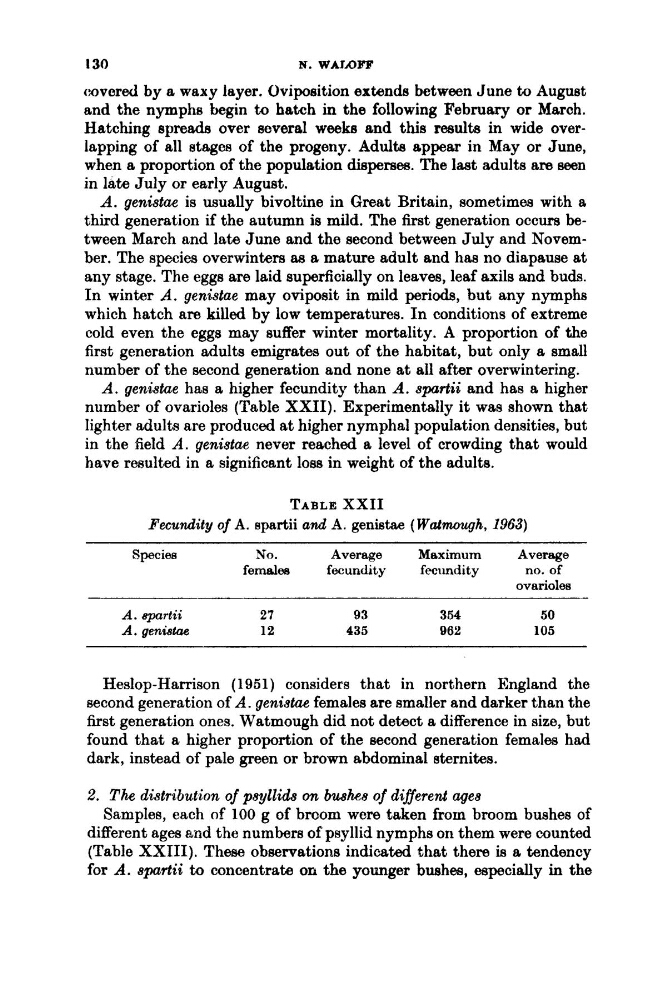
A. genistae has a higher fecundity than A. spartii and has a higher
number of ovarioles (Table XXII). Experimentally it was shown that
lighter adults are produced at higher nymphal population densities, but
in the field A. genistae never reached a level of crowding that would
have resulted in a significant loss in weight of the adults.
TABLE XXII
Fecundity of A. spartii and A. genistae (Watmough, 1963)
Species
No.
Average
Maximum
Average
ova ri o 1 es
females
fecundity
fecundity
no. of
A . Bpartii
27
93
354
50
A . gen&stae
12
435
962
105
Heslop-Harrison (1951) considers that in northern England the
second generation of A. genistue females are smaller and darker than the
first generation ones. Watmough did not detect a difference in size, but
found that a higher proportion of the second generation females had
dark, instead of pale green or brown abdominal aternites.
2. The distribution of psyllids on buahes of different age8
Samples, each of 100 g of broom were taken from broom bushes of
different ages and the numbers of psyllid nymphs on them were counted
(Table XXIII). These observations indicated that there is a tendency
for A. sprtii to concentrate on the younger bushes, especially in the
N. WALOFF
cmvered by a waxy layer. Oviposition extends between June to August
and the nymphs begin to hatch in the following February or March.
Hatching spreads over soVera1 weeks and this results in wide overlapping of all stages of the progeny. Adults appear in May or June,
when a proportion of the population disperses. "he last adults are seen
in late July or early August.
A. genistae is usually bivoltine in Great Britain, sometimes with a
third generation if the autumn is mild. The first generation occurs between March and late June and the second between July and November. The species overwinters &B a mature adult and has no diapause at
any stage. The eggs are laid superficially on leaves, leaf axils and buds.
In winter A. genistue may oviposit in mild periods, but any nymphs
which hatch are killed by low temperatures. In conditions of extreme
cold even the eggs may suffer winter mortality. A proportion of the
first generation adults emigrates out of the habitat, but only a small
number of the second generation and none at all after overwintering.
A. genistae has a higher fecundity than A. spartii and has a higher
number of ovarioles (Table XXII). Experimentally it was shown that
lighter adults are produced at higher nymphal population densities, but
in the field A. genistae never reached a level of crowding that would
have resulted in a significant loss in weight of the adults.
TABLE XXII
Fecundity of A. spartii and A. genistae (Watmough, 1963)
Species
No.
Average
Maximum
Average
ova ri o 1 es
females
fecundity
fecundity
no. of
A . Bpartii
27
93
354
50
A . gen&stae
12
435
962
105
Heslop-Harrison (1951) considers that in northern England the
second generation of A. genistue females are smaller and darker than the
first generation ones. Watmough did not detect a difference in size, but
found that a higher proportion of the second generation females had
dark, instead of pale green or brown abdominal aternites.
2. The distribution of psyllids on buahes of different age8
Samples, each of 100 g of broom were taken from broom bushes of
different ages and the numbers of psyllid nymphs on them were counted
(Table XXIII). These observations indicated that there is a tendency
for A. sprtii to concentrate on the younger bushes, especially in the