

94
N. WALOFF
No plants rJurvive under old broom bushes and there is an accumulation of charact,erist,ic broom litter in which many insect species pass
parts of their lives and in which many predators, particularly the earwigs PorJicula auriculuria L. and the mites Anystis concentrate and
hibernate in large numbers.
Brief description of the main study areas
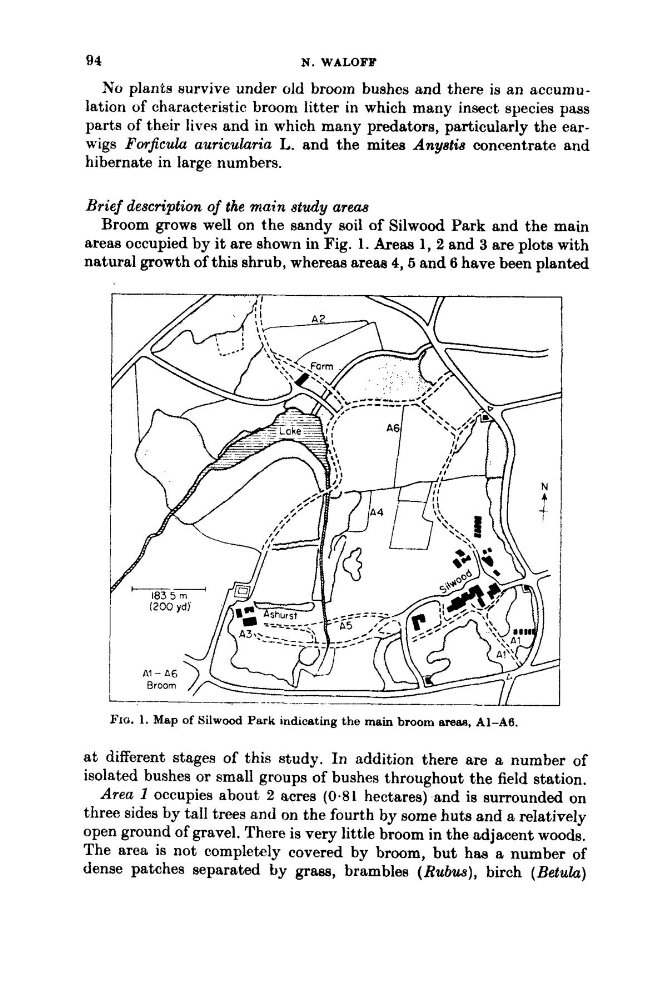
Broom grows well on the sandy soil of Silwood Park and the main
areas occupied by it are shown in Fig. 1. Areaa 1, 2 and 3 are plots with
natural growth of this shrub, whereas a r e a 4 , 6 and 6 have been planted
Fro. 1. Map of Silwood Park indicating the main broom areaa, Al-A6.
a t different stages of this study. In addition there are a number of
isolated bushes or small groups of bushes throughout the field station.
Area 1 occupies about 2 acres (0.81 hectares) and is surrounded on
three sides by tall trees and on the fourth by some huts and a relatively
open ground of gravel. There is very little broom in the adjacent woods.
The area is not completely covered by broom, but haa a number of
dense patches separated by grass, brambles (Rubus), birch (Betu2a)
N. WALOFF
No plants rJurvive under old broom bushes and there is an accumulation of charact,erist,ic broom litter in which many insect species pass
parts of their lives and in which many predators, particularly the earwigs PorJicula auriculuria L. and the mites Anystis concentrate and
hibernate in large numbers.
Brief description of the main study areas
Broom grows well on the sandy soil of Silwood Park and the main
areas occupied by it are shown in Fig. 1. Areaa 1, 2 and 3 are plots with
natural growth of this shrub, whereas a r e a 4 , 6 and 6 have been planted
Fro. 1. Map of Silwood Park indicating the main broom areaa, Al-A6.
a t different stages of this study. In addition there are a number of
isolated bushes or small groups of bushes throughout the field station.
Area 1 occupies about 2 acres (0.81 hectares) and is surrounded on
three sides by tall trees and on the fourth by some huts and a relatively
open ground of gravel. There is very little broom in the adjacent woods.
The area is not completely covered by broom, but haa a number of
dense patches separated by grass, brambles (Rubus), birch (Betu2a)